
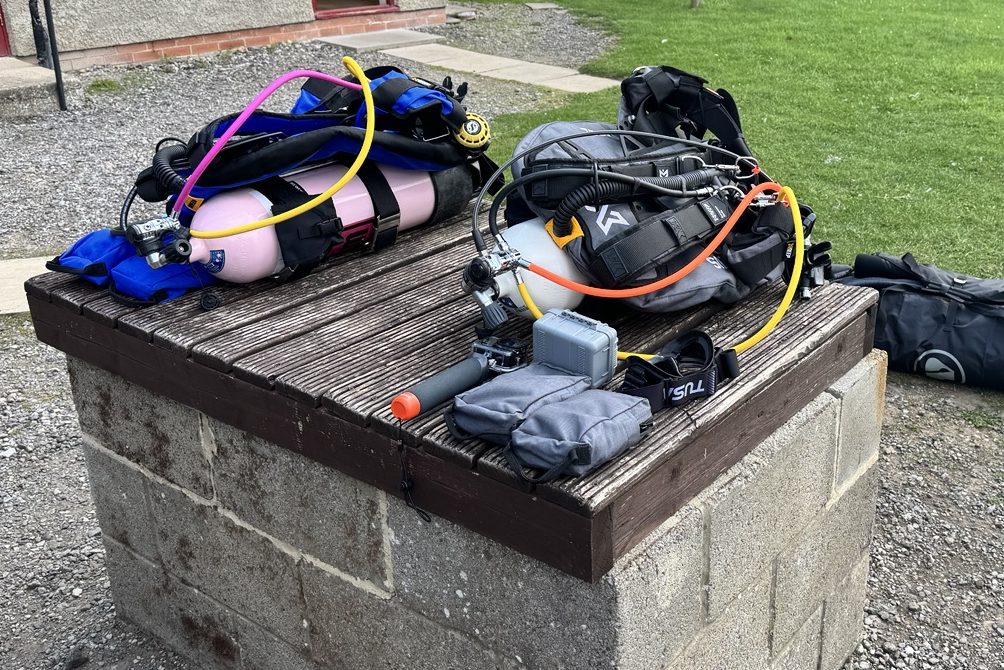
Gear • Diver Development • Backplate & Wing
Backplate and Wing: Why I Made the Move
I thought backplate-and-wing systems were for technical divers. Then Gemma and I tried one — and everything started to feel simpler.
Like most divers, my first dives were in standard rental jacket-style BCDs.
That was just what diving looked like to me at the time. You rented the kit, strapped it on, jumped in, and got on with the dive.
When I later spotted a nearly-new Aqualung Axiom BCD, I snapped it up.
It was a perfectly good BCD.
I just never quite felt right in it.
Gemma was having a similar problem for a different reason. She has a larger chest and found jacket-style BCDs could become sore and uncomfortable after a few dives.
We had both heard of backplate-and-wing systems, but I originally filed them mentally under:
Technical diver stuff. Probably not for us.
That assumption did not survive very long once I started looking into them properly.
A reef-keeping road trip accidentally became a dive-kit purchase
Diving was not the only expensive hobby Gemma and I had managed to develop by this point.
Since starting scuba, we had also become reef keepers.
So one day we headed towards Manchester and Leeds to look around marine fish shops and, naturally, dive shops.
One of the places we stopped at was Robin Hood Watersports.
One thing led to another.
Then another.
And somehow both of us ended up ordering XDEEP ZEN backplate-and-wing systems.
They took roughly six to eight weeks to arrive.
By then it was early 2025 and far too cold for me to get excited about jumping straight into Ellerton — our local swamp.
Sorry.
Lake.
The boxes finally arrived
After weeks of waiting, the ZENs finally turned up.
Unboxing them was probably the first point where the whole BP/W idea stopped being something I had been researching and became an actual piece of dive kit sitting in front of me.
And the first thing that struck me was how simple it all was.
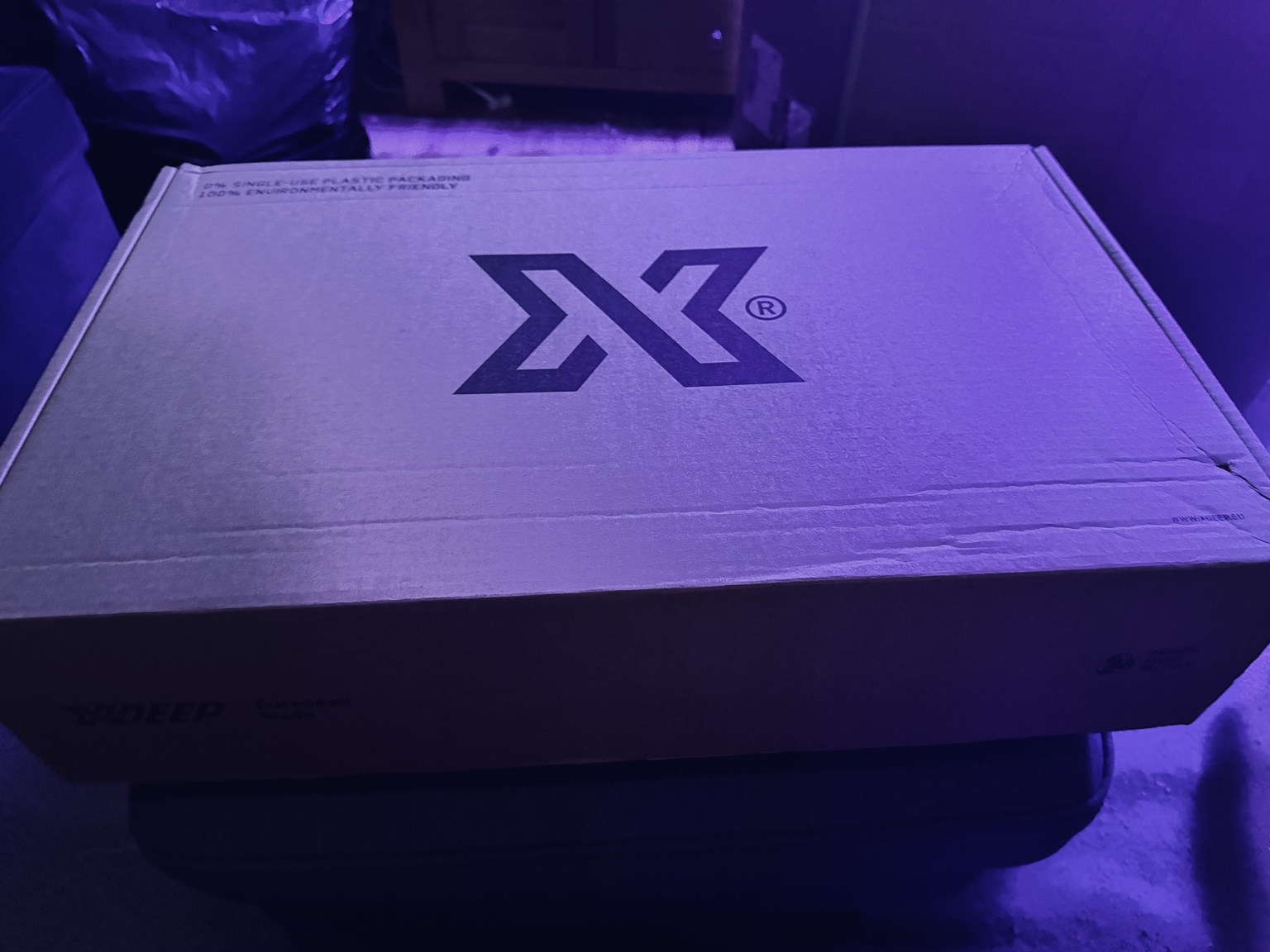
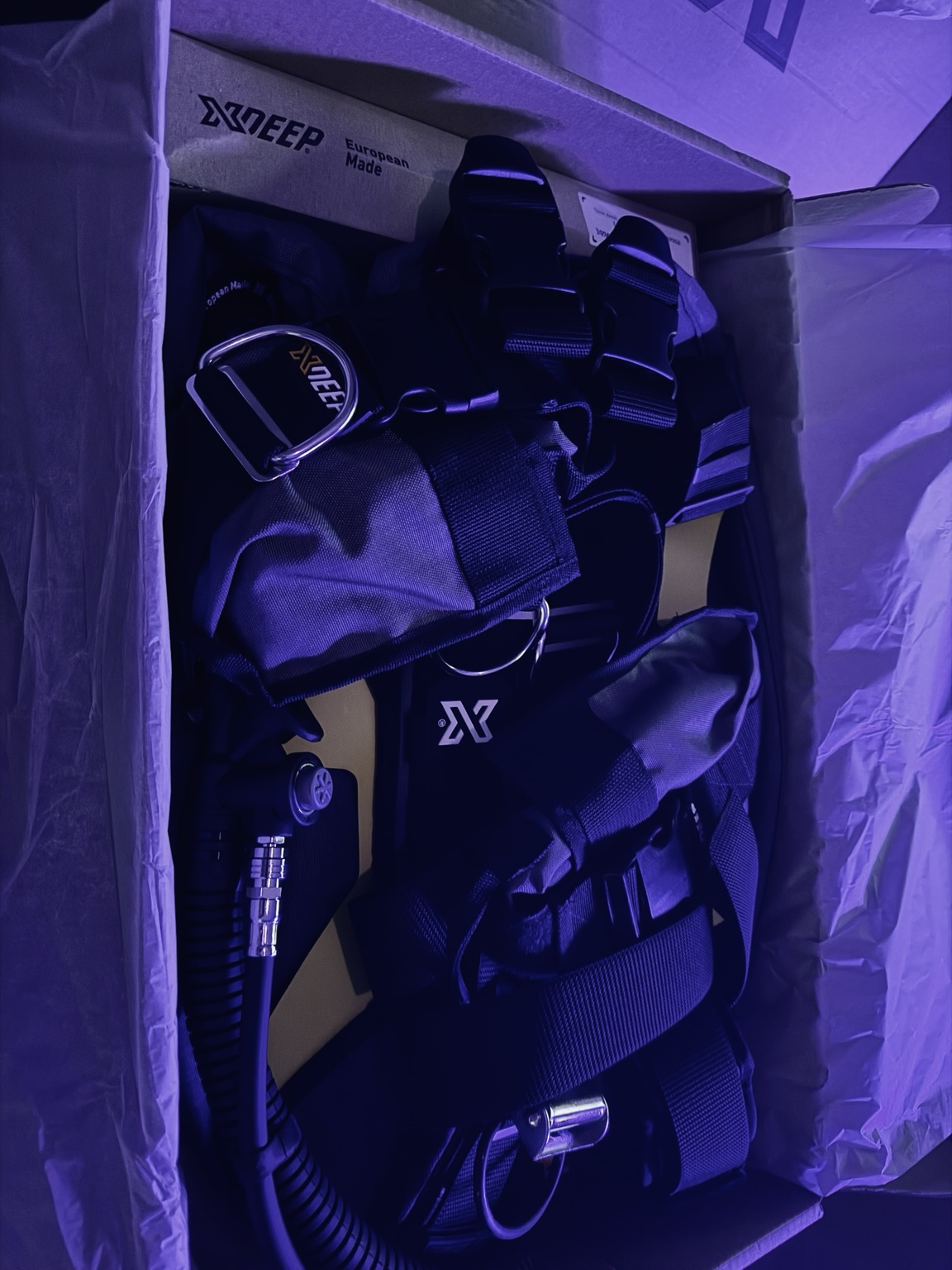
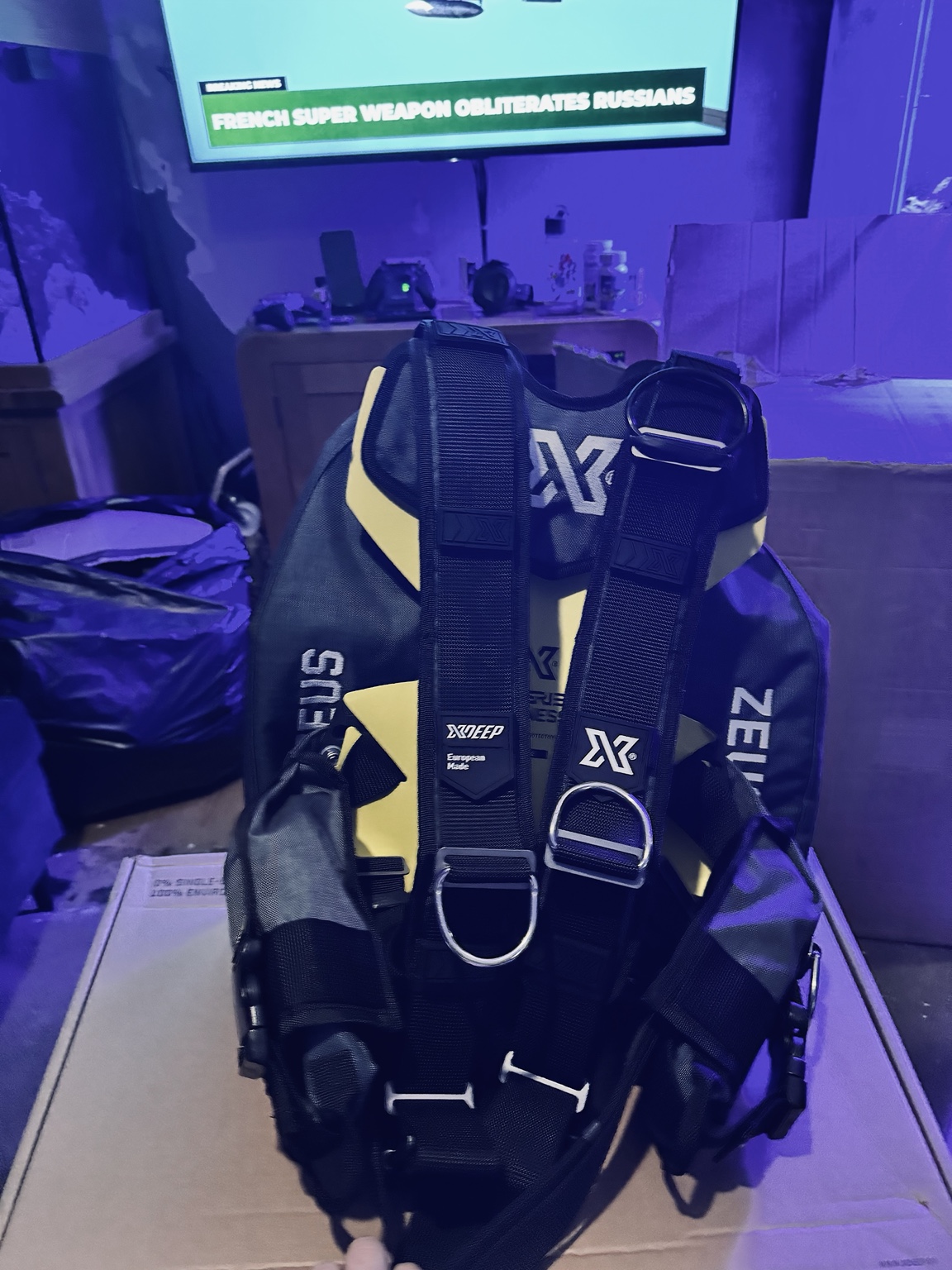
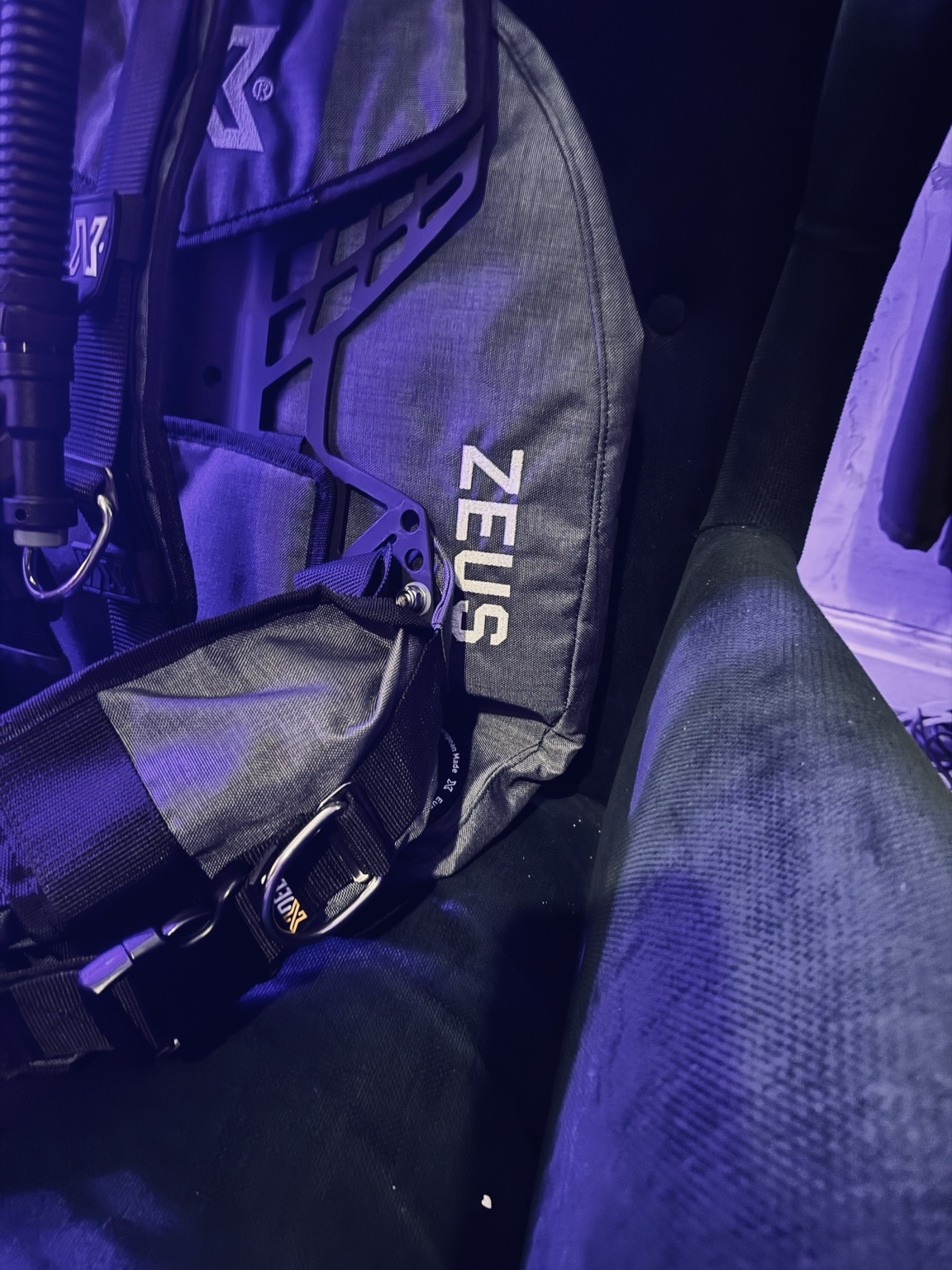
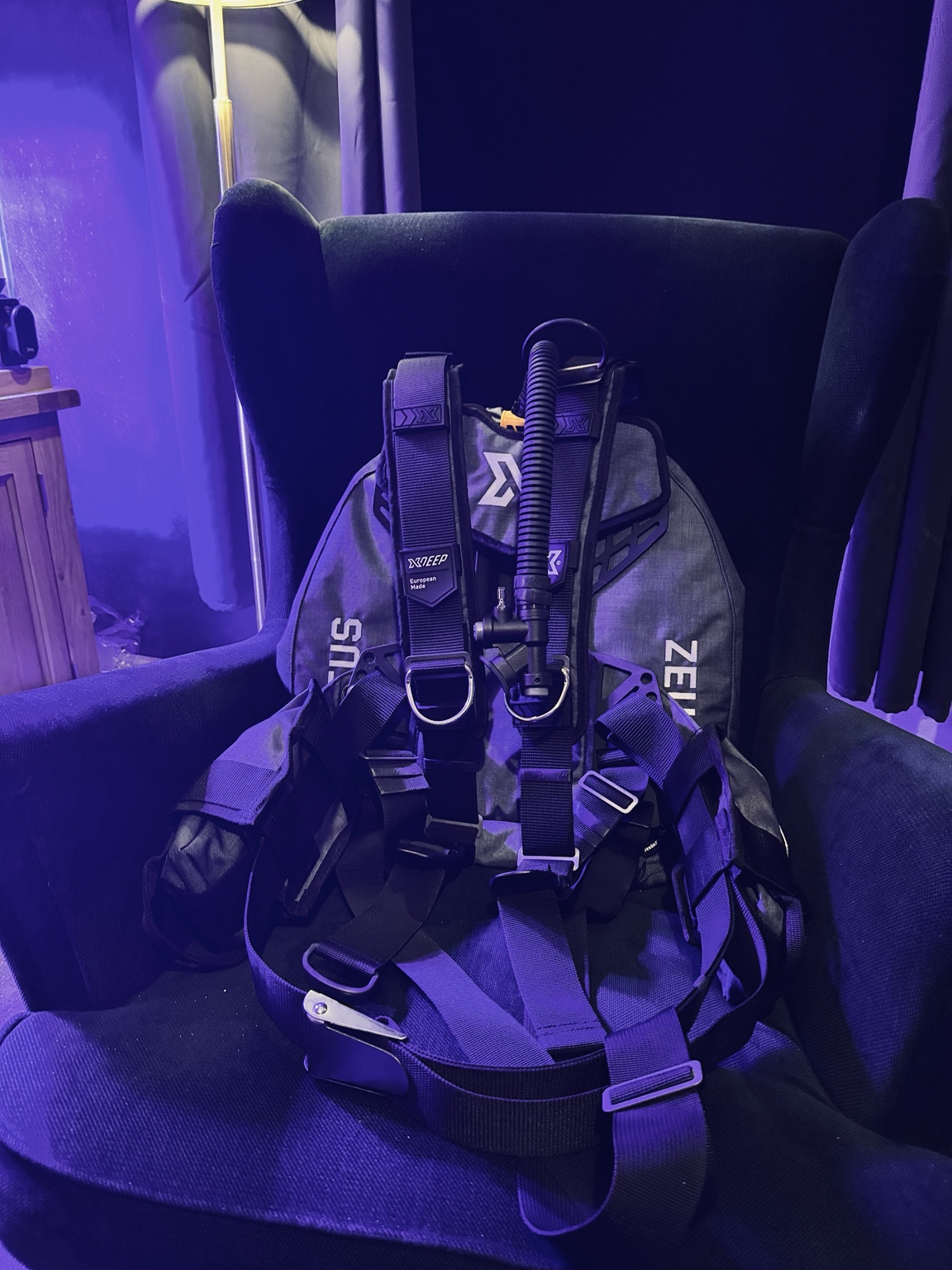
That unboxing was also the beginning of me understanding one of the things I now like most about BP/W systems: individual parts actually look like individual parts.
Wing. Plate. Harness. Hardware.
Nothing particularly mystical.
So I hired a five-metre pool
Rather than wait for open-water weather, I hired the five-metre diving pool at our local swimming pool.
It cost about £50, with a lifeguard on standby.
For anyone testing a major new piece of dive equipment, I would genuinely recommend looking into whether you can do something similar locally.
A controlled pool is a much better place to discover that your harness is wrong, your tank is too high, or something is rubbing than halfway through an open-water dive.
Gemma and I put the rigs on, walked to the edge, and took a giant stride into the pool.
Almost immediately, both of us found ourselves naturally settling into horizontal trim.
We spent roughly an hour at five metres doing nothing particularly glamorous — just practising skills while neutrally buoyant and getting used to the rigs.
That session told us a lot.
What surprised me most was how quickly it disappeared
On land, you absolutely know the ZEN is there.
Once you add the backplate, cylinder, regulators, ballast and everything else, there is no pretending you are wearing a lightweight fashion accessory.
But the moment I get into the water and the weight comes off my back, the whole thing seems to disappear.
That is probably the biggest difference for me compared with a jacket BCD.
A jacket always felt like something I was wearing.
The ZEN feels like part of the configuration around me.
Once I am neutrally buoyant, I barely notice it.
Anything I no longer have to think about is one less thing competing for attention during the dive.
From seahorse with a dive shop attached to sleek orca
Moving to BP/W also changed how I thought about everything else I was carrying.
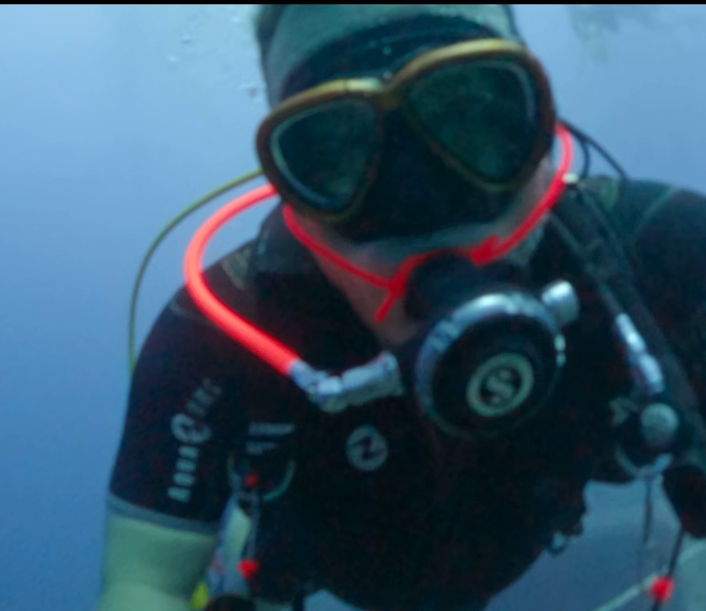
In a jacket BCD, even if I managed to get myself horizontal, I could have a slate, compass, knife, small torch, flashing beacon, magnetic hose clips, multiple spools, multiple DSMBs and a huge SPG console all hanging underneath me.
I was basically a seahorse with a dive shop strapped to him.
The more I dived the ZEN, the more I started asking a different question:
What do I actually need for this dive?
Slowly, the dangling kit disappeared.
Now, if I need something, it has a proper home.
The goal is to move through the water more like a sleek orca and less like a mobile clearance aisle.
My pocket system
Tech pockets were one of the biggest insights for me because they forced me to think about what I actually expect to use and what is there for emergencies.
Right pocket — utility and routine-use kit
- Wetnotes with dive plan or tables
- Slate when needed
- Routine DSMB and spool or reel
- Second backup torch
My first backup torch is clipped to the right shoulder D-ring and held neatly in place with a ranger band.
If I am doing something with a lot of note taking — a site survey, PADI AWARE activity or similar — I may use a wrist slate instead.
Left pocket — safety and emergency kit
- Spare mask
- Safety spool
- Yellow emergency SMB or lift bag where appropriate
- Spare double-ender
- CPR mask
- Shears or other cutting tool
- Multi-tool where appropriate
- Waterproof ID card with QR code
My ID card is there for a reason I hope never matters.
If I am ever in a situation where I cannot tell somebody who I am, I take some comfort from knowing there is still a route back to my family.
Redundancy depends on the dive
I do not believe redundancy means carrying two of absolutely everything.
It depends on what is required to stay safe and what is actually needed to complete the dive.
On a night dive, for example, I take a primary light and two strong backups.
If the primary fails, I can move onto a proper backup and still retain another solid reserve.
On a daytime lobster dive, I may only take one light because losing that light does not remove my ability to complete the dive safely.
The important part is not simply carrying the backup.
I need to know exactly where it is and be able to retrieve it instinctively and safely.
That includes securing gear inside the pocket. A bolt snap and bit of bungee can stop your shiny new reel from disappearing into the abyss at precisely the moment you need it.
BP/W helps trim — it does not create skill
A backplate-and-wing makes it much easier for me to adopt a skydiver-style horizontal position.
But let us be clear about something.
You can absolutely wear a BP/W and still seahorse, bicycle-kick and happily work your cylinder down towards 50 bar.
It is a tool.
It does not magically give you core strength.
It certainly does not give you the glutes of a Kardashian.
Those things take time, practice and — if you are built like me — rather a lot of effort in the gym.
What the ZEN does for me is make good positioning easier to find and easier to maintain.
That leaves more attention available for the actual dive.
Advanced Open Water was when it really clicked
Our first dives after the pool shakedown were at Ellerton.
Those dives confirmed that the systems worked.
But Advanced Open Water was where the benefit really became obvious.
If I remember correctly, after the Navigation dive both Gemma and I were told that our trim was really good.
Then we were asked how many years we had been diving.
When we explained that our Open Water certification had only been the previous May, the reaction was basically disbelief.
At one point we were even asked if we were secretly PADI test shoppers.
It was funny, but it also confirmed something useful.
The BP/W had not magically turned us into good divers.
It had given us a setup that made good trim easier to maintain, which meant we could concentrate on navigation and the other skills instead of constantly correcting ourselves.
How we dive as a team
Gemma and I naturally settle into a fairly tight formation.
One of us leads and the other sits slightly offset, roughly a metre away and close enough that an arm’s-length movement puts us right alongside one another.
When Matthew dives with us, he takes the opposite side and we form a shallow V, with the point slightly ahead.
It keeps everyone visible without feeling crowded.
The BP/W did not invent that formation, but because Gemma and I are both stable and comfortable in trim, maintaining it feels natural.
Gemma’s verdict
Gemma loves her ZEN.
At this point, I think she would fight me to the death if I suggested we leave it at home and hire a jacket BCD on holiday.
Either that, or clothes would start disappearing from the suitcase until the BP/W fitted.
For her, moving away from the jacket also solved the discomfort around her chest that had helped start this whole search in the first place.
She has little interest in moving into decompression diving.
That matters because it proves the point: you do not need technical diving to be your destination for BP/W to make sense.
Jacket BCD vs backplate-and-wing — my experience
| Area | Jacket BCD | Backplate & Wing | My take |
|---|---|---|---|
| Land comfort | Can be very comfortable depending on model | Depends heavily on harness choice | Close, but BP/W wins for me in hot climates because it is less enclosing |
| Travel | Usually bulky unless buying a dedicated travel BCD | Can be stripped down and packed very small | BP/W wins comfortably for me |
| Initial setup | Put it on and adjust a few straps | Needs proper initial fitting | Jacket BCD wins at first |
| Pockets | Often comes with two large built-in pockets | Often comes with none | BCD wins out of the box — two massive bags of holding |
| Weight distribution | Usually centred around integrated or belt weight | Plate, P-weight, trim pockets and dumpable ballast can all be used | BP/W wins by a long way for me |
| Trim | Absolutely possible with good setup and skill | Feels naturally easier for me | BP/W wins personally |
| Donning and doffing | Generally simple and familiar | Can take more practice, especially the crotch strap | BCD is easier initially |
| Repairability | Can depend heavily on manufacturer and construction | Modular wing, bladder, harness and plate | BP/W wins for long-term maintainability |
| Customisation | Mostly fixed by manufacturer | Highly configurable | BP/W wins |
Weighting is more interesting than it first appears
At first glance, you might assume a jacket BCD is automatically lighter.
Sometimes it is.
But the more useful question is how you want the total ballast distributed once you are correctly weighted.
You do not necessarily need 100% of your ballast to be ditchable.
When properly weighted, removing even a relatively small amount should make you positively buoyant without turning the ascent into a Polaris missile launch.
A BP/W gives you a lot of freedom in where the weight goes.
You can choose different backplate materials, add P-weights behind the plate, use trim pockets, integrated dumpable pockets or a traditional weight belt.
Moving some ballast closer to the centre of the body can also help tune trim.
I chose aluminium because my diving is roughly a 60/40 split between UK diving and destinations that involve getting on an aircraft.
Aluminium gives me the structure I want without adding too much luggage penalty.
If nearly all my diving was cold-water UK diving, I would look much harder at stainless steel because the plate itself could replace some ballast.
The crotch strap and the hip thrust
Jacket BCDs are generally easier for people to get in and out of initially.
With a BP/W, the crotch strap is often the bit that catches people out.
Once I found the correct hip-thrust motion, however, I discovered I could both make the ladies blush and flick the strap forward far enough to grab it.
Gemma sometimes gets me to grab hers for her.
That does highlight a genuine consideration though.
Somebody with reduced mobility may struggle to retrieve their own strap and may not feel comfortable asking a buddy to do it.
Harness choice and buddy familiarity matter.
Myths I tested for myself
“BP/W is only for technical divers.”
That was my own assumption before buying one.
It is simply not how I see it now.
BP/W can support technical progression, but it works perfectly well for ordinary recreational diving too.
“It will push you face-down on the surface.”
I had heard this often enough that Gemma and I deliberately tested it.
Neither of us has experienced this supposed unavoidable face-plant effect, even when deliberately over-inflating the wing.
What I have noticed is that I generally sit slightly lower than some divers in jacket BCDs.
I have seen jacket users sitting with the water below their rib cage. The ZEN normally holds me around mid-chest.
I am perfectly happy with that.
Surface swimming on my back is particularly easy.
You can quite often find me floating face-up before a dive, staring at the sky and generally refusing to be productive.
“BP/W is too complicated for recreational diving.”
This is probably the myth that makes the least sense to me now.
A basic BP/W is extremely simple.
Plate. Wing. Harness. Cam bands. Cylinder.
That visual simplicity can make it look more technical, but stripped back is exactly what makes the system simple.
“They are uncomfortable.”
That depends on the harness, your body and whether it has actually been fitted correctly.
There are now recreational harness systems with padding, quick releases and cinching straps if that is what you prefer.
You do not have to earn some imaginary badge of honour by using a harness you dislike.
Who should not rush out and buy one?
I would not automatically make BP/W somebody’s first big equipment purchase.
You need to know that diving is probably going to become more than the occasional holiday activity.
If you only do a handful of warm-water dives each year, hiring a good jacket BCD may be the easier and more sensible choice.
A BP/W starts to make more sense when you know you want to dive regularly, refine your trim, travel with your own configuration, customise your setup, or perhaps move further into advanced or technical diving.
Buy it because it solves a problem or supports the diver you are becoming.
Do not buy one because somebody on the internet told you that “proper divers” use them.
A practical first BP/W setup
| Component | Starting point |
|---|---|
| Backplate | Aluminium for lighter travel-focused use; stainless steel if you want more ballast built into the system |
| Wing | Donut-style wing sized for the cylinder and exposure protection you actually use |
| Harness | Either a one-piece Hogarthian harness or a recreational-style harness with quick releases and padding — choose what feels comfortable |
| Crotch strap | Use one. It keeps the plate stable and stops the system riding up |
| Cam bands | Two good-quality bands securing the cylinder properly |
| Single tank adapter | Use one if your chosen plate/wing combination requires it or if it improves cylinder stability |
Basic fit checkpoints
- Shoulder straps loose enough to slide a fist underneath
- Shoulder D-rings around collarbone/armpit level
- Waist buckle slightly right of centre
- Crotch strap snug rather than restrictive
- Crotch D-ring roughly a hand-width above the bottom of the plate
- Top of the plate sitting just below the C7 vertebra at the base of the neck
- You should be able to reach back and touch the upper plate area with both hands
Harness choice: use what works for you
I do not think there is any point telling somebody they must use a one-piece Hogarthian harness if they hate wearing one.
Recreational harnesses with shoulder padding, quick releases and cinching straps can make the move from a jacket BCD feel much more familiar.
If you later decide you want to try a continuous one-piece harness, the change does not necessarily cost much.
The replacement XDEEP webbing I found was around £15.
So starting with the more familiar harness and experimenting later is perfectly reasonable.
Fit and comfort matter more than proving you can tolerate a particular harness style.
Do the first shakedown almost naked
Not literally.
Please keep your exposure protection on.
What I mean is: do not immediately bolt every pocket, torch, reel, camera and accessory you own onto a brand-new BP/W.
Dive the basic system first.
If possible, use a pool.
Leave the pockets and unnecessary extras off and concentrate on fit, trim, tank position and whether anything is restricting movement.
If you can stick an action camera on the pool wall and record the whole session, even better.
Watching yourself afterwards can tell you far more about how the configuration is behaving than trying to judge everything purely from how it felt.
Then make tiny adjustments
Neither mine nor Gemma’s ZEN was fitted once and then declared finished forever.
We have both adjusted them a few times.
The changes are small now.
Harness length, plate position, how something sits or where a piece of equipment lives.
The aim is simply to remove more friction.
Once the big decisions are right, you are sanding off the little annoyances until the system becomes increasingly invisible.
Does BP/W mean technical diving is next?
It can be a useful stepping stone.
For me, the ideas of streamlining, modularity, deliberate equipment placement and trim have fed naturally into my interest in sidemount and technical diving.
But that does not mean technical diving has to be the destination.
Gemma is a perfect example.
She has little or no interest in moving into decompression diving and still absolutely loves her ZEN.
For her, it is simply the equipment that fits her better and works for the recreational diving she wants to do.
Equipment should support the diver you are.
It should not force you towards somebody else’s idea of what your diving should become.
Final thought
Some divers will resist anything that feels new in recreational diving.
I am still not entirely sure where the idea that a backplate-and-wing automatically pushes you face-first into the water came from.
What mattered to me was testing it.
Gemma and I got into a controlled pool, used the equipment, practised with it, then took it into open water and kept refining it.
For us, it worked.
The more I dive it, the more it disappears into the system.
The harness fits my body. My equipment has a home. Nothing dangles. Trim takes less thought. The whole configuration creates less friction.
That is probably the biggest lesson I have taken from moving to BP/W.
Good dive equipment should not constantly remind you that you are wearing it.
But I am not going to tell every diver to throw away their jacket BCD.
For somebody else, that jacket may be the system that fits perfectly and disappears into the background.
As with all gear: test everything and choose what disappears into the background for you.