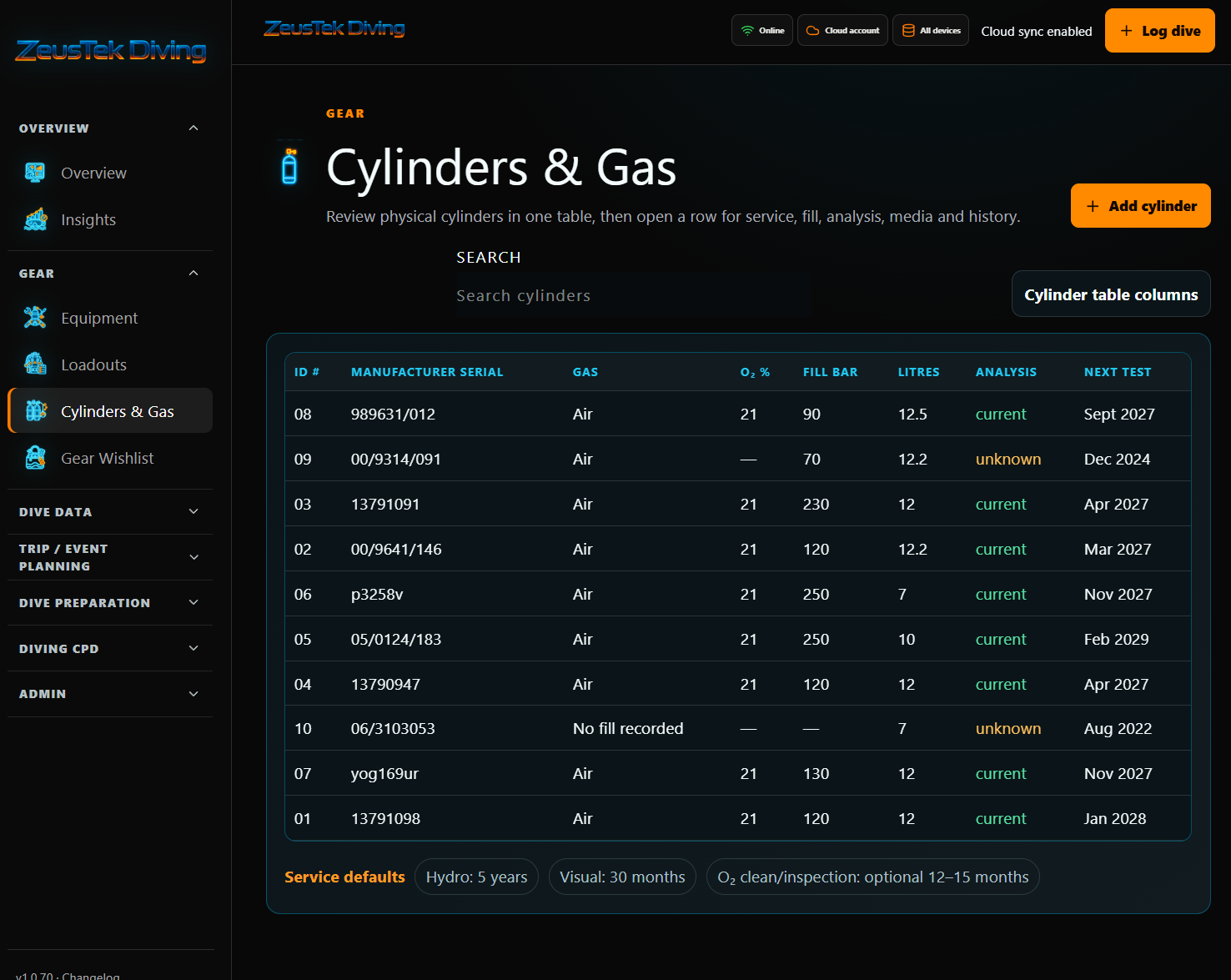
Once the cylinder collection reached sixteen, “I’m sure that one is in test” stopped being an acceptable database.
Sixteen cylinders is enough to need a system
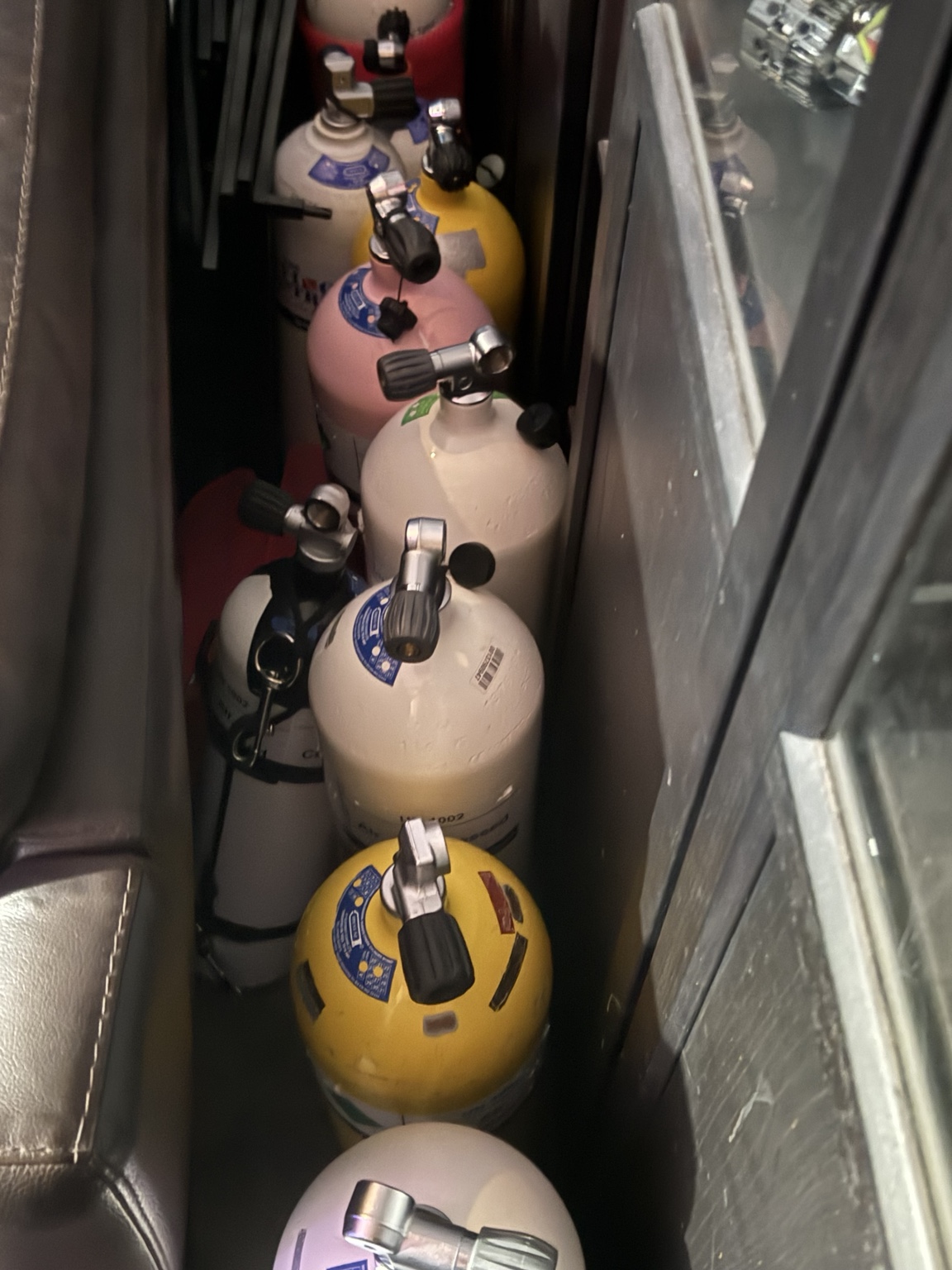
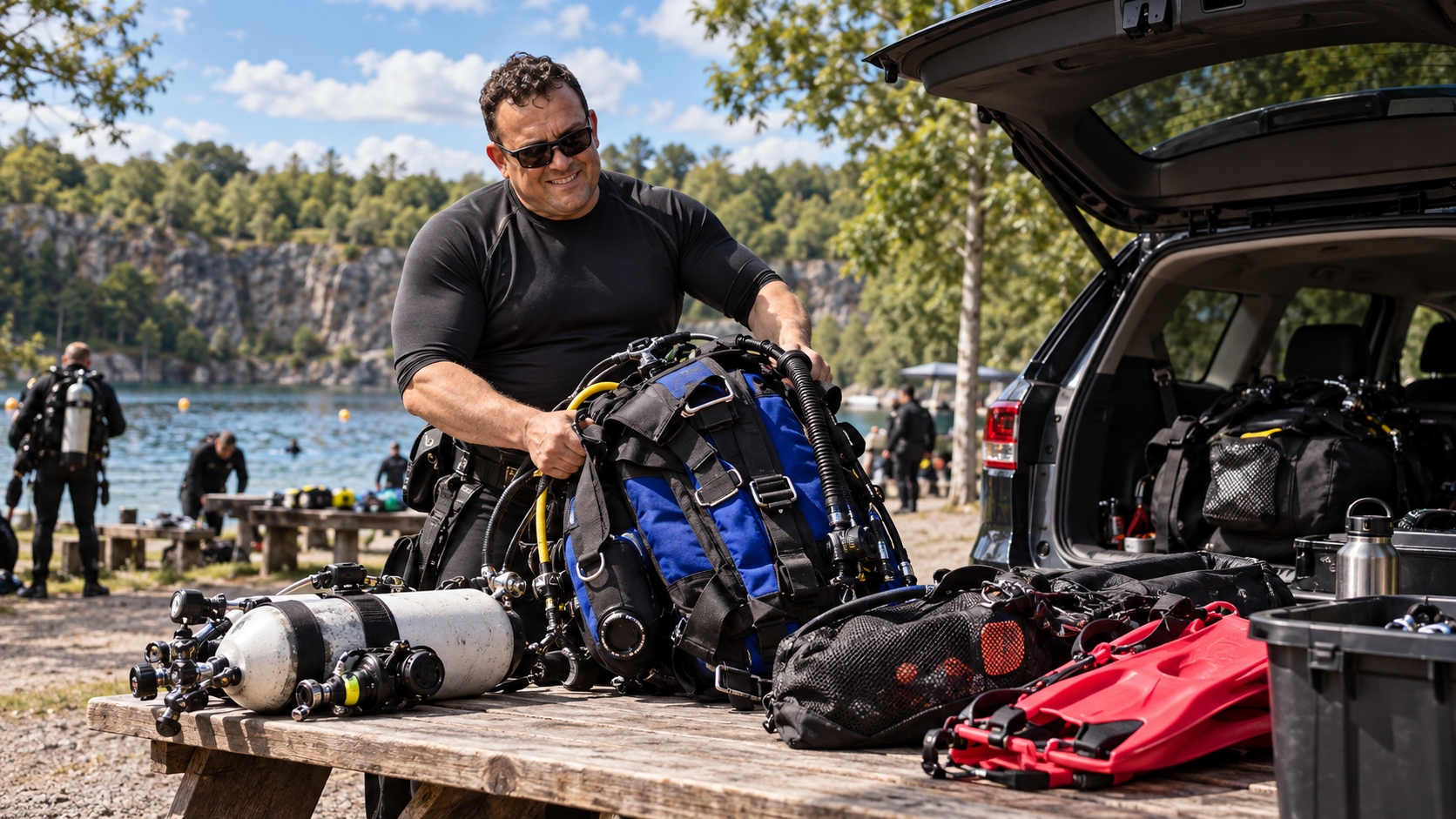
I currently have sixteen cylinders in the wider kit pool.
That sounds faintly ridiculous when written down, but different sizes and uses accumulate surprisingly quickly once diving expands beyond one recreational single cylinder.
The problem is that every physical cylinder comes with information that matters: what it is, what gas is in it, when it was filled, whether it has a current analysis, when its test is due and whether O2-clean status matters for how I intend to use it.
At that point memory is not a system.
If I have to stare at a cylinder and think “I’m pretty sure…”, the tracking has already failed.
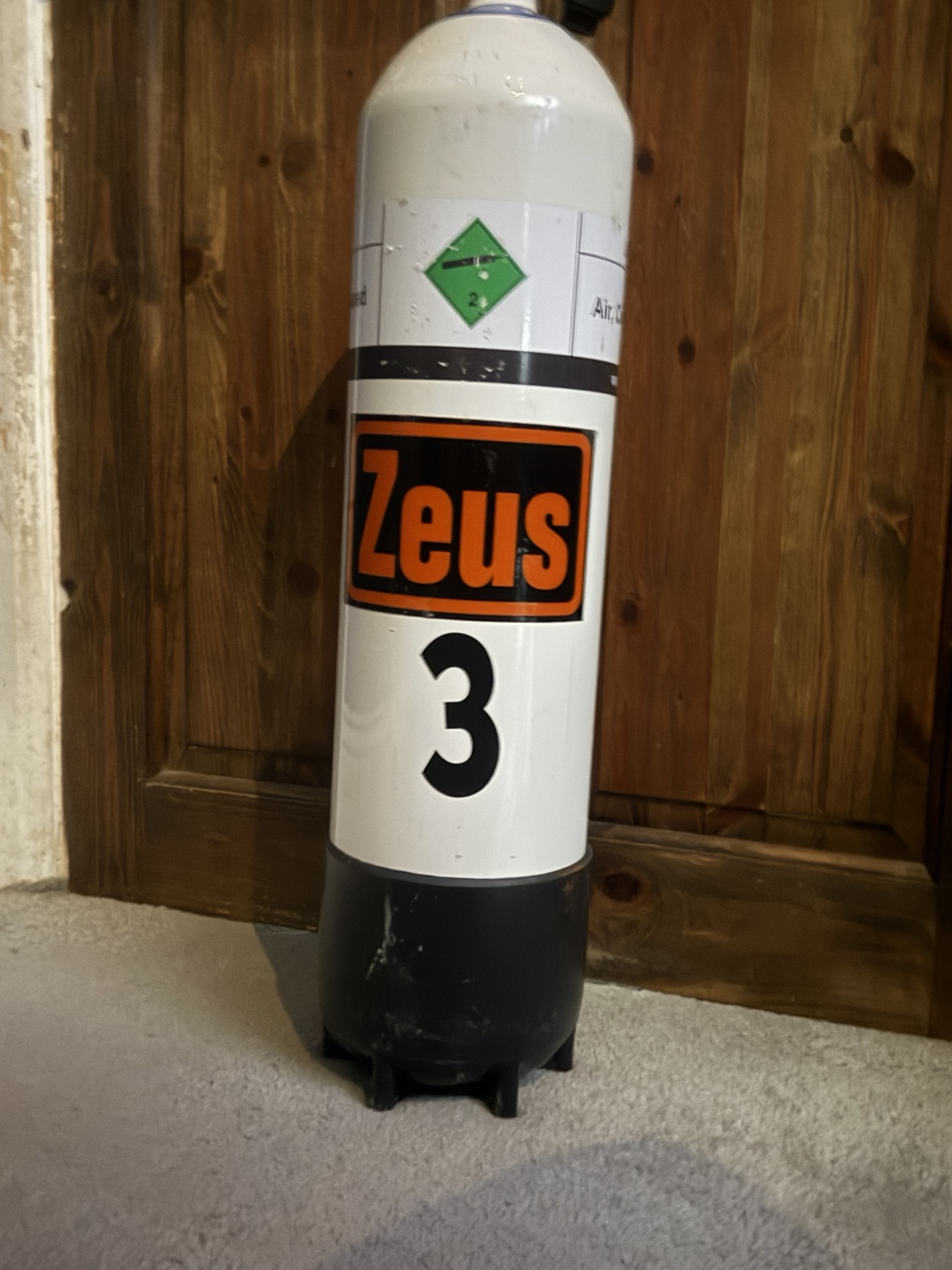
Giving each physical cylinder its own identity makes it much easier to connect the tank in front of me with its service and gas record.With sixteen cylinders in the wider kit pool, the system has to work across a collection rather than one or two familiar tanks.
Every cylinder gets an identity
I am moving toward treating each cylinder as its own record rather than just “one of the 12s”.
An ID label gives me something simple to connect the physical object to the digital record.
That means the app can hold the manufacturer serial, capacity, current gas and service information without me trying to decode a row of nearly identical steel cylinders in the garage.
Gas is a current state, not a permanent property
A cylinder is not “the Nitrox one” forever.
What matters is what is actually in it now.
So the useful fields for me include gas type, oxygen percentage where relevant, fill pressure and whether the analysis is current.
The point is not to replace proper gas analysis or labels. The digital record is there to support the physical process, not pretend it happened.
Service dates are where software earns its keep
Hydro, visual inspection and O2-clean status are exactly the sort of things that are easy to remember until suddenly they are not.
With a couple of cylinders, a mental note might survive.
With sixteen, I want the system to show me what is coming due rather than discovering it when I am already trying to get something filled.
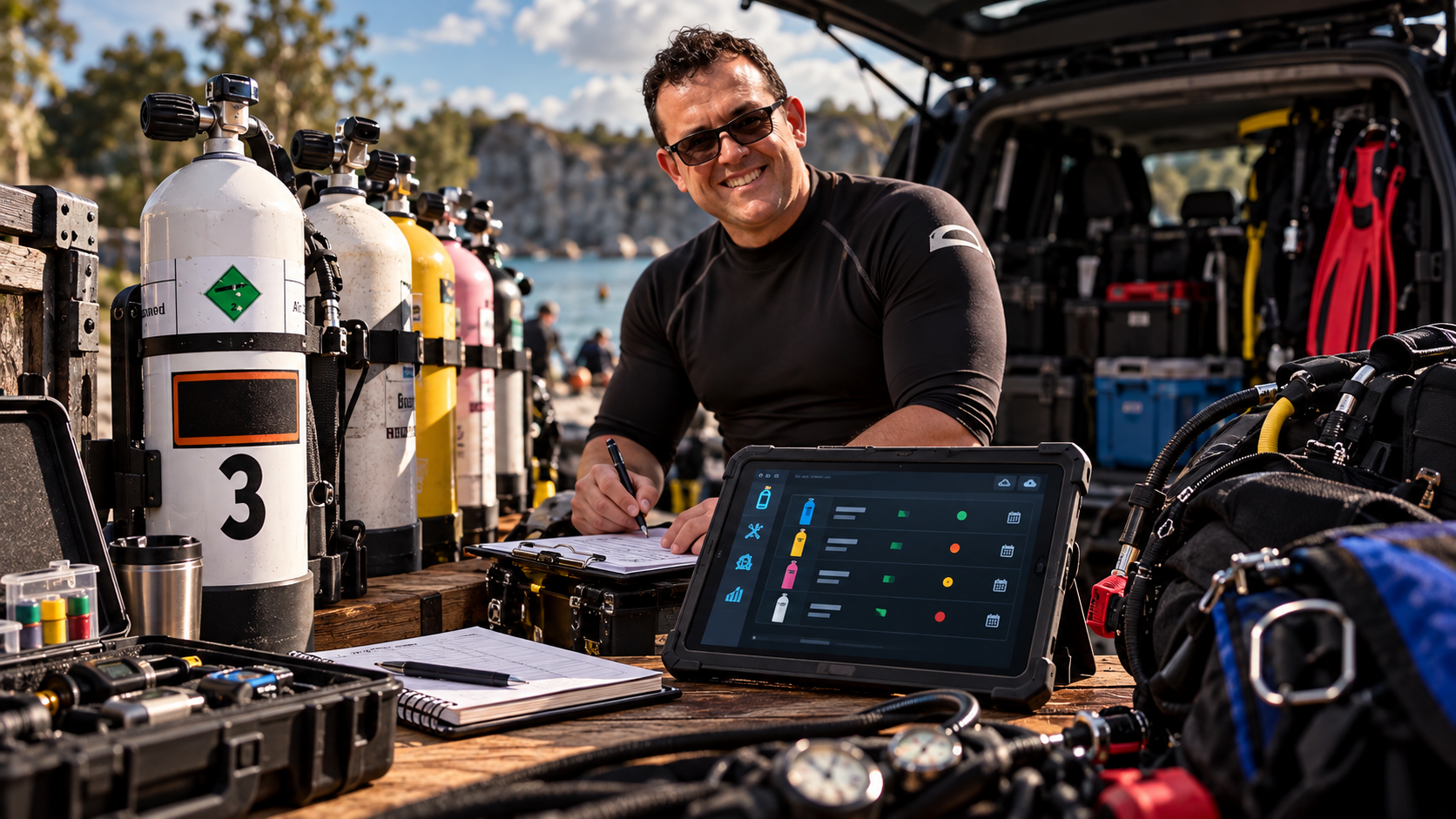
The ZeusTek Diving cylinder view brings gas, fills and service information together so I can see what needs attention before a dive day.
The same idea extends to the rest of the kit
Cylinders are the obvious case because they have formal test and gas information attached to them, but I am gradually using the same thinking across other equipment.
Regulator service history, loadouts, what belongs together and what is ready to go all become much easier when the information is in one place.
This is one of the reasons the ZeusTek Diving WPA app keeps growing. I am building it around the questions I repeatedly need answered.
I want less pre-dive faff, not more admin
The danger with any tracking system is that it becomes a hobby in its own right.
I do not want to spend twenty minutes entering data for every five minutes I spend actually diving.
The system has to save time overall.
If I can look at one screen and know which cylinders are in test, what gas they contain and what needs attention, then the admin has earned its place.
I like systems, but only when they reduce uncertainty.
Sixteen cylinders is enough equipment that I want facts, not memory and crossed fingers.
Good organisation should make the dive day feel simpler, not more complicated.
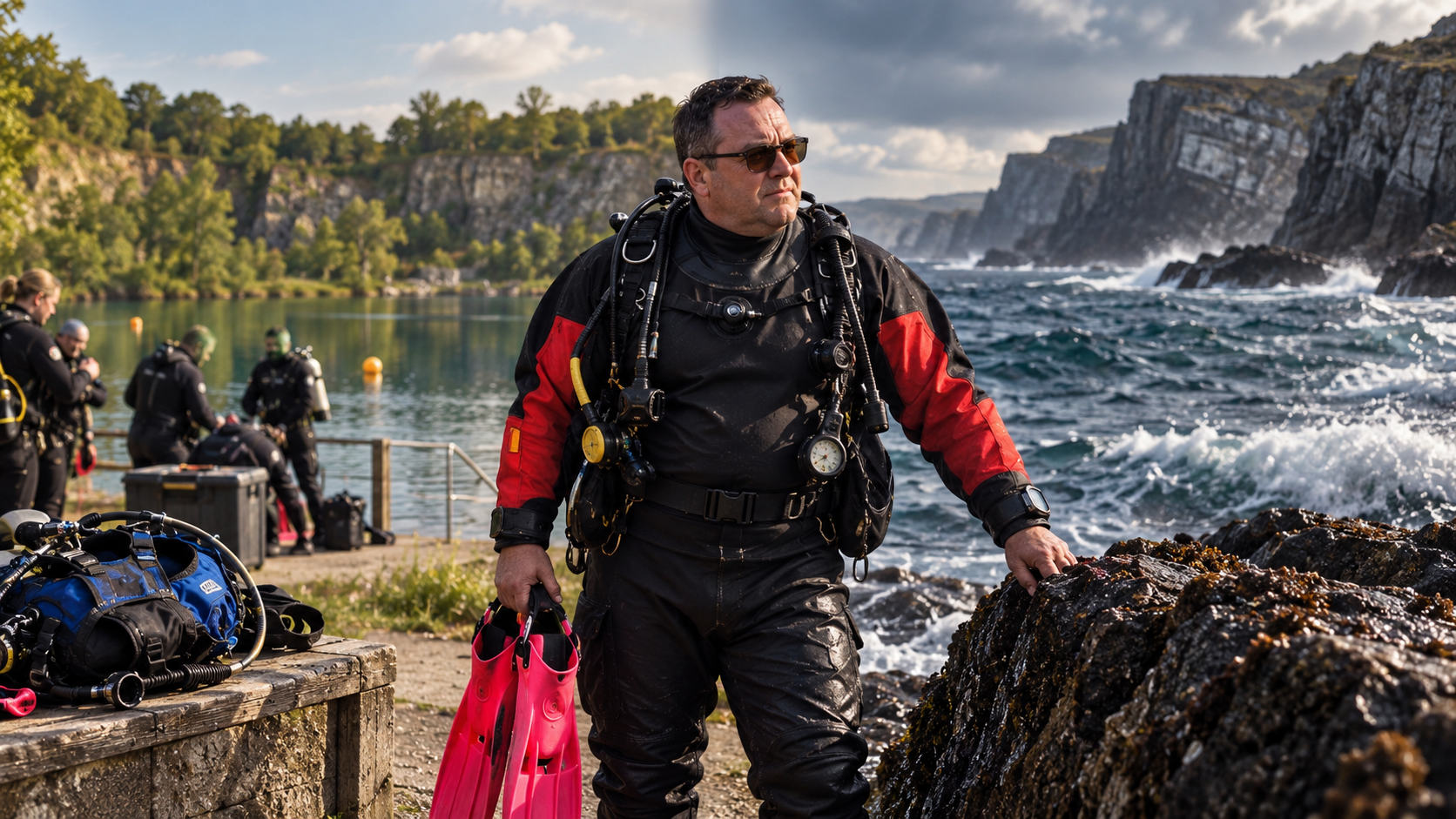
I do not see quarries as fake diving or the sea as automatically better. They give me different problems to solve.
Quarries are where I can make things boring
I actually like quarry diving.
That does not mean I think a quarry is the same thing as the sea.
Its biggest strength is often the opposite: it removes variables.
Known entry points, no tide, generally predictable navigation and a familiar shore setup make it much easier to repeat a skill until it becomes boring.
That is incredibly useful for training.
A quarry is not valuable because it imitates the sea perfectly. It is valuable because it lets me practise without the sea changing the exam paper halfway through.
Inland sites give me a controlled place to repeat skills, configuration and the basics.UK sea diving adds the environment itself to the workload: exposure protection, entries, exits and changing conditions.
Inland sites expose the basics
When the environment is relatively controlled, it becomes harder to blame the conditions for untidy fundamentals.
Buoyancy, trim, shutdown practice, DSMB work, finning, weighting and general configuration can all be repeated with fewer distractions.
That makes inland diving a very good workshop.
The sea makes the whole dive matter
Coastal diving adds a different layer.
Weather, swell, current, entry and exit, boat movement, slippery rocks, visibility and changing conditions can all matter before I even get to the underwater part.
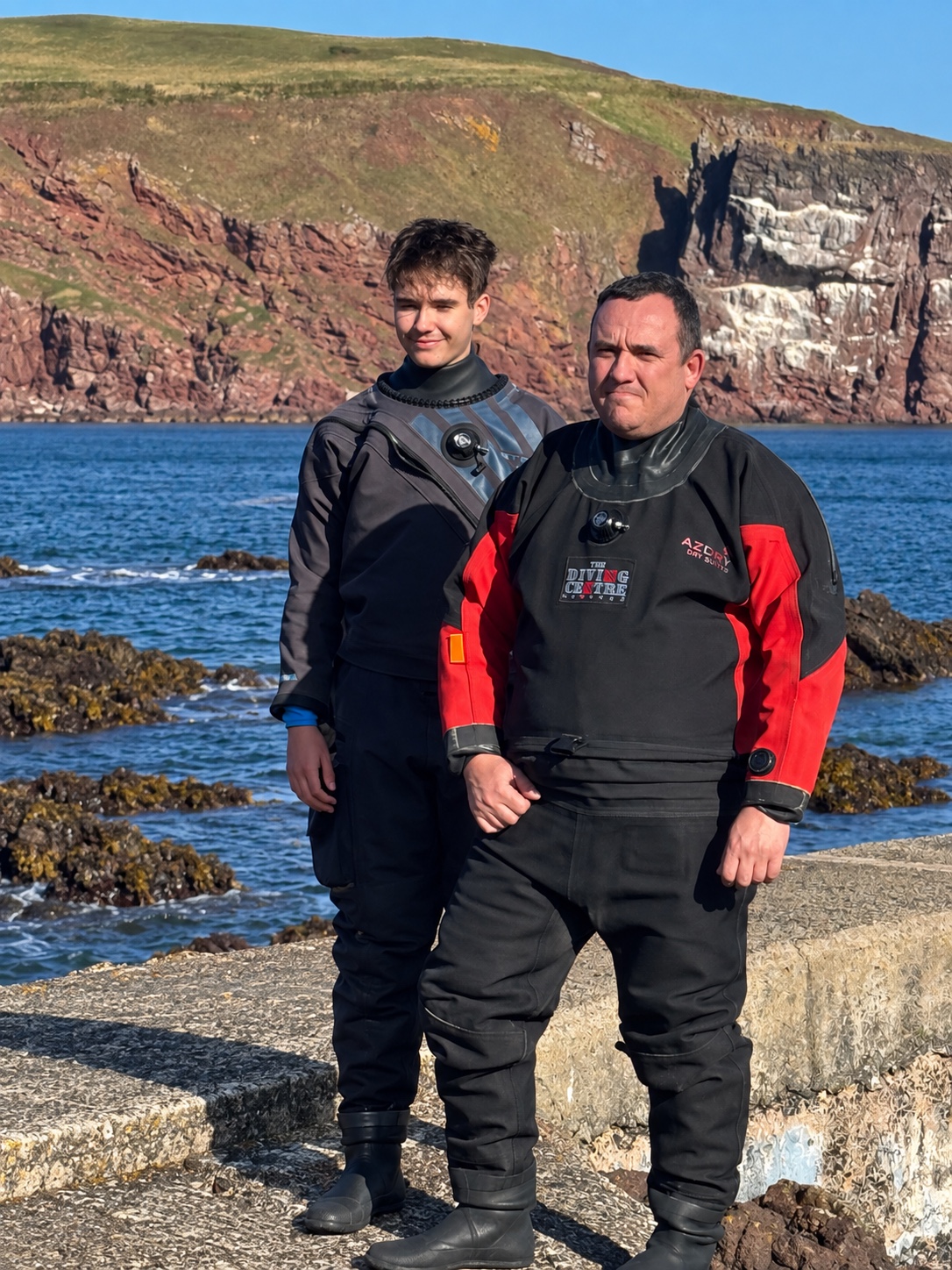
St Abbs reinforced that for me. The dive itself can be lovely while the shore exit reminds you very quickly that the day does not end at the safety stop.
Natural navigation feels different
The sea has also made me pay more attention to natural navigation.
At St Abbs I remember using the rock formation as a reference and thinking about the relationship between the coastline and direction rather than simply following a fixed quarry feature.
That kind of navigation feels more connected to the environment.
The sea teaches energy management
One of the biggest differences for me is energy.
A long carry, awkward entry, waves, a ladder or a shore exit can eat into the same physical and mental reserve I need underwater.
That links directly to the human-factors side of diving: pre-dive faff and physical workload are not separate from the dive just because they happen above the water.
I want both in my training
If I only dived quarries, I would miss the environmental judgement and adaptability the sea demands.
If I only dived the sea, I would lose one of the easiest places to repeat skills deliberately without every session being dictated by conditions.
For where I am heading—Divemaster development, sidemount and eventually more technical diving—I want both.
The quarry gives me repetition.
The sea gives me variability.
Both expose weaknesses, just in different ways.
One lets me sharpen the tool. The other makes me use it.
A dive light is simple until darkness, signalling and redundancy make it part of the plan rather than just another gadget.
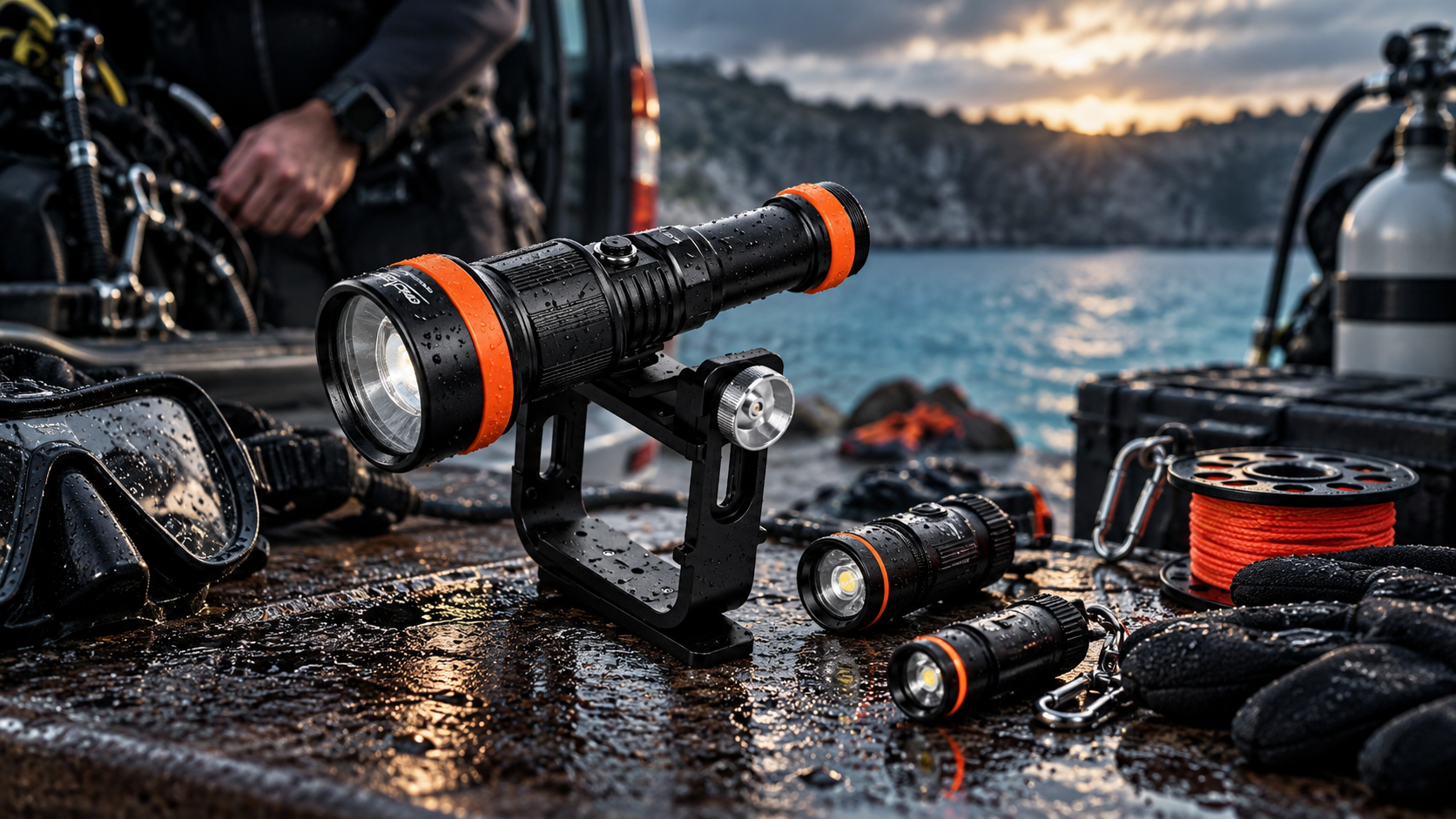
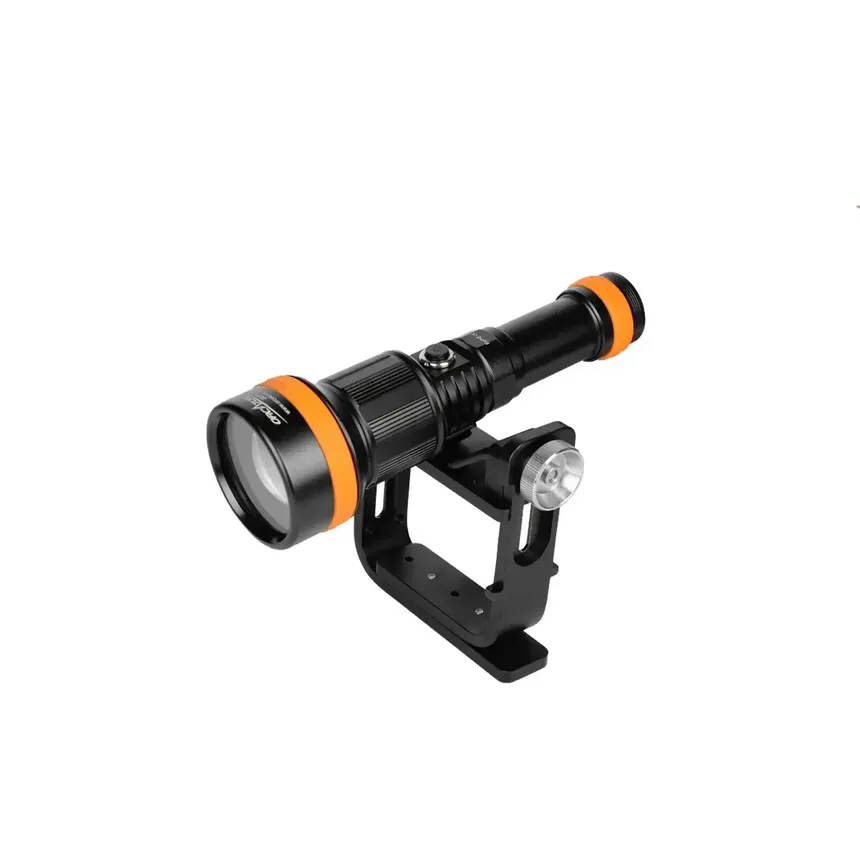
My current primary is the ZD710
Recently I have been using the ZD710 on a Goodman handle as my main light for recreational diving.
For the sort of dives I am doing now, it is a very comfortable setup.
The handle keeps the light where I want it without turning one hand into a permanent torch holder, and the light easily covers the roughly 60-minute recreational dives that make up most of my current use.
The best primary light is not the one with the biggest specification sheet. It is the one that fits the dive I am actually doing.
My current recreational primary: the ZD710 on a Goodman-style handle.
The Goodman handle changed how useful the light feels
I like being able to use my hand while still having the light aligned with it.
That matters for clipping things off, checking gauges, handling a spool or just communicating without constantly swapping a torch between hands.
It also makes the light feel like part of the configuration rather than something I happen to be carrying.
Backups are boring until they are not
I carry backup lights because the failure mode is obvious.
If the primary stops working on a daylight dive, that may just be annoying. On a night dive or somewhere the light is genuinely part of orientation and communication, it matters a lot more.
My current backups include an orange OrcaTorch backup and four HiCloud dive torches in the wider kit pool.
I do not need all of them clipped to me on every dive, but having multiple working lights available makes it much easier to build the redundancy appropriate to the dive.
Beacons have a different job
I also use small beacons as part of the wider lighting kit.
I do not see them as a substitute for a torch. Their value is visibility and identification rather than illuminating the reef.
That distinction matters because “light” is really several different jobs: seeing, being seen and signalling.
Technical diving may change the equation
As I move toward technical diving, longer runtimes and decompression stops are going to change what I ask from the primary light.
I may well go back to a canister light for that kind of diving, with the ZD710 moving into the backup role.
That would not mean the ZD710 suddenly became inadequate. It would mean the dive became longer and the consequences of losing the primary became more important.
I am trying to build systems, not collect torches
It is very easy with dive kit to buy another gadget because another gadget exists.
I am trying to think in roles instead:
What is my primary?
What is my independent backup?
How long does the planned dive require the system to work?
How am I using light for communication?
What changes when the dive becomes longer or more complex?
That is a much more useful way for me to decide what comes with me.
Right now the ZD710 on the Goodman handle fits my recreational diving very well.
As the diving changes, the lighting system can change with it.
The goal is not more lumens. It is dependable light for the dive I planned.
Strength Training for Scuba Divers: Why It Matters
I like being strong. Diving has shown me where that strength is genuinely useful — and where technique matters more.
Scuba is wonderfully weightless once you are underwater
One of the funny things about scuba is that the bit everybody photographs is often the easiest part physically.
Once I am neutrally buoyant and settled underwater, I want the whole thing to look almost lazy.
The hard work tends to happen before and after that: cylinders, bags, fins, drysuit, weights, ladders, boats, uneven ground and getting a fully kitted body from one place to another without wasting half the day’s energy.
Strength is most useful when it makes the logistics of diving less demanding, not when it makes me fight the water.
Being a big strong bloke has obvious advantages
I have always enjoyed strength training and I am naturally a big, heavyset bloke.
That is handy when something genuinely needs lifting or carrying.
A 12-litre steel cylinder does not become light because we call diving a recreational activity. Add a BCD or wing, regulators, weights and exposure protection and there is plenty of kit to move around before anybody gets wet.
Being stronger gives me more reserve for those jobs.
But brute force is a poor diving technique
The important bit is not confusing strength with skill.
Underwater, I do not want to muscle anything into place. I want trim, buoyancy and good positioning to do the work.
The same applies to rescue. Physical strength is useful, but good technique, leverage, positioning and calm problem-solving should come first.
I would much rather use strength as spare capacity than as the only reason a technique works.
Strength should be a reserve, not a substitute for technique.
Where I notice strength most
For me, the practical benefits show up in fairly ordinary places:
moving cylinders and assembled kit;
getting equipment on and off safely;
shore entries and exits;
boat ladders and awkward steps;
carrying kit across a quarry or car park;
helping a buddy with equipment;
having more physical reserve when a day becomes longer than planned.
None of those are glamorous, but they all affect how much energy I have left for the actual dive.
A lot of the physical work in scuba happens before and after the weightless bit underwater.
Fitness is bigger than strength
I also do not want to pretend a big bench press solves everything.
Divemaster preparation is making that particularly obvious. Surface swimming, finning efficiency, cardiovascular endurance, mobility and simply being comfortable working for longer all matter.
My challenge is not to become stronger for the sake of chasing numbers. It is to turn the strength I already enjoy building into useful diving capacity while improving the areas that strength cannot cover.
The goal is to arrive at the water with energy left
A good strength programme for me is not really about looking like a strong diver.
It is about making the physical chores around diving feel routine.
If moving cylinders, climbing a ladder or helping with somebody else’s kit costs less of my available energy, I have more attention and reserve for the dive itself.
I like lifting heavy things in the gym. That is part of who I am.
But the diving payoff is much simpler: I want the kit to feel manageable, the entry to feel controlled and the water to be where I become relaxed.
Strong enough for the kit. Skilled enough not to need strength underwater.
My aquarium hobby gave me a head start — not because I know every species, but because I had already learned how to look.
Fish ID was one of the easier AOW dives for me
When Fish ID came up as part of my Advanced Open Water course, I expected it to be enjoyable.
What surprised me was how familiar the thinking felt.
Years of keeping marine aquariums had already pushed me into fish taxonomy, family groups, body shapes, colour patterns and behaviour.
I certainly cannot identify every fish I see, but the process of working out what I am looking at was already something my brain enjoyed doing.
Aquarium keeping did not give me every answer. It taught me what details to look for.
I tend to look for families before species
Trying to identify every animal down to species level immediately is a brilliant way to overwhelm yourself.
I find it easier to start broad.
What shape is it? How does it swim? Where is it feeding? Is it hovering above the reef, sitting on sand, tucked into rockwork or defending a patch?
Once I have the likely family or type in mind, the smaller markings become much more useful.
Behaviour is part of identification
One thing aquarium keeping teaches very quickly is that behaviour matters.
Fish learn routines and recognise the people around their tank. They also have very obvious individual personalities.
That makes me pay attention underwater to what an animal is doing rather than only its colour.
Is it grazing? Picking at coral? Hovering over a burrow? Guarding eggs? Cleaning another fish? Disappearing into the same hole every time a diver approaches?
Those observations make the dive more interesting even when I never manage to put an exact species name on the animal.
The ugly little details help too
Keeping reefs has also taught me about algae, pests, the biological cycle and water chemistry.
That means I am often just as interested in what is growing on the rock as what is swimming over it.
A patch of algae, a tiny invertebrate, a burrow, a damaged coral surface or a cluster of something unfamiliar can become the thing I remember from the dive.
Taxonomy became a hobby almost by accident
I did not sit down one day and decide I needed to learn marine taxonomy.
It happened because one question leads to another.
What is that fish? What family is it in? What does it eat? Is it reef safe? What does it look like as a juvenile? Why is it behaving like that?
Do that for long enough and you end up with a surprisingly useful framework when somebody hands you a Fish ID slate underwater.
The goal is curiosity, not showing off
I do not want Fish ID to turn into another badge-collecting exercise where the person who can name the most Latin species wins.
For me the useful outcome is that I pay closer attention.
If I identify the fish later from a photograph or book, brilliant. If I only come away knowing that I watched something behave in an interesting way, that is still a better dive than swimming past it without noticing.
The aquarium hobby gave me vocabulary and a habit of observation.
Diving gives me the chance to use both where the animals actually live.
The more I know what I am looking at, the less of the reef becomes background scenery.
I want my log to tell me more than where I went and how deep I got.
I still start with paper
I have built a fairly serious digital home for my diving, but immediately after a dive I still like writing things down on paper.
There is a reason for that.
The act of writing forces me to slow down and replay the dive in my head. What did I see? What felt good? What felt untidy? Was there a moment where I was overloaded? Did I use more gas than expected? Was the weighting right? Did the entry cost more energy than it should have?
If I only tap a few numbers into an app, it is easy to record the dive without really processing it.
Writing it by hand gives me one more pass through the experience while it is still fresh.
The paper log is not just storage. For me, writing is part of the debrief.
The app is becoming the main repository
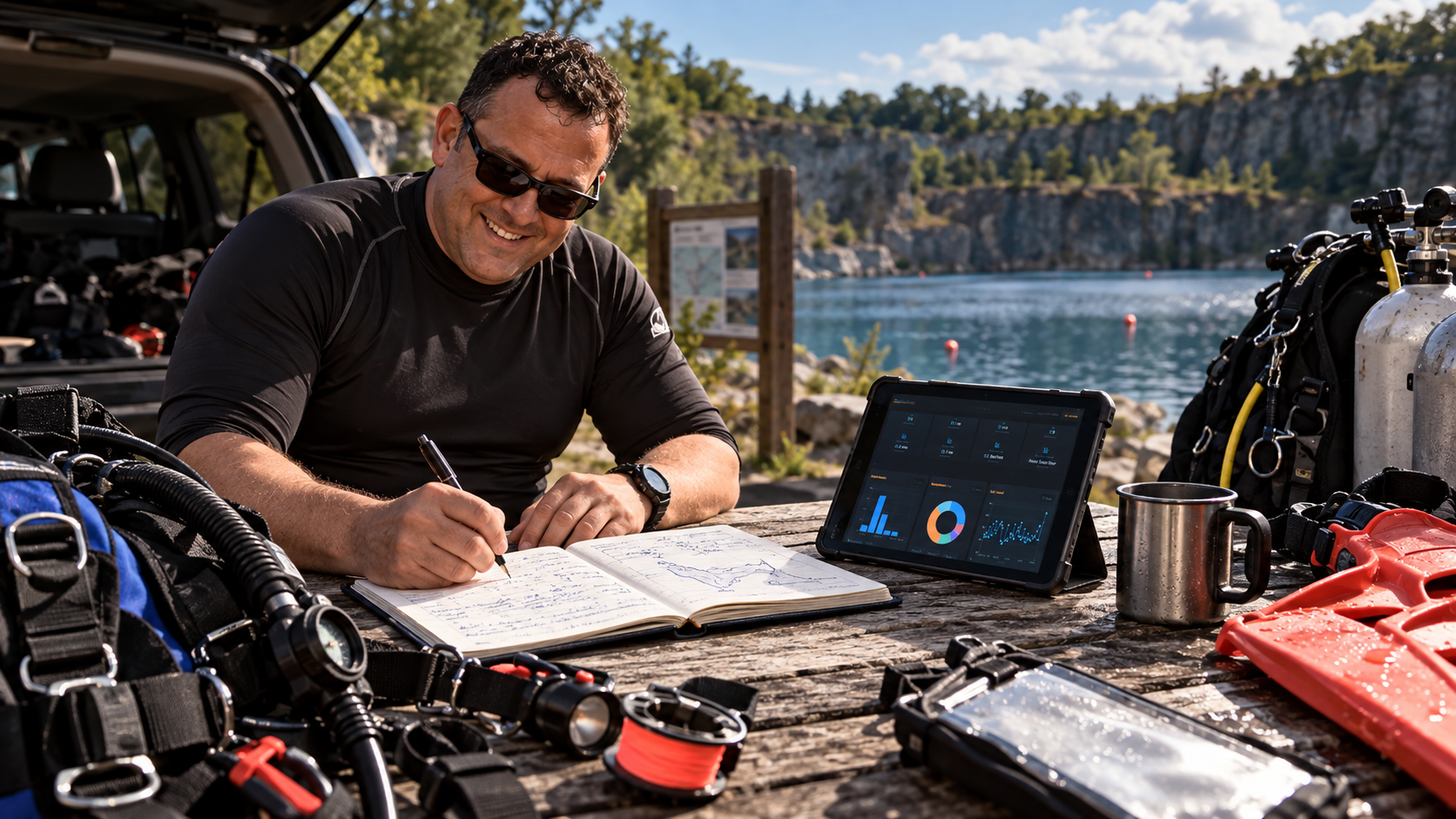
The other half of the system is the ZeusTek Diving WPA web app I have been building.
That is fast becoming the main repository for everything diving.
I can keep the individual dive records, equipment, cylinders, training, insights and planning in one place and then look across multiple dives instead of treating every log entry as an isolated memory.
That is where digital logging starts to become genuinely useful to me.
Depth and time are the easy bit
Maximum depth and dive time are obvious things to record, and of course they matter.
But by themselves they tell me very little about whether the dive was good.
I am interested in the context around those numbers: environment, activity, conditions, entry type, what I was wearing, what cylinder I used, weighting, what the dive was trying to achieve and why it ended.
Two forty-minute dives can be completely different workloads.
Gas becomes useful when it becomes a trend
I track gas because I want to understand how my breathing changes rather than beat myself up over one number.
A single SAC or RMV figure can be affected by depth, temperature, current, workload, stress, kit, fitness and what I was actually doing.
Once enough dives are in the system, the interesting question becomes whether there is a trend and what was different on the outliers.
That is much more useful than declaring one dive “good” and another “bad” because of a number.
I want to log the human factors as well
The parts I increasingly care about are often the least glamorous ones.
Was I tired before the dive?
Was there a lot of pre-dive faff?
Did I feel rushed?
Was I cold?
Did something keep stealing my attention?
Was there a decision I would make differently next time?
Those things are harder to reduce to a neat chart, but they are often where the most useful learning sits.
If a log only records the dive profile, it can miss the reasons the dive felt the way it did.
The point is not to collect numbers
I like data. That probably surprises nobody who knows me.
But I do not want to turn diving into a spreadsheet competition.
The purpose of collecting data is to help me see patterns, make better decisions and remember the actual experience.
If a metric does not help me learn, plan or reflect, it can very quickly become noise.
Paper first, analysis later
So my current workflow is deliberately a mixture of old and new.
Paper gives me the immediate reflection. The web app gives me the long-term memory and analysis.
I expect the digital side to keep growing because I am building it around the way I actually dive, but I do not see myself throwing the notebook away.
For me, a useful dive log should answer more than “where did I go?”
It should help answer “what did I learn, what changed, and what should I do differently next time?”
A dive becomes experience when I actually process it.
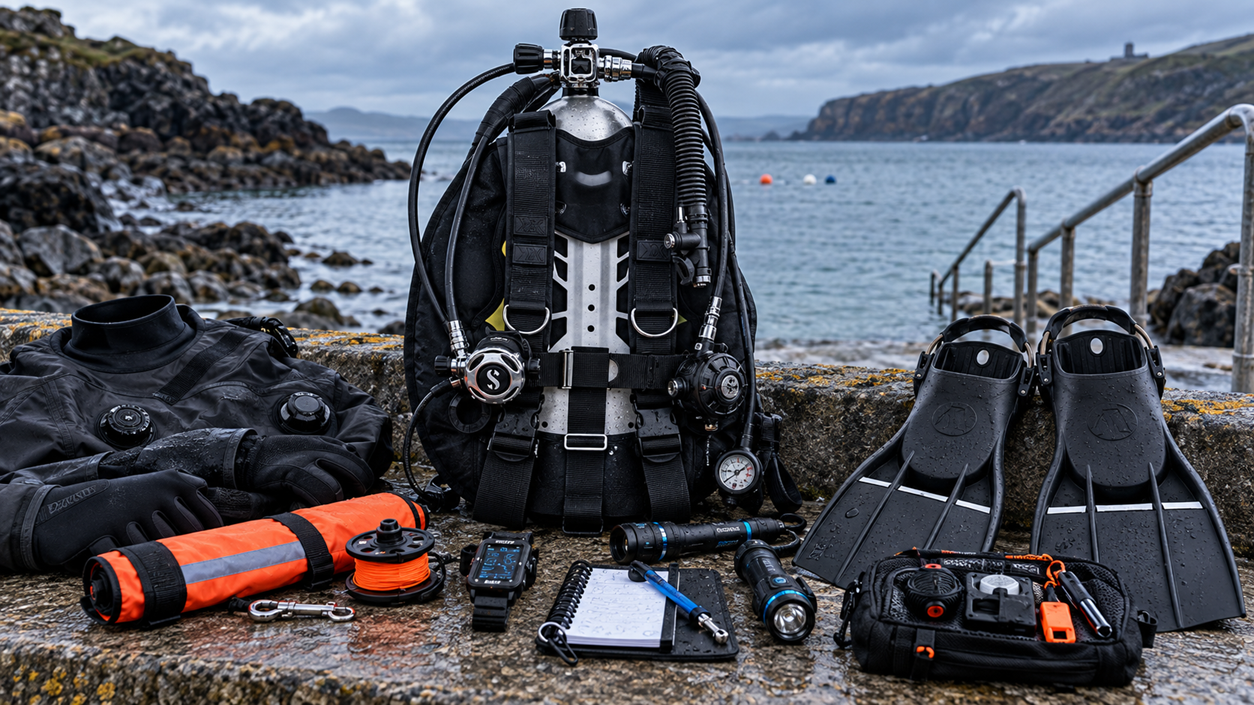
My equipment has slowly changed from “carry everything” to “everything has a reason and a home.”
My current dive setup looks very different from the gear configuration I started with.
Early on, I carried almost anything I thought might possibly be useful.
Slate.
Compass.
Knife.
Lights.
Beacon.
Multiple spools.
Multiple DSMBs.
Huge console.
If I owned it, there was a reasonable chance it was hanging off me somewhere.
These days I think about kit differently.
If I need it, it should have a reason for being there and a predictable place to live.
The foundation: XDEEP ZEN backplate and wing
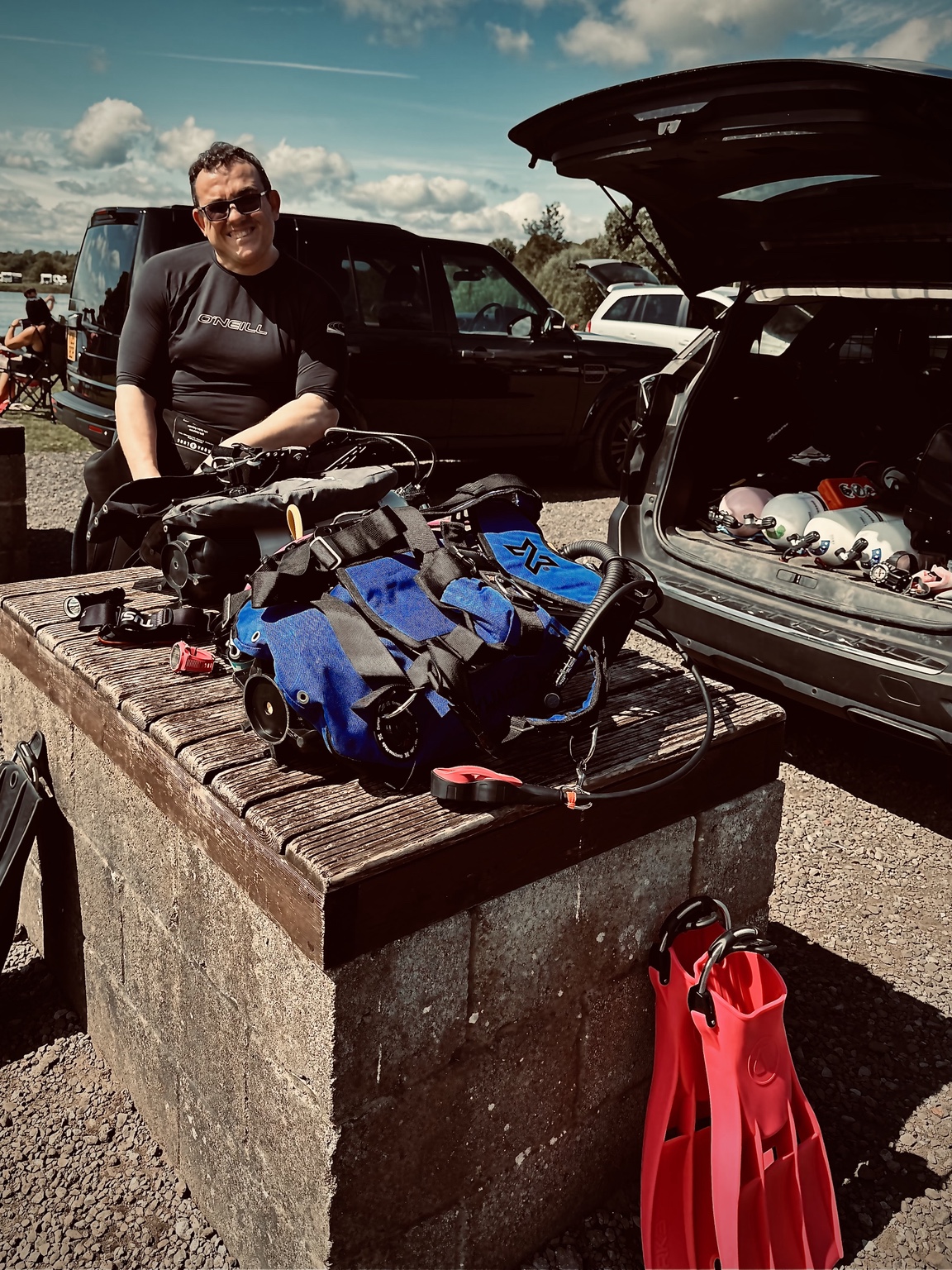
My normal backmount setup is built around an XDEEP ZEN wing with the ZEN NX aluminium backplate.
I chose aluminium because my diving is split between UK diving and trips that involve air travel.
It gives me the rigid platform I want without making airline luggage even more entertaining than it already is.
The biggest benefit is not that it looks technical.
It is that underwater I barely notice it.
Once the harness is adjusted properly and the weight comes off my back in the water, the system almost disappears.
That is exactly what I want from equipment.
Exposure protection depends entirely on the dive
I do not have one exposure setup that I try to force onto every environment.
For warmer diving I still enjoy being in a wetsuit.
In the Red Sea, I actually like feeling the water against my skin.
Depending on conditions, I have a 5 mm wetsuit, a 4 mm shortie and lighter thermal options.
For colder UK diving I use a drysuit.
I currently have a neoprene drysuit, although a custom trilaminate suit is high on my future purchase list because I want more mobility and less of the Maggie-Simpson-in-a-snowsuit experience.
I also have my 7 mm semi-dry, which still has a place.
The important thing for me is choosing the exposure protection that fits the actual conditions rather than automatically reaching for the biggest or warmest option.
Regulators: several options, one job
Over time I have ended up with a fairly substantial regulator collection.
My first stages include Scubapro MK25, MK17 EVO and additional MK25 EVO units.
Second stages include G260s, an A700, R380s, R190 and R105.
I do not carry all of them on every dive, obviously.
The advantage of having multiple regulator sets is being able to configure cylinders for different kinds of diving without constantly stripping everything apart.
As I move further towards sidemount and technical diving, that flexibility becomes increasingly useful.
Cylinders: this got out of hand quite quickly
I appear to have accidentally collected cylinders.
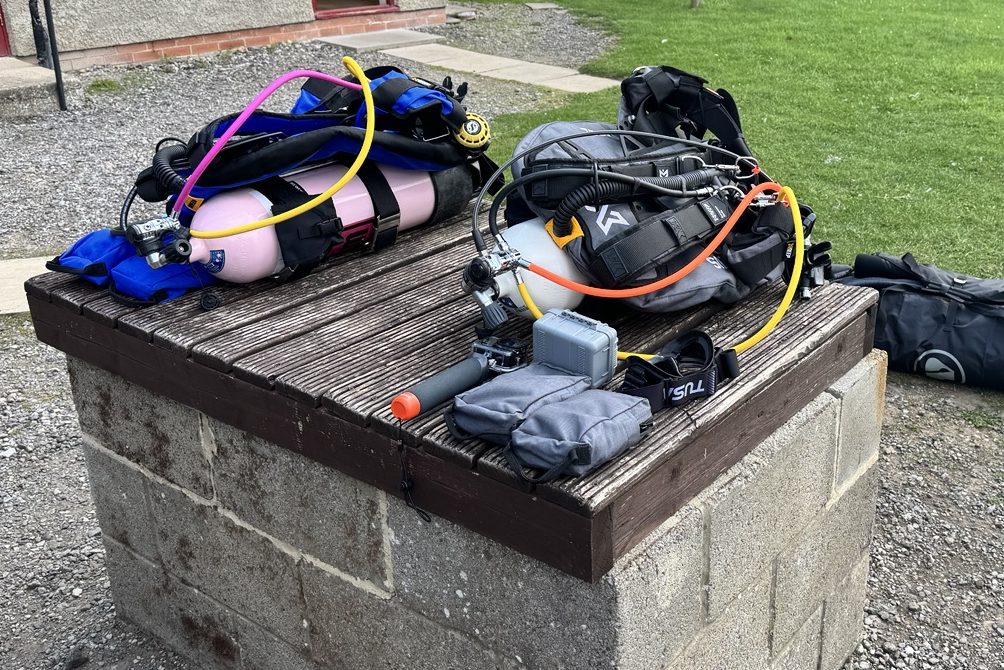
At the moment the collection includes multiple 12-litre steels, a 2 × 12-litre twinset, 10-litre stumpies, 7-litre cylinders, 5-litre cylinders, a 3-litre and a 2-litre.
There are also pony mounts and sidemount or cross-body options.
That sounds excessive until you start changing configurations.
A cylinder that makes sense as a normal back-gas cylinder is not necessarily the cylinder you want as a pony, stage or suit-inflation bottle.
The collection gives me options.
It also gives Gemma plenty of evidence whenever she wants to argue that my definition of “essential dive equipment” has become dangerously flexible.
Computers: information without becoming obsessed with screens
My current dedicated dive computer is an Aqualung i330R.
I also use an Apple Watch Ultra, with the Ultra 3 becoming part of the wider setup.
Longer term, I am looking at moving towards a more technical-capable dedicated computer with air integration.
The computer matters enormously, but I do not want to spend the whole dive staring at it.
Depth.
Time.
Gas.
NDL.
Deco information when that eventually becomes relevant.
I want those checks to become routine enough that I can process the information quickly and then get back to actually diving.
Lights depend on whether darkness is part of the problem
My main lights currently include an Orca D610 and Orca ZD710, along with several backup lights.
I also carry small blue and red Orca beacons when appropriate.
My redundancy changes with the dive.
On a night dive, I take a primary and two strong backups.
That means if the primary dies, I still move onto a proper light while retaining another backup.
On a normal daytime dive where a torch is only useful for looking into cracks for lobsters, I may take only one.
Redundancy should match the consequence of losing the item, not the size of the equipment cupboard at home.
My right pocket: things I expect to use
My right pocket is basically the utility pocket.
It contains the things I reasonably expect to reach for during the dive.
Wetnotes containing the dive plan or tables
Slate where required
Routine DSMB
Routine spool or reel
Second backup torch where appropriate
My first backup torch normally sits clipped to the right shoulder D-ring and is held neatly against the harness with a ranger band.
If I am doing a dive with lots of recording — a survey or conservation activity, for example — I may use a wrist slate instead.
My left pocket: safety and emergency kit
The left pocket is more about things I hope I do not need.
Spare mask
Safety spool
Yellow emergency SMB or lift bag where appropriate
Spare double-ender
CPR mask
Shears or cutting tool
Small multi-tool where appropriate
Waterproof personal ID card
I use a waterproof ID card containing a QR code.
It is not something I particularly enjoy thinking about, but if I am ever in a situation where I cannot identify myself, I find some comfort in knowing that there is still information available to help connect me back to my family.
DSMBs and spools: I may own slightly too many
My DSMB and spool collection has become fairly healthy.
I have multiple DSMBs, finger spools ranging from roughly 10 metres to 50 metres, and larger reels extending out towards 150 metres.
I also have surface buoys and flags.
But owning ten spools does not mean ten spools need to come on the dive.
Normally there is a routine DSMB and deployment spool, plus an emergency or safety option where the dive justifies it.
Everything else can remain in the bag until there is an actual reason to carry it.
Cutting tools should be reachable
I have never understood the point of carrying an emergency tool somewhere I cannot actually reach in an emergency.
A cutting device should be secure but accessible.
Shears and compact cutting tools make more sense to me than carrying something enormous simply because it looks impressive.
As with the rest of my setup, the important question is:
Can I reach it instinctively when I am stressed?
The £20 dive mirror
One of the cheapest pieces of equipment I have added has turned out to be surprisingly useful.
A small dive mirror.
I originally bought it before leading part of a St Abbs dive with Matthew behind me.
It meant I could glance into the mirror and check that he was still where I expected without constantly turning around.
It is also useful for doing my own bubble checks.
Twenty quid.
Tiny.
Hardly glamorous.
Very useful.
My fins and boots are deliberately boring
My main fins are black RK3s.
I also use different boots depending on the site and exposure setup, including Cressi rock boots and other dive boots.
That is one reason I am leaning towards socks rather than permanently attached boots when I eventually buy my trilaminate drysuit.
I want the ability to choose the boot for the environment rather than have the suit make that decision for me.
Hoods and gloves: UK diving’s glamour department
I have accumulated different hood and glove thicknesses — roughly 3 mm, 5 mm and heavier cold-water options.
Again, I would rather choose based on conditions than automatically wear the thickest thing I own.
My hands can be beautifully warm in a drysuit while my face feels painfully cold.
Nobody said UK diving was supposed to make complete sense.
Nitrox analyser
I carry my own NCR Nitrox analyser.
If I am going to breathe a gas mixture, I want to know what is actually in the cylinder rather than rely entirely on somebody else’s label.
That becomes even more important as I move further towards technical training and multiple-gas configurations.
First-aid and emergency equipment
My surface emergency kit has grown alongside my Rescue training.
I have a substantial EFR kit that includes items such as splints and general first-aid equipment.
An oxygen kit is another area I want to develop further.
This equipment obviously does not come underwater with me.
But it is still part of what I consider a complete dive setup.
The dive does not begin at the descent and it does not end at the safety stop.
I am still changing the setup
This is not a finished configuration.
I do not think it ever will be.
The next big changes are likely to come from sidemount, technical training and a trilaminate drysuit.
That will change where cylinders live.
It may change buoyancy strategy.
It will change gas planning.
Some equipment will move.
Some will disappear.
Some new items will undoubtedly arrive in suspiciously large cardboard boxes.
The important part is that the changes should solve problems rather than simply create a more impressive-looking equipment pile.
My rule for deciding what comes on the dive
I increasingly put equipment into three groups.
Needed for life support or safety
If losing it threatens the ability to safely complete the dive, I think seriously about redundancy.
Needed to complete the planned dive
This depends on the mission.
Night diving needs lights.
Surveys need recording equipment.
A lobster dive may need a torch but not three of them.
Nice to have
This is where I am much more ruthless now.
If I cannot explain what the item is doing for me on this particular dive, perhaps it can enjoy a relaxing afternoon in the dive bag.
One is none and two is one — sometimes
I like the basic redundancy principle of “one is none and two is one.”
But I do not apply it blindly.
Losing a primary light during a night dive is very different from losing the torch I was using to look underneath a rock at midday.
Redundancy should be related to consequence.
And carrying a backup is not enough.
I need to know where it is.
I need to be able to reach it.
I need to be able to deploy it without dropping something else.
That is why bolt snaps and bungee inside pockets matter.
A shiny backup reel is significantly less useful when it is slowly disappearing into the abyss.
Gear should reduce task loading
This is probably the principle connecting the entire setup.
I do not want equipment constantly demanding my attention.
The harness should fit.
The regulator should be where I expect it.
The backup torch should be reachable.
The DSMB should be in the same pocket.
Nothing should be dangling around underneath me.
If something fails, I should already know what comes next.
The more of that becomes automatic, the more attention I have available for the environment, my buddy and the actual reason I got into the water.
Final thought
My current kit setup is not the correct scuba configuration.
It is simply the configuration that currently works for me.
Gemma’s setup is slightly different.
Matthew’s will be different again.
And mine will almost certainly change as I move further towards sidemount and technical diving.
What matters more than any particular brand or piece of equipment is that I understand why it is there.
It should fit.
It should have a home.
It should solve a problem.
And ideally, once I am underwater, I should barely have to think about it.
Carry what the dive needs. Know where it lives. Let the kit disappear.
I thought backplate-and-wing systems were for technical divers. Then Gemma and I tried one — and everything started to feel simpler.
Like most divers, my first dives were in standard rental jacket-style BCDs.
That was just what diving looked like to me at the time. You rented the kit, strapped it on, jumped in, and got on with the dive.
When I later spotted a nearly-new Aqualung Axiom BCD, I snapped it up.
It was a perfectly good BCD.
I just never quite felt right in it.
Gemma was having a similar problem for a different reason. She has a larger chest and found jacket-style BCDs could become sore and uncomfortable after a few dives.
We had both heard of backplate-and-wing systems, but I originally filed them mentally under:
Technical diver stuff. Probably not for us.
That assumption did not survive very long once I started looking into them properly.
A reef-keeping road trip accidentally became a dive-kit purchase
Diving was not the only expensive hobby Gemma and I had managed to develop by this point.
Since starting scuba, we had also become reef keepers.
So one day we headed towards Manchester and Leeds to look around marine fish shops and, naturally, dive shops.
One of the places we stopped at was Robin Hood Watersports.
One thing led to another.
Then another.
And somehow both of us ended up ordering XDEEP ZEN backplate-and-wing systems.
They took roughly six to eight weeks to arrive.
By then it was early 2025 and far too cold for me to get excited about jumping straight into Ellerton — our local swamp.
Sorry.
Lake.
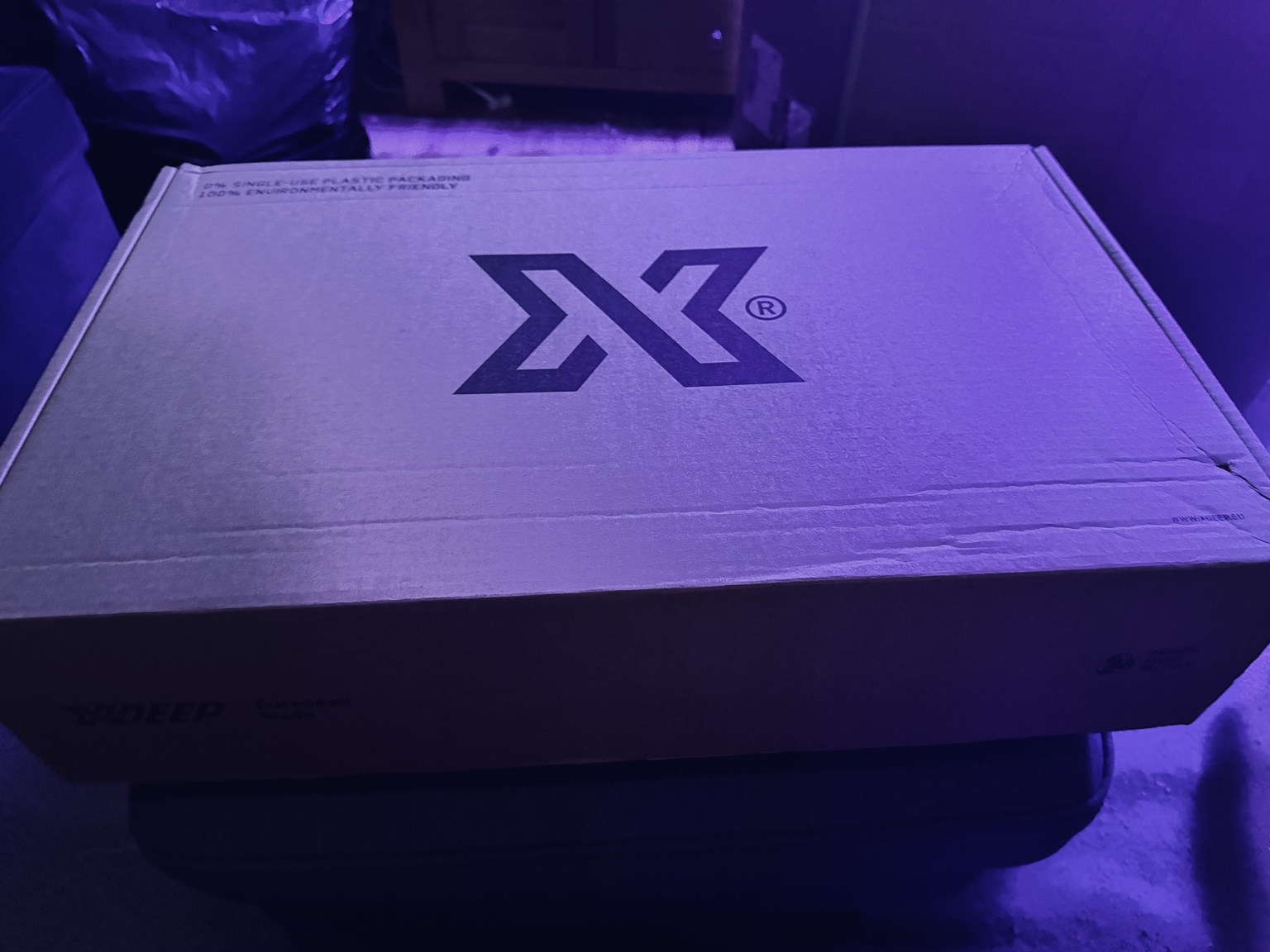
The boxes finally arrived
After weeks of waiting, the ZENs finally turned up.
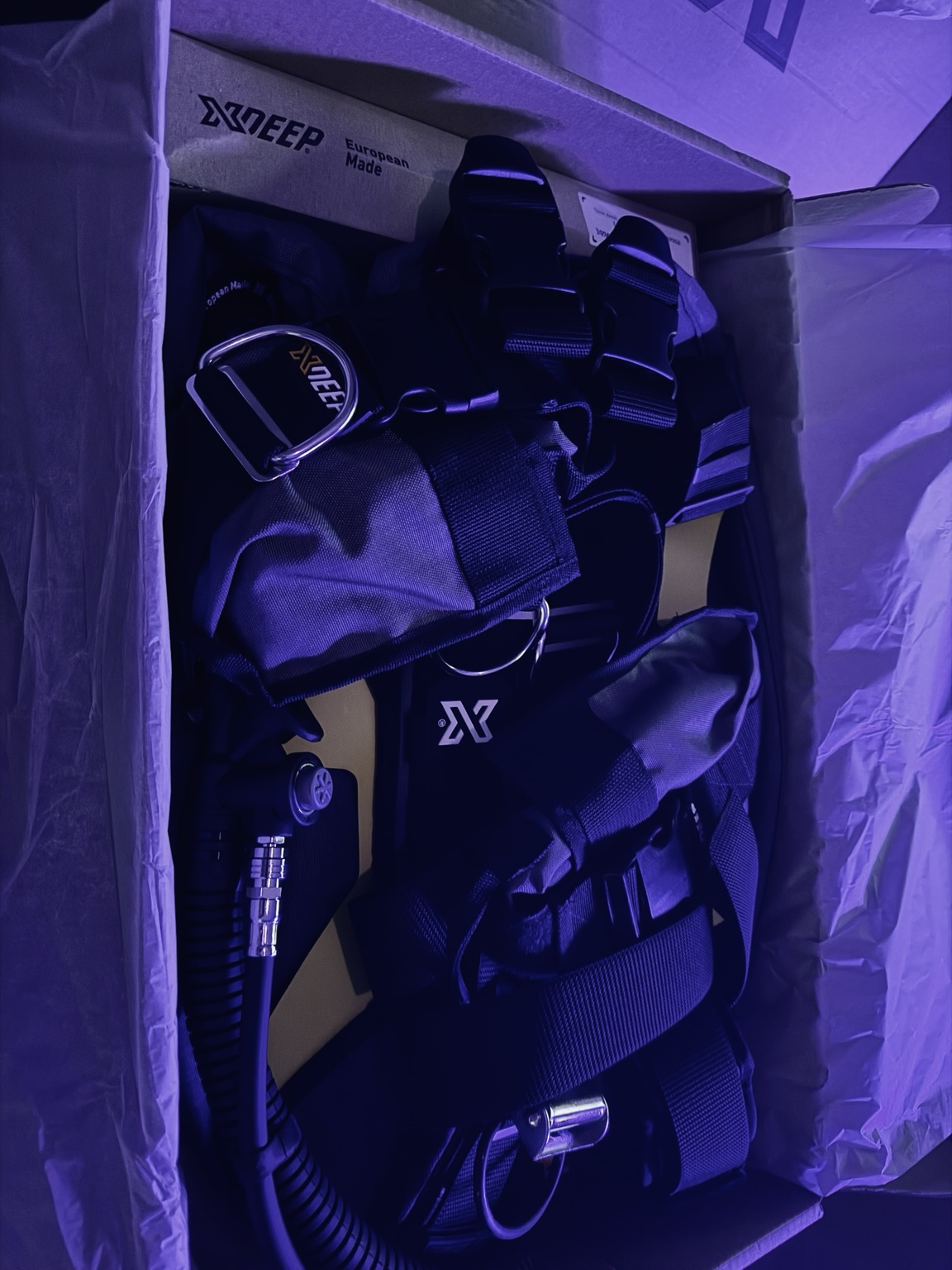
Unboxing them was probably the first point where the whole BP/W idea stopped being something I had been researching and became an actual piece of dive kit sitting in front of me.
And the first thing that struck me was how simple it all was.
Six to eight weeks of waiting condensed into one cardboard box.
First look inside — a lot less bulk than the jacket BCD I was used to.
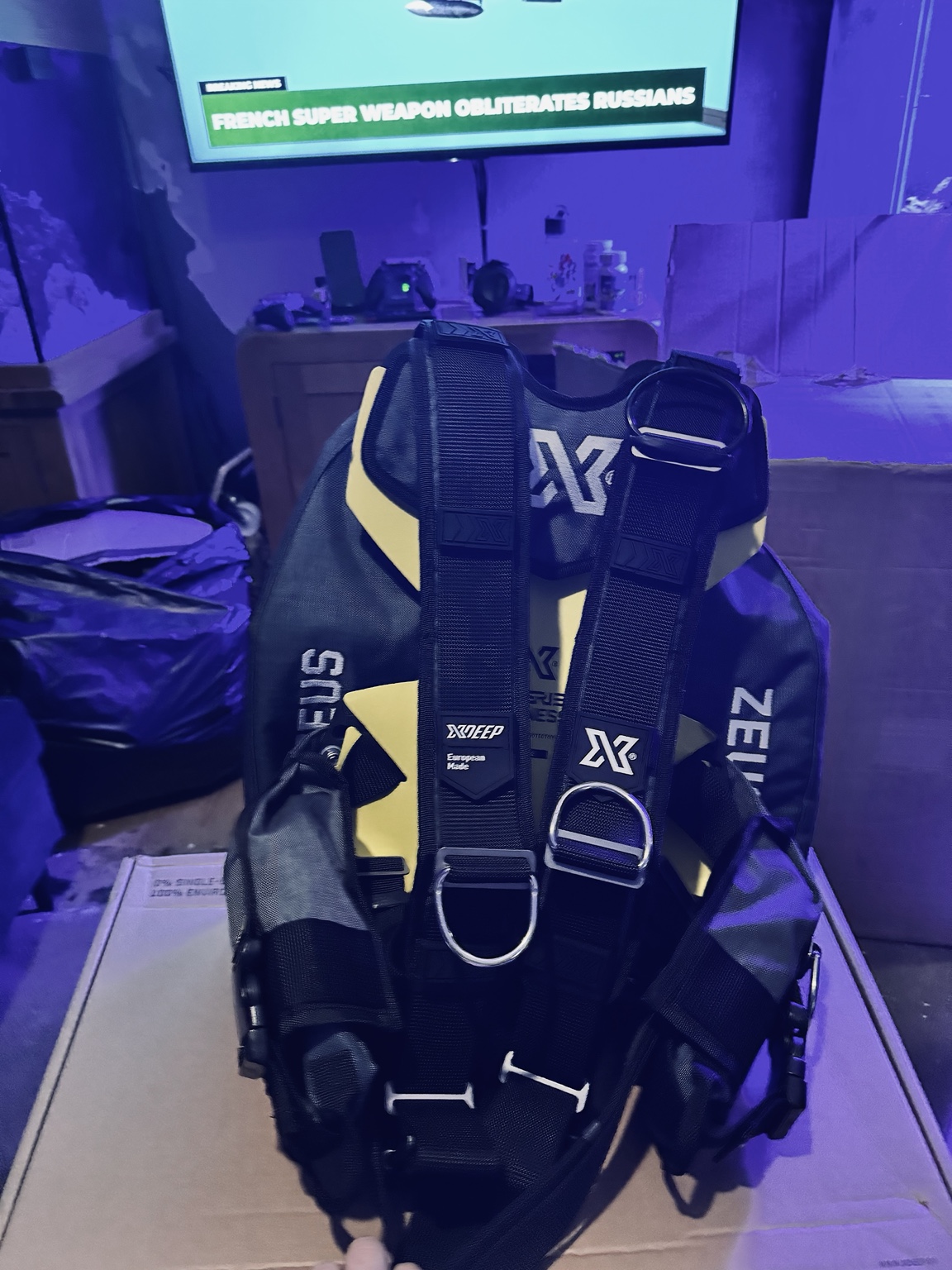
The harness looks technical at first glance, but it is really just webbing, hardware and a plate adjusted to fit you.
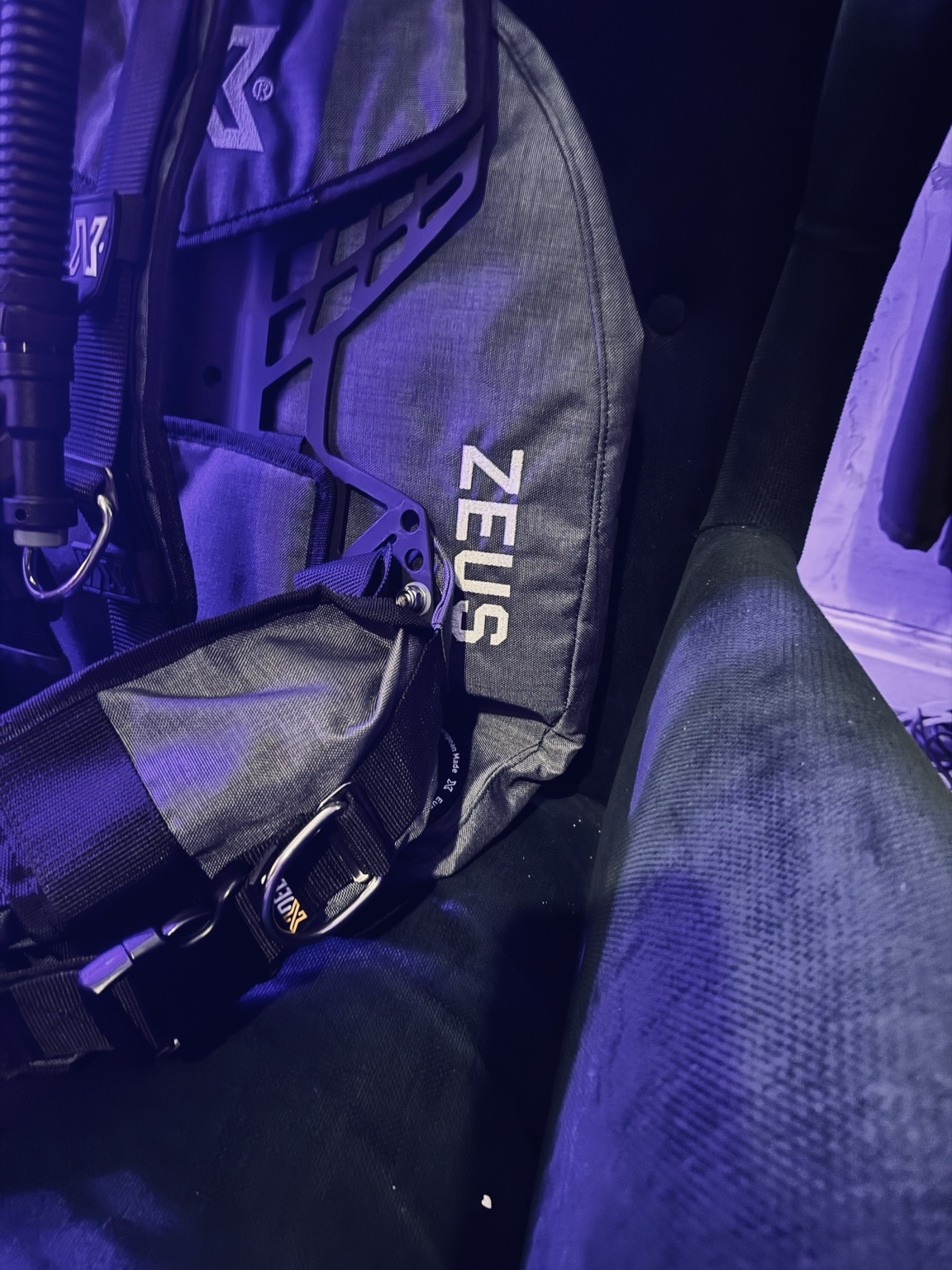
Looking at the side construction was when the modular nature of the system really started to make sense.
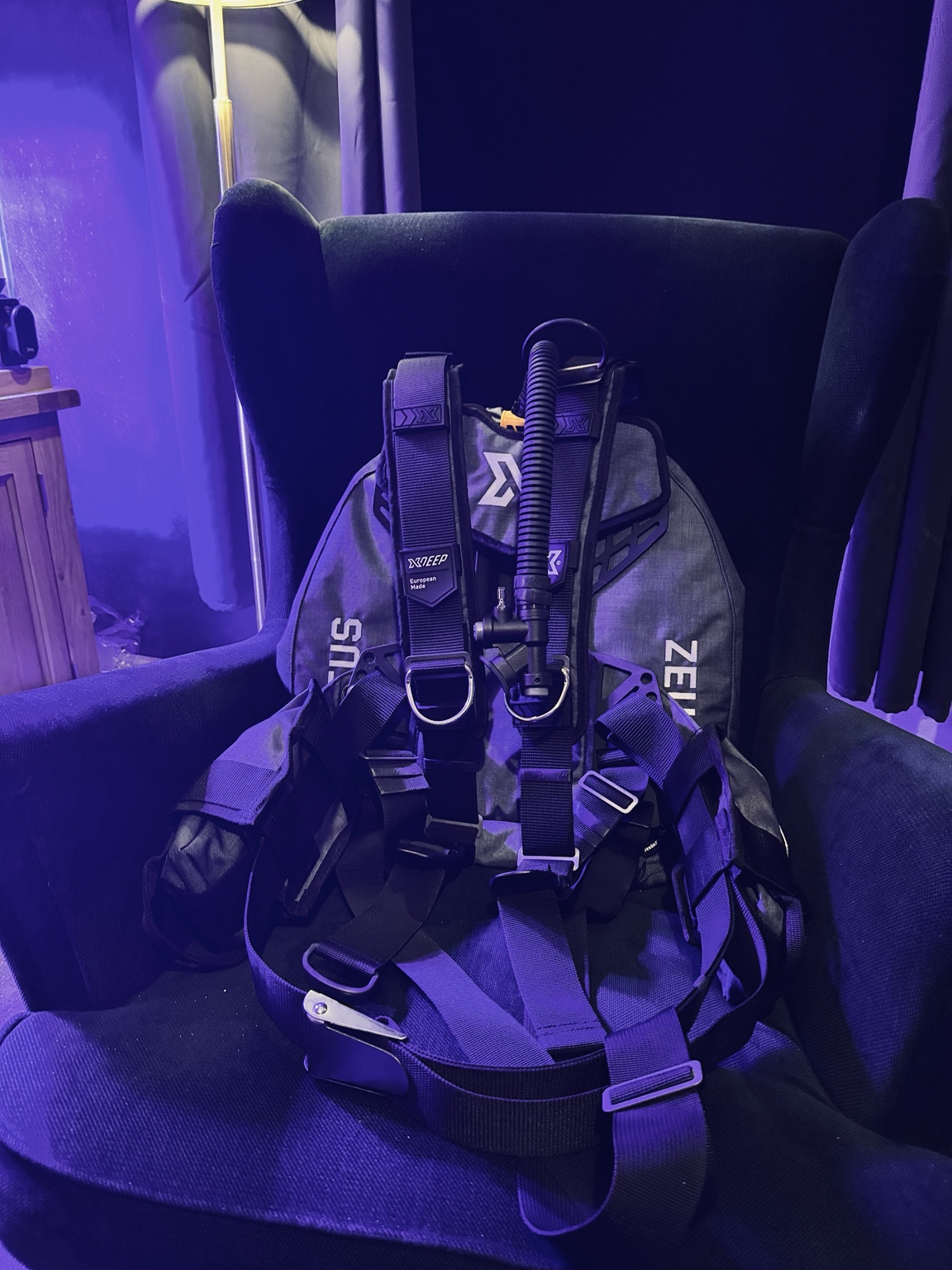
The assembled ZEN before its first dive — still looking complicated because it was unfamiliar, not because there was actually much to it.
That unboxing was also the beginning of me understanding one of the things I now like most about BP/W systems: individual parts actually look like individual parts.
Wing. Plate. Harness. Hardware.
Nothing particularly mystical.
So I hired a five-metre pool
Rather than wait for open-water weather, I hired the five-metre diving pool at our local swimming pool.
It cost about £50, with a lifeguard on standby.
For anyone testing a major new piece of dive equipment, I would genuinely recommend looking into whether you can do something similar locally.
A controlled pool is a much better place to discover that your harness is wrong, your tank is too high, or something is rubbing than halfway through an open-water dive.
Gemma and I put the rigs on, walked to the edge, and took a giant stride into the pool.
Almost immediately, both of us found ourselves naturally settling into horizontal trim.
We spent roughly an hour at five metres doing nothing particularly glamorous — just practising skills while neutrally buoyant and getting used to the rigs.
That session told us a lot.
What surprised me most was how quickly it disappeared
On land, you absolutely know the ZEN is there.
Once you add the backplate, cylinder, regulators, ballast and everything else, there is no pretending you are wearing a lightweight fashion accessory.
But the moment I get into the water and the weight comes off my back, the whole thing seems to disappear.
That is probably the biggest difference for me compared with a jacket BCD.
A jacket always felt like something I was wearing.
The ZEN feels like part of the configuration around me.
Once I am neutrally buoyant, I barely notice it.
Anything I no longer have to think about is one less thing competing for attention during the dive.
This is what I mean when I say the BP/W disappears into the background. Once it is fitted properly, there is remarkably little around me to notice or fight with.
From seahorse with a dive shop attached to sleek orca
Moving to BP/W also changed how I thought about everything else I was carrying.
In a jacket BCD, even if I managed to get myself horizontal, I could have a slate, compass, knife, small torch, flashing beacon, magnetic hose clips, multiple spools, multiple DSMBs and a huge SPG console all hanging underneath me.
I was basically a seahorse with a dive shop strapped to him.
The more I dived the ZEN, the more I started asking a different question:
What do I actually need for this dive?
Slowly, the dangling kit disappeared.
Now, if I need something, it has a proper home.
The goal is to move through the water more like a sleek orca and less like a mobile clearance aisle.
My pocket system
Tech pockets were one of the biggest insights for me because they forced me to think about what I actually expect to use and what is there for emergencies.
Right pocket — utility and routine-use kit
Wetnotes with dive plan or tables
Slate when needed
Routine DSMB and spool or reel
Second backup torch
My first backup torch is clipped to the right shoulder D-ring and held neatly in place with a ranger band.
If I am doing something with a lot of note taking — a site survey, PADI AWARE activity or similar — I may use a wrist slate instead.
Left pocket — safety and emergency kit
Spare mask
Safety spool
Yellow emergency SMB or lift bag where appropriate
Spare double-ender
CPR mask
Shears or other cutting tool
Multi-tool where appropriate
Waterproof ID card with QR code
My ID card is there for a reason I hope never matters.
If I am ever in a situation where I cannot tell somebody who I am, I take some comfort from knowing there is still a route back to my family.
Redundancy depends on the dive
I do not believe redundancy means carrying two of absolutely everything.
It depends on what is required to stay safe and what is actually needed to complete the dive.
On a night dive, for example, I take a primary light and two strong backups.
If the primary fails, I can move onto a proper backup and still retain another solid reserve.
On a daytime lobster dive, I may only take one light because losing that light does not remove my ability to complete the dive safely.
The important part is not simply carrying the backup.
I need to know exactly where it is and be able to retrieve it instinctively and safely.
That includes securing gear inside the pocket. A bolt snap and bit of bungee can stop your shiny new reel from disappearing into the abyss at precisely the moment you need it.
BP/W helps trim — it does not create skill
A backplate-and-wing makes it much easier for me to adopt a skydiver-style horizontal position.
But let us be clear about something.
You can absolutely wear a BP/W and still seahorse, bicycle-kick and happily work your cylinder down towards 50 bar.
It is a tool.
It does not magically give you core strength.
It certainly does not give you the glutes of a Kardashian.
Those things take time, practice and — if you are built like me — rather a lot of effort in the gym.
What the ZEN does for me is make good positioning easier to find and easier to maintain.
That leaves more attention available for the actual dive.
Advanced Open Water was when it really clicked
Our first dives after the pool shakedown were at Ellerton.
Those dives confirmed that the systems worked.
But Advanced Open Water was where the benefit really became obvious.
If I remember correctly, after the Navigation dive both Gemma and I were told that our trim was really good.
Then we were asked how many years we had been diving.
When we explained that our Open Water certification had only been the previous May, the reaction was basically disbelief.
At one point we were even asked if we were secretly PADI test shoppers.
It was funny, but it also confirmed something useful.
The BP/W had not magically turned us into good divers.
It had given us a setup that made good trim easier to maintain, which meant we could concentrate on navigation and the other skills instead of constantly correcting ourselves.
How we dive as a team
Gemma and I naturally settle into a fairly tight formation.
One of us leads and the other sits slightly offset, roughly a metre away and close enough that an arm’s-length movement puts us right alongside one another.
When Matthew dives with us, he takes the opposite side and we form a shallow V, with the point slightly ahead.
It keeps everyone visible without feeling crowded.
The BP/W did not invent that formation, but because Gemma and I are both stable and comfortable in trim, maintaining it feels natural.
Gemma’s verdict
Gemma loves her ZEN.
At this point, I think she would fight me to the death if I suggested we leave it at home and hire a jacket BCD on holiday.
Either that, or clothes would start disappearing from the suitcase until the BP/W fitted.
For her, moving away from the jacket also solved the discomfort around her chest that had helped start this whole search in the first place.
She has little interest in moving into decompression diving.
That matters because it proves the point: you do not need technical diving to be your destination for BP/W to make sense.
Jacket BCD vs backplate-and-wing — my experience
Area
Jacket BCD
Backplate & Wing
My take
Land comfort
Can be very comfortable depending on model
Depends heavily on harness choice
Close, but BP/W wins for me in hot climates because it is less enclosing
Travel
Usually bulky unless buying a dedicated travel BCD
Can be stripped down and packed very small
BP/W wins comfortably for me
Initial setup
Put it on and adjust a few straps
Needs proper initial fitting
Jacket BCD wins at first
Pockets
Often comes with two large built-in pockets
Often comes with none
BCD wins out of the box — two massive bags of holding
Weight distribution
Usually centred around integrated or belt weight
Plate, P-weight, trim pockets and dumpable ballast can all be used
BP/W wins by a long way for me
Trim
Absolutely possible with good setup and skill
Feels naturally easier for me
BP/W wins personally
Donning and doffing
Generally simple and familiar
Can take more practice, especially the crotch strap
BCD is easier initially
Repairability
Can depend heavily on manufacturer and construction
Modular wing, bladder, harness and plate
BP/W wins for long-term maintainability
Customisation
Mostly fixed by manufacturer
Highly configurable
BP/W wins
Weighting is more interesting than it first appears
At first glance, you might assume a jacket BCD is automatically lighter.
Sometimes it is.
But the more useful question is how you want the total ballast distributed once you are correctly weighted.
You do not necessarily need 100% of your ballast to be ditchable.
When properly weighted, removing even a relatively small amount should make you positively buoyant without turning the ascent into a Polaris missile launch.
A BP/W gives you a lot of freedom in where the weight goes.
You can choose different backplate materials, add P-weights behind the plate, use trim pockets, integrated dumpable pockets or a traditional weight belt.
Moving some ballast closer to the centre of the body can also help tune trim.
I chose aluminium because my diving is roughly a 60/40 split between UK diving and destinations that involve getting on an aircraft.
Aluminium gives me the structure I want without adding too much luggage penalty.
If nearly all my diving was cold-water UK diving, I would look much harder at stainless steel because the plate itself could replace some ballast.
The crotch strap and the hip thrust
Jacket BCDs are generally easier for people to get in and out of initially.
With a BP/W, the crotch strap is often the bit that catches people out.
Once I found the correct hip-thrust motion, however, I discovered I could both make the ladies blush and flick the strap forward far enough to grab it.
Gemma sometimes gets me to grab hers for her.
That does highlight a genuine consideration though.
Somebody with reduced mobility may struggle to retrieve their own strap and may not feel comfortable asking a buddy to do it.
Harness choice and buddy familiarity matter.
Myths I tested for myself
“BP/W is only for technical divers.”
That was my own assumption before buying one.
It is simply not how I see it now.
BP/W can support technical progression, but it works perfectly well for ordinary recreational diving too.
“It will push you face-down on the surface.”
I had heard this often enough that Gemma and I deliberately tested it.
Neither of us has experienced this supposed unavoidable face-plant effect, even when deliberately over-inflating the wing.
What I have noticed is that I generally sit slightly lower than some divers in jacket BCDs.
I have seen jacket users sitting with the water below their rib cage. The ZEN normally holds me around mid-chest.
I am perfectly happy with that.
Surface swimming on my back is particularly easy.
You can quite often find me floating face-up before a dive, staring at the sky and generally refusing to be productive.
“BP/W is too complicated for recreational diving.”
This is probably the myth that makes the least sense to me now.
A basic BP/W is extremely simple.
Plate. Wing. Harness. Cam bands. Cylinder.
That visual simplicity can make it look more technical, but stripped back is exactly what makes the system simple.
“They are uncomfortable.”
That depends on the harness, your body and whether it has actually been fitted correctly.
There are now recreational harness systems with padding, quick releases and cinching straps if that is what you prefer.
You do not have to earn some imaginary badge of honour by using a harness you dislike.
Who should not rush out and buy one?
I would not automatically make BP/W somebody’s first big equipment purchase.
You need to know that diving is probably going to become more than the occasional holiday activity.
If you only do a handful of warm-water dives each year, hiring a good jacket BCD may be the easier and more sensible choice.
A BP/W starts to make more sense when you know you want to dive regularly, refine your trim, travel with your own configuration, customise your setup, or perhaps move further into advanced or technical diving.
Buy it because it solves a problem or supports the diver you are becoming.
Do not buy one because somebody on the internet told you that “proper divers” use them.
A practical first BP/W setup
Component
Starting point
Backplate
Aluminium for lighter travel-focused use; stainless steel if you want more ballast built into the system
Wing
Donut-style wing sized for the cylinder and exposure protection you actually use
Harness
Either a one-piece Hogarthian harness or a recreational-style harness with quick releases and padding — choose what feels comfortable
Crotch strap
Use one. It keeps the plate stable and stops the system riding up
Cam bands
Two good-quality bands securing the cylinder properly
Single tank adapter
Use one if your chosen plate/wing combination requires it or if it improves cylinder stability
Basic fit checkpoints
Shoulder straps loose enough to slide a fist underneath
Shoulder D-rings around collarbone/armpit level
Waist buckle slightly right of centre
Crotch strap snug rather than restrictive
Crotch D-ring roughly a hand-width above the bottom of the plate
Top of the plate sitting just below the C7 vertebra at the base of the neck
You should be able to reach back and touch the upper plate area with both hands
Harness choice: use what works for you
I do not think there is any point telling somebody they must use a one-piece Hogarthian harness if they hate wearing one.
Recreational harnesses with shoulder padding, quick releases and cinching straps can make the move from a jacket BCD feel much more familiar.
If you later decide you want to try a continuous one-piece harness, the change does not necessarily cost much.
The replacement XDEEP webbing I found was around £15.
So starting with the more familiar harness and experimenting later is perfectly reasonable.
Fit and comfort matter more than proving you can tolerate a particular harness style.
Do the first shakedown almost naked
Not literally.
Please keep your exposure protection on.
What I mean is: do not immediately bolt every pocket, torch, reel, camera and accessory you own onto a brand-new BP/W.
Dive the basic system first.
If possible, use a pool.
Leave the pockets and unnecessary extras off and concentrate on fit, trim, tank position and whether anything is restricting movement.
If you can stick an action camera on the pool wall and record the whole session, even better.
Watching yourself afterwards can tell you far more about how the configuration is behaving than trying to judge everything purely from how it felt.
Then make tiny adjustments
Neither mine nor Gemma’s ZEN was fitted once and then declared finished forever.
We have both adjusted them a few times.
The changes are small now.
Harness length, plate position, how something sits or where a piece of equipment lives.
The aim is simply to remove more friction.
Once the big decisions are right, you are sanding off the little annoyances until the system becomes increasingly invisible.
Does BP/W mean technical diving is next?
It can be a useful stepping stone.
For me, the ideas of streamlining, modularity, deliberate equipment placement and trim have fed naturally into my interest in sidemount and technical diving.
But that does not mean technical diving has to be the destination.
Gemma is a perfect example.
She has little or no interest in moving into decompression diving and still absolutely loves her ZEN.
For her, it is simply the equipment that fits her better and works for the recreational diving she wants to do.
Equipment should support the diver you are.
It should not force you towards somebody else’s idea of what your diving should become.
Final thought
Some divers will resist anything that feels new in recreational diving.
I am still not entirely sure where the idea that a backplate-and-wing automatically pushes you face-first into the water came from.
What mattered to me was testing it.
Gemma and I got into a controlled pool, used the equipment, practised with it, then took it into open water and kept refining it.
For us, it worked.
The more I dive it, the more it disappears into the system.
The harness fits my body. My equipment has a home. Nothing dangles. Trim takes less thought. The whole configuration creates less friction.
That is probably the biggest lesson I have taken from moving to BP/W.
Good dive equipment should not constantly remind you that you are wearing it.
But I am not going to tell every diver to throw away their jacket BCD.
For somebody else, that jacket may be the system that fits perfectly and disappears into the background.
As with all gear: test everything and choose what disappears into the background for you.