
Dive Journal • Reflection • ZeusTek Diving
What I’m Tracking in My Dive Log — and Why
I want my log to tell me more than where I went and how deep I got.
I still start with paper
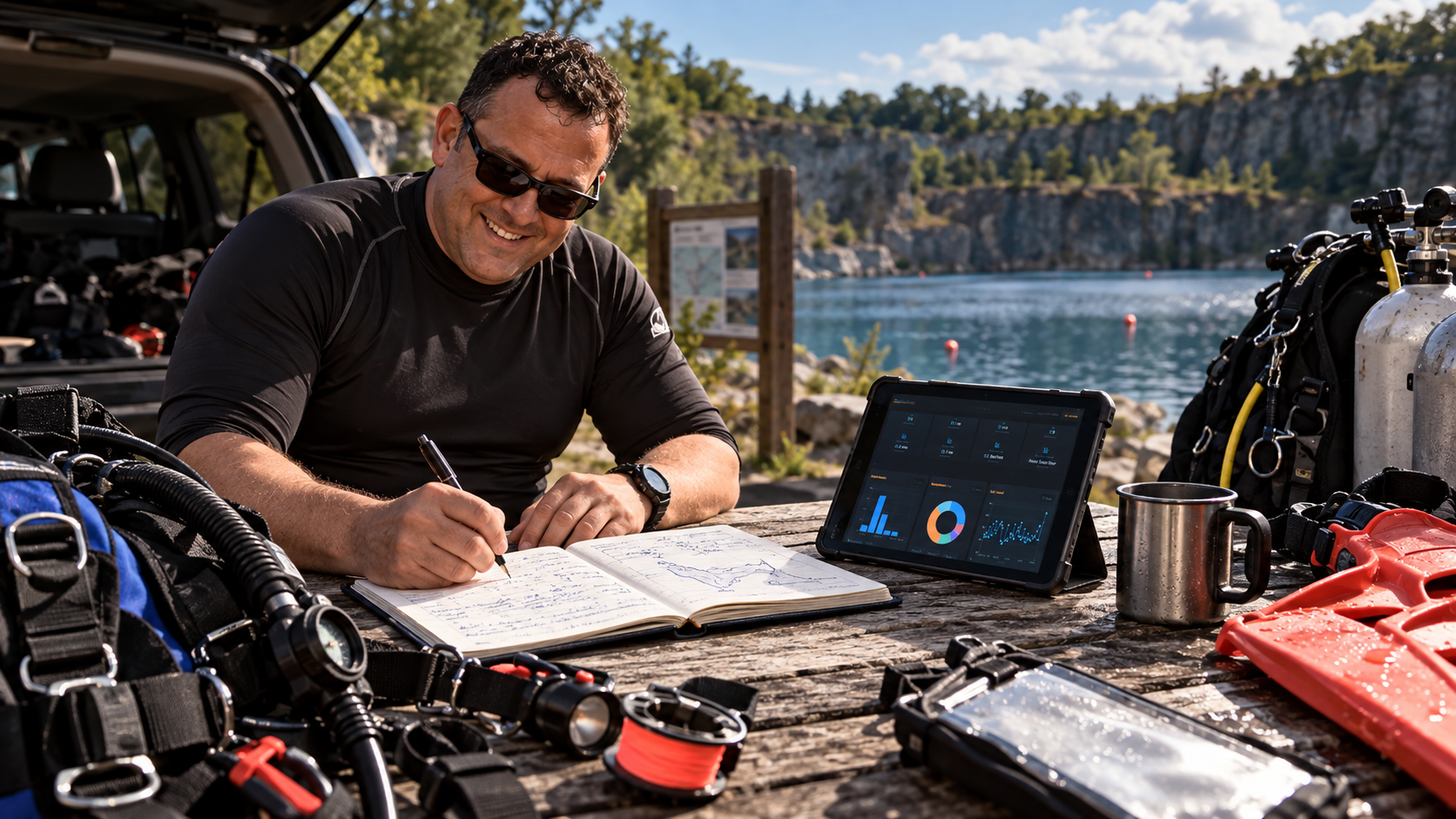
I have built a fairly serious digital home for my diving, but immediately after a dive I still like writing things down on paper.
There is a reason for that.
The act of writing forces me to slow down and replay the dive in my head. What did I see? What felt good? What felt untidy? Was there a moment where I was overloaded? Did I use more gas than expected? Was the weighting right? Did the entry cost more energy than it should have?
If I only tap a few numbers into an app, it is easy to record the dive without really processing it.
Writing it by hand gives me one more pass through the experience while it is still fresh.
The paper log is not just storage. For me, writing is part of the debrief.
The app is becoming the main repository
The other half of the system is the ZeusTek Diving WPA web app I have been building.
That is fast becoming the main repository for everything diving.
I can keep the individual dive records, equipment, cylinders, training, insights and planning in one place and then look across multiple dives instead of treating every log entry as an isolated memory.
That is where digital logging starts to become genuinely useful to me.
Depth and time are the easy bit
Maximum depth and dive time are obvious things to record, and of course they matter.
But by themselves they tell me very little about whether the dive was good.
I am interested in the context around those numbers: environment, activity, conditions, entry type, what I was wearing, what cylinder I used, weighting, what the dive was trying to achieve and why it ended.
Two forty-minute dives can be completely different workloads.
Gas becomes useful when it becomes a trend
I track gas because I want to understand how my breathing changes rather than beat myself up over one number.
A single SAC or RMV figure can be affected by depth, temperature, current, workload, stress, kit, fitness and what I was actually doing.
Once enough dives are in the system, the interesting question becomes whether there is a trend and what was different on the outliers.
That is much more useful than declaring one dive “good” and another “bad” because of a number.
I want to log the human factors as well
The parts I increasingly care about are often the least glamorous ones.
- Was I tired before the dive?
- Was there a lot of pre-dive faff?
- Did I feel rushed?
- Was I cold?
- Did something keep stealing my attention?
- Was there a decision I would make differently next time?
Those things are harder to reduce to a neat chart, but they are often where the most useful learning sits.
If a log only records the dive profile, it can miss the reasons the dive felt the way it did.
The point is not to collect numbers
I like data. That probably surprises nobody who knows me.
But I do not want to turn diving into a spreadsheet competition.
The purpose of collecting data is to help me see patterns, make better decisions and remember the actual experience.
If a metric does not help me learn, plan or reflect, it can very quickly become noise.
Paper first, analysis later
So my current workflow is deliberately a mixture of old and new.
Paper gives me the immediate reflection. The web app gives me the long-term memory and analysis.
I expect the digital side to keep growing because I am building it around the way I actually dive, but I do not see myself throwing the notebook away.
For me, a useful dive log should answer more than “where did I go?”
It should help answer “what did I learn, what changed, and what should I do differently next time?”
A dive becomes experience when I actually process it.