Training Notes • UK Diving • Drysuit
Drysuit Lessons from UK Diving
Warm underwater, awkward on the surface, occasionally resembling Maggie Simpson — and one of the most useful skills I have added to my diving.
Drysuit diving feels very different from the diving I originally fell in love with.
In the Red Sea I love feeling the water against my skin. There is something about warm water, a thin wetsuit and that direct connection with the environment that I would not want to give up.
So I do not see myself becoming somebody who wears a drysuit everywhere simply because I own one.
For me, a drysuit is primarily a UK diving tool and, increasingly, something I can see becoming part of my future technical diving.
What it has already done is make me a more adaptable diver.
Comfortable underwater, strange on the surface
Underwater, I find a drysuit surprisingly comfortable.
On the surface, it still feels slightly odd.
There is gas moving around the suit, material around your body, valves to think about and a completely different relationship between your body position and buoyancy.
The interesting part is that once I am horizontal underwater, the classic technical-diving trim position actually feels more natural to me in a drysuit.
In a wetsuit I sometimes feel as though I am actively holding that position. In the drysuit, when the gas is where I want it, I can relax into it.
Of course, understanding that and actually mastering it are two different things.
I understood the basic drysuit buoyancy surprisingly quickly, probably during the first 60-minute pool session. I can still have moments, though, where my trim makes me look like a newborn horse discovering legs.
Then again, I am not convinced anyone ever completely masters diving. Mother Nature — or an unexpectedly territorial triggerfish — always seems ready to remind us that we are not actually fish.
Learning to control the bubble
One of the biggest differences is learning that your whole body becomes part of the buoyancy system.
Gas moves. Your feet move. Your shoulders move. Your body angle changes where that bubble wants to go.
That means thinking ahead and acting slowly.
Go slow. Stop. Think. Assess. Act. Pause. Repeat.
Pressing the inflation button on your chest does not instantly stop a descent. Buoyancy takes a moment to respond. If you wait until you are already moving quickly before doing something, you are reacting late.
Small inputs, patience and letting the gas move have become much more important to me.
The inverted-recovery skill, incidentally, was far easier than I expected. It is one of those skills that sounds wonderfully dramatic before you actually practise it.
Cuff dump versus shoulder dump
My first drysuit was a rental and had a cuff dump.
Personally, I found it much more awkward than a shoulder dump. Once I had experienced both, the shoulder valve made far more sense for the kind of diving I want to do.
That experience has already influenced what I am looking for when I eventually buy my own suit.
A convenience zip is another feature that quickly moved into the “yes please” category.
A pee valve, on the other hand, is very definitely not on my personal wish list.
Warm body, painfully cold face
One of the funniest contrasts on my first open-water drysuit dives was temperature.
My body and hands could be so warm that I was sweating, while my face felt painfully cold.
Welcome to UK diving.
I also discovered that more insulation is not automatically better for me.
Some of the very thick 400-weight undersuits can be so bulky that, combined with a rental drysuit, simply getting fins on and off becomes an exercise in flexibility that I apparently did not sign up for.
I naturally run quite warm. My Scubapro thermal one-piece is currently enough for me in many conditions.
It may not be the sexiest item of dive clothing ever created. Gemma may laugh at me in it, but she still loves her big bear.
Nineteen kilograms was a lesson
My first open-water drysuit dive also taught me rather a lot about weighting.
Including my backplate, I was given around 19 kg.
For comparison, I normally use around 10 kg in my 7 mm semi-dry. Depending on the drysuit, I now know I am generally somewhere around the 11–14 kg range.
At 19 kg, holding a two-minute hover around 11 metres was considerably harder than it needed to be because I had to carry and manage a much larger gas bubble.
That was probably one of the clearest demonstrations I could have had that overweighting does not simply mean “you sink more easily.”
You have to compensate for that weight with gas, and now you have more gas moving around the suit as well.
Everything becomes busier.
Then came the St Abbs exit
Getting into the water with all that weight was hard work.
Getting back out at St Abbs with a one-to-two metre swell and a rocky exit was something else entirely.
Somebody tried to help me out of the water and grabbed the corrugated inflator hose on my XDEEP NX ZEN.
Anyone who dives a wing can probably already see where this is going.
The hose came off.
I went back underwater.
And I came back up with a wing that now contained rather more North Sea than XDEEP probably intended.
At that point subtle technique gave way to brute force and I hauled myself over the boulders and out of the water.
I may have looked as though I was about to collapse, and I managed to cut my nose on the way out, but that is UK shore diving for you.
I promise it is worth it.
Help is useful when everybody knows how to help
I did not blame the person who grabbed the hose. He was trying to help.
While I was doing the field repair before our second dive, we had a chat about safer places to grab somebody wearing a wing.
For my setup, the cylinder valve or my shoulder straps are far better places to get hold of me.
I thanked him for trying.
That matters to me. Reporting or discussing a problem does not have to mean assigning blame. If something happens, understand why, explain it, fix what needs fixing and make the next attempt better.
The weight does not disappear when the dive ends
Another thing UK diving has taught me is that physical workload starts long before you descend and continues after you surface.
A steel cylinder can still weigh around 14 kg when empty. Add your ballast, backplate, wing, regulators and the rest of the kit and you can find yourself trying to leave the water carrying the equivalent of an extra child across your back and hips.
Dropping removable weight pockets or a belt once you are safely onto the upper rocks can make an enormous difference.
I have also bought a gear trolley.
Walking 600 metres fully kitted after an early start and a two-to-two-and-a-half-hour drive to the dive site is simply wasting energy that I would rather have available for the dive.
I much prefer boat diving.
To be fair, I prefer boat diving in tropical water too, so at least I am consistent.
Doing the course with Matthew
One of the best parts of the drysuit course had nothing to do with valves, weighting or buoyancy.
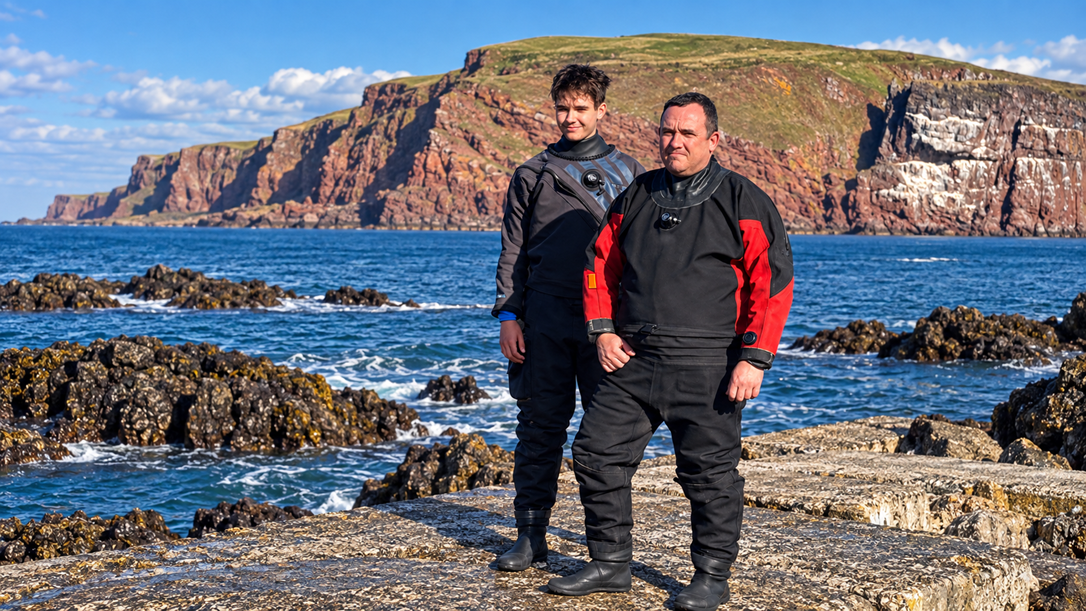
I did it with my son, Matthew.
He was doing his Advanced Open Water at the same time and only had around 15 dives, so he was much less experienced than me.
He can also be a fairly typical teenager and occasionally needs instructions repeated before they penetrate the force field surrounding a teenage brain.
But I was confident he would be fine, and doing the course together turned it into a genuine father-and-son experience.
It was also good for him to see me diving rather than simply hear me talking about it.
Leading with one eye behind me
During part of the St Abbs dive I got to lead.
I was proud to have Matthew behind me, but I was not simply swimming ahead and assuming everything was fine.
I had recently bought a small dive mirror for about £20, and it has become one of those pieces of kit that punches well above its price.
While leading, I could glance at the mirror and keep an eye on Matthew without constantly turning around.
It is also useful for doing my own bubble checks.
Twenty quid. Tiny bit of kit. Surprisingly useful.
“Natural navigation, my son”
Matthew was slightly confused afterwards about how I knew where I was going.
I jokingly told him:
It is living on the east coast and natural navigation, my son.
There was a real lesson underneath the joke.
We knew roughly where land was. On the outward leg the rock formation had been on our left, so on the return it needed to be on our right as we swam back through the kelp towards the exit.
It was simple out-and-back navigation.
But it was nice that Matthew was seeing how observation on the way out becomes information you can use on the way home.
Matthew’s first UK sea dive
That dive was also Matthew’s first time diving in the sea in the UK.
Until then his sea diving had been in the Red Sea. Gemma and I had only taken him to Capernwray for the first time the week before.
Then suddenly he was underwater at St Abbs.
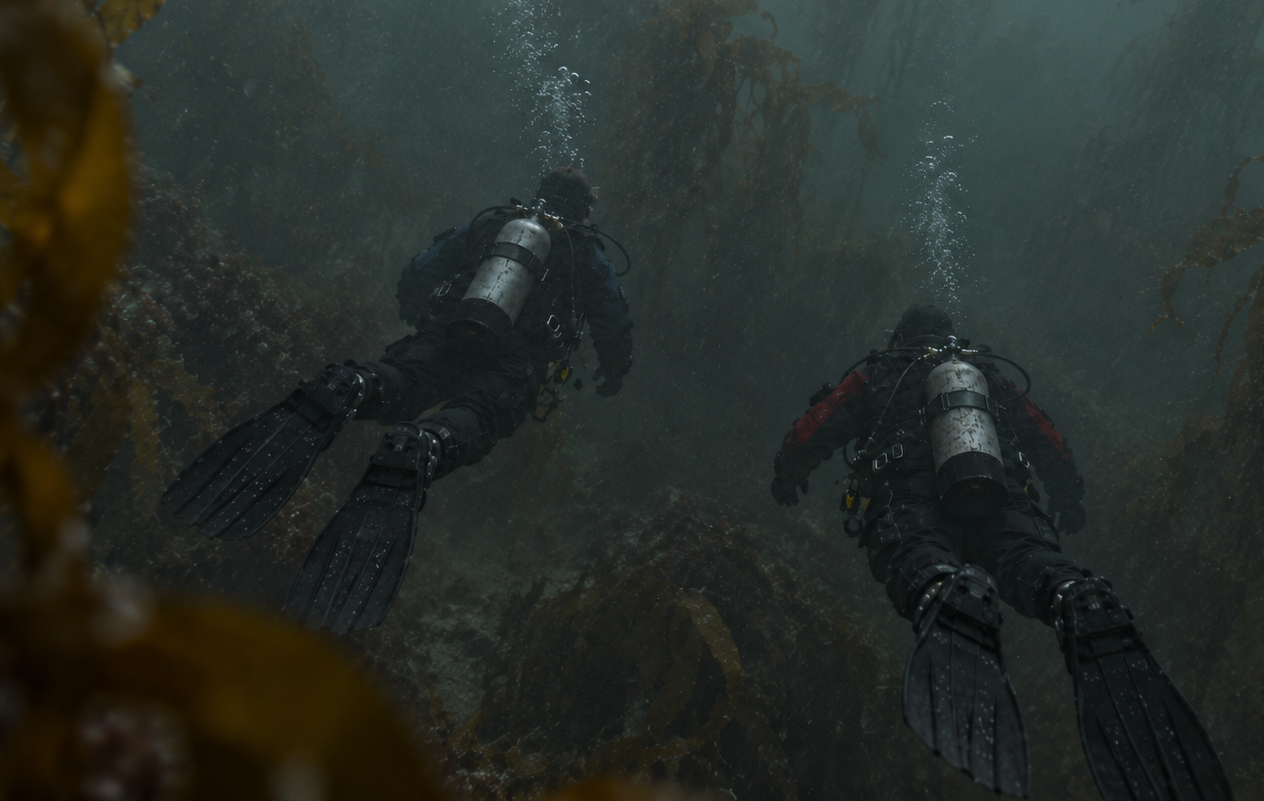
We swam through kelp around three metres tall, forming what felt like an underwater forest, with lobsters peering out from cracks and crevices in the rock faces.
We might not have clownfish, but the North East coast is absolutely teeming with life.
Some of it looks as though somebody populated another planet with strange underwater aliens and forgot to tell the rest of us.
Watching Matthew experience that for the first time made the dive even better.
What I want from my own drysuit
Buying my own trilaminate drysuit is one of my next big equipment purchases, so I am now asking much more specific questions than I would have before the course.
If I can afford it, I am leaning strongly towards custom made.
Mobility is the biggest reason.
Some bulky neoprene and rental combinations leave me feeling a little like Maggie Simpson in the early Simpsons episodes, wrapped in her enormous orange snowsuit and wondering where her limbs have gone.
That is not quite the look I am aiming for while trying to configure sidemount cylinders.
My current wish list includes quick-change latex wrist seals, although I am still deciding what I want around the neck; a shoulder dump; front-entry and convenience zips with protective covers; wider braces; proper technical pockets on both thighs; some stretch through the back; and reinforced material around the seat, shoulders, back and knees.
I also currently prefer socks rather than fixed boots because I use different boots at different dive sites.
And yes, somewhere on the braces to secure a car key would be handy.
The key will still be going in a ziplock bag. I am adventurous, not insane.
Learning different ways of doing the same job
At the moment I primarily use the suit for buoyancy underwater and the wing at the surface.
As I move towards technical and sidemount diving, I know I may encounter instructors who want a different approach.
My attitude to that is simple.
If an instructor tells me to use the wing as the primary buoyancy device, I want to understand why. While I am under their tuition, I will learn their method and do what I am being taught.
Afterwards, I can look at what I learned, assess the reasoning and decide what is appropriate for my own diving.
I am also interested in eventually looking at a separate inflation-gas bottle for the drysuit as my technical configuration develops.
The important bit for me is not defending a method because it is what I already know.
Learn the reasoning. Practise the method. Then decide from experience rather than habit.
The season is longer — but Britain is still Britain
A drysuit gives me the ability to dive for more of the year, although realistically I am still unlikely to do much UK diving between late November and mid-April.
That has less to do with being cold underwater and more to do with what the sea is doing above it.
Winter conditions can leave the coast far too blown out to make the dive worthwhile.
What the drysuit has done, though, is make me look at destinations that would previously have seemed far less appealing.
Iceland and diving Silfra between the tectonic plates is now very definitely sitting on that mental list.
Apparently once you own enough thermal underwear, the world becomes a dangerous place for your holiday budget.
Where I want this to lead
When I imagine finally feeling that I have really got drysuit trim nailed, I do not picture hovering in a quarry proving I can stay still.
I picture descending onto the SS Thistlegorm.
I am leading the dive for the first time. I am completely still in the water, in clean horizontal trim, with a cylinder tucked neatly beneath each arm in sidemount.
I look across at the divers following me. They see a calm face rather than somebody fighting their equipment.
I smile, signal to them, and welcome them into the inside of a wreck that already means something to me.
If I can do that without really thinking about the drysuit at all — because the buoyancy, trim and gas movement have become automatic — I will probably feel that I have got somewhere close.
Close.
Because I am fairly certain the sea will immediately find another way to remind me that I am still learning.
Final thought
Drysuit diving has made me a more adaptable diver, but the suit itself is only the tool that makes that possible.
It opens colder water, more of the year, different dive sites and an entirely different underwater world.
It has made me relearn buoyancy, think harder about weighting, trim, gas movement, entries, exits and how much energy I am spending before I even get into the water.
In return, it gives me access to places I would otherwise miss.
I still love warm-water diving and the feel of the Red Sea against my skin. I do not see a drysuit as automatically better.
It is simply another tool — one that lets me become more capable and more adaptable in environments that ask something different from me.
If somebody who only dives warm water asks why they should bother with all the extra kit just to dive in the North Sea, my answer is simple.
It is a completely different world. And if you can learn to dive comfortably in the North Sea, you are preparing yourself to dive almost anywhere else on the little blue marble we call home.
Learn the suit. Adapt to the conditions. Open up more of the planet.