Technical Diving • Sidemount • Diver Development
Why Sidemount Appeals to Me More Than Twinset
I already own twin 12s. The problem is that somebody eventually has to pick the bloody things up.
I already have a twinset.
So my interest in sidemount is not based on never having considered the obvious alternative.
Manifolded twins make complete sense for a lot of diving, and plenty of very good technical divers use them.
But the more I think about the diving I actually want to do, the more sidemount seems to fit me better.
Not because it is newer.
Not because it looks more technical.
And definitely not because I think it will magically make me a better diver.
It simply seems to solve more of the problems that matter to me.
The right configuration is not the most impressive one. It is the one that makes sense for the dive and the diver.
The twinset problem starts on land
My biggest issue with twinset is not what happens underwater.
It is everything required to get the thing there.
Have you ever picked up twin 12s?
Now add your backplate, wing, regulators and whatever ballast your exposure protection requires.
That is a substantial lump of equipment sitting on your back before the dive has even started.
For UK diving, that matters.
We have already established that some of our dive sites have an unhealthy relationship with car parks, rocks, long walks and inconvenient exits.
I do not see much virtue in exhausting myself carrying one enormous rigid package to the water when there may be another way of achieving the same goal.
Sidemount changes the logistics
One of the big attractions of sidemount is being able to move the cylinders independently.
Instead of carrying twin 12s as one giant unit, I can move cylinders separately and clip them on nearer the water where the site allows it.
That immediately changes the physical cost of the dive day.
Easier entry.
Easier exit.
Less weight sitting on my spine while walking around on land.
Given how much I already think about conserving energy before a UK dive, that matters enormously to me.
I want to spend my energy diving, not proving I can carry the dive site on my back.
Travel makes the difference even bigger
My diving is not exclusively UK based.
I travel.
And airlines tend to become strangely unreasonable when you suggest taking a manifolded set of twin 12-litre steel cylinders as hand luggage.
Sidemount is much more attractive in that environment.
I can travel with the harness, wing, regulators and cylinder rigging, then configure suitable hire cylinders at the destination.
The cylinders do not have to belong to me for the configuration to work.
Twinset is very different.
If the destination does not have a correctly configured manifolded twinset available, I cannot simply turn two ordinary hire cylinders into the same setup with a few bits from my luggage.
For somebody who expects to keep combining UK diving with trips abroad, sidemount feels far more portable.
My first little taste came from a pony bottle
Deep Diver was probably where sidemount stopped being an abstract idea for me.
At 40 metres I was carrying an additional side-slung pony.
It obviously was not a full sidemount configuration.
But having a cylinder beside me gave me a small taste of what moving gas off my back could feel like.
I liked it.
I liked being aware of the additional gas.
I liked the planning around it.
And I liked having the cylinder somewhere I could see and interact with easily.
That experience was one of the things that pushed me into looking at sidemount much more seriously.
Independent gas appeals to my brain
One of the strongest technical attractions for me is having two independent cylinder and regulator systems.
That changes how I think about redundancy.
Rather than one manifolded back-gas system, I have gas distributed across independent systems beside me.
Of course, that also introduces new responsibilities.
Gas has to be managed properly between cylinders.
Regulators have to be used deliberately.
Cylinder pressures have to remain part of the dive plan rather than becoming something I vaguely check whenever I remember.
Weirdly, that is part of what attracts me.
I like systems where the “what if?” has an answer before the dive begins.
Freedom underwater matters too
Sidemount also looks like it will suit the way I want to move underwater.
The word I keep coming back to is freedom.
I do not want to feel locked inside one large rigid package.
With cylinders beside me, I can interact with them.
I can reach the valves.
I can change their position.
I can trim the cylinders rather than simply accepting wherever a rigid twinset puts the mass.
That flexibility appeals to me a lot.
Then there are wrecks
Wreck diving is one of the big reasons I am interested in technical progression.
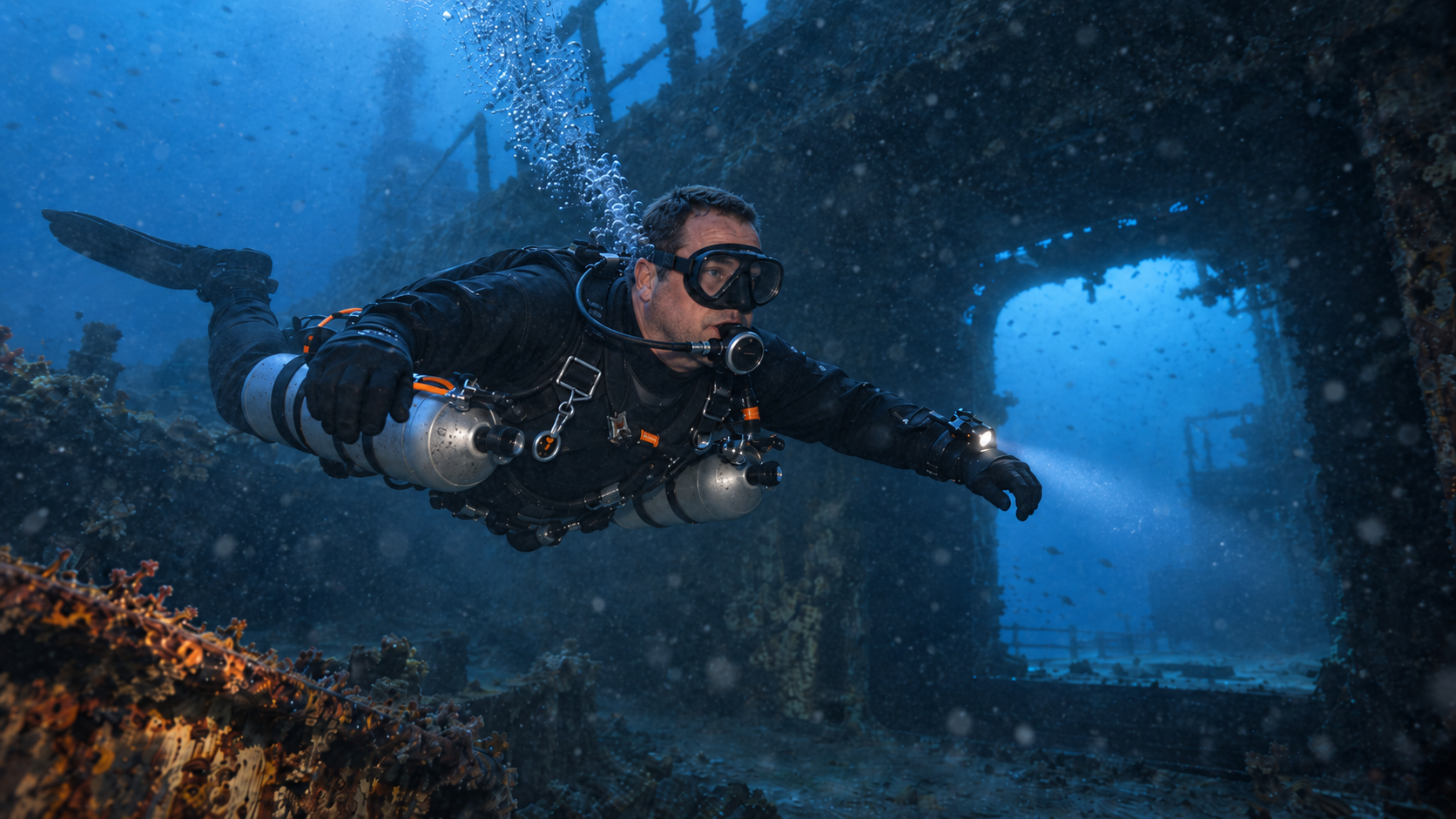
I have already enjoyed being inside wrecks such as the Thistlegorm.
What interests me is sensible penetration and swim-throughs where there is actually something worth going in to see.
I am not particularly interested in forcing myself through tiny restrictions purely so I can later tell somebody that I fitted.
Sidemount gives me more options around wreck structure.
The cylinders sit alongside me rather than forming one wide rigid block across my back.
They can also be moved when the environment and training make that appropriate.
That does not turn every hole in a wreck into an invitation.
Training, gas, line work, team planning and exit strategy still matter.
But the configuration gives me options.
Depth is not really the goal
This links back to something Deep Diver taught me.
I am not particularly interested in going deeper simply because I can.
Forty metres is just forty metres.
If there is a wreck feature at 38 metres, a swim-through, something unusual to see or a proper training objective, then the depth may be justified.
If the only objective is touching the number and coming back up, I am not especially interested.
Technical training appeals to me much more because of what the planning can unlock.
More options.
More redundancy.
Longer planned dives.
Wreck penetration.
Structured decompression where appropriate.
Better answers to failures.
Technical diving can sound backwards from the outside
People sometimes hear “technical diving” and immediately translate it to:
More dangerous diving.
I understand why.
The dives can involve greater complexity, different gases, overhead environments or decompression obligations.
But one thing that appeals to me is how much attention technical training gives to planning failures before they happen.
What if a regulator fails?
What if gas disappears?
What if the planned exit becomes unavailable?
What gas do I need to solve the problem?
What is the team doing?
What is the backup?
I love that kind of thinking.
Not because complexity automatically creates safety.
It does not.
But deliberate redundancy and planning can create options when something changes.
I know I am going to get worse before I get better
I am not expecting to put on a sidemount wing and immediately look like I have been diving the configuration for ten years.
Quite the opposite.
I expect a few fairly substantial steps backwards.
My current trim and buoyancy feel increasingly natural.
Changing the entire buoyancy and cylinder configuration means learning parts of that again.
Where does the gas sit?
Where do the cylinders sit?
How does the wing behave?
How does my centre of gravity change?
How does propulsion feel with cylinders alongside me?
I know there will be dives where I look significantly less polished than I currently do.
That is fine.
I would rather temporarily look like a beginner again than pretend a new configuration requires no relearning.
Fit the system first
When I eventually start the sidemount course, the first thing I want is not a long list of impressive drills.
I want the wing fitted correctly.
Then I want the cylinders sitting correctly.
Perfectly horizontal.
Close to the body.
Valves where they should be.
Nothing hanging down like a pair of shopping bags.
Once the platform is right, then I want to start learning the skills.
That order matters to me.
I do not want to spend a course compensating for a badly fitted rig and accidentally turn those compensations into habits.
The current front runner
At the moment, the XDEEP STEALTH 2.0 TEC is the system sitting at the top of my list.
I have also looked at systems from Hollis, Apeks and others.
The STEALTH keeps pulling me back because it appears to line up with the direction I want my diving to go.
But this is exactly where I need to follow my own gear rule.
Test everything and choose what disappears into the background for you.
I do not want to buy a sidemount system purely because the specification sheet looks good or because I already like another XDEEP product.
I want experience in the configuration before treating the buying decision as final.
Sidemount first, then Tec 40?
I would be happy for my sidemount and Tec 40 progression to overlap.
But at the moment I am leaning towards doing sidemount first.
The reason is task loading.
If I am still consciously thinking about where my cylinders sit, how the wing behaves or how to manage the configuration, that is attention I cannot spend elsewhere.
Tec 40 will introduce its own procedures and planning.
I would rather have the basic sidemount platform feeling familiar before I start layering more complexity on top.
Get the platform boring first. Then add complexity.
This will not be my “technical-only” setup
One thing I am already fairly confident about is that I do not see sidemount as something I would save for special technical dives.
Once I am properly trained and comfortable, I can genuinely see myself using it for around 90% of my diving.
Recreational dives too.
If the configuration gives me easier entries, independent gas, clean trim, good travel options and freedom underwater, I do not see why I would leave it at home simply because the planned dive is inside recreational limits.
The other 10% would probably be the simplest dives where a single cylinder on my XDEEP ZEN is the obvious answer.
That gives me two configurations rather than forcing one setup onto everything.
At first, though, I want to use it constantly
When I first qualify in sidemount, I want to use it whenever reasonably possible.
Not because I think it is automatically the best setup for every dive.
Because I need repetition.
I want gas switching to stop feeling novel.
I want clipping and unclipping cylinders to stop requiring conscious thought.
I want the valves to be exactly where my hands expect them.
I want the trim to become normal.
I want to stop thinking:
“I am diving sidemount.”
And simply think:
“I am diving.”
Then it becomes another tool
Once that confidence exists, my attitude changes.
Sidemount does not need to win.
Single-tank backmount does not need to win.
I just need to choose the tool that makes sense.
Simple recreational dive where a single cylinder on the ZEN is easiest?
Use the ZEN.
Dive where independent cylinders, easier transport, wreck flexibility or technical planning make sidemount the better configuration?
Use sidemount.
That is ultimately where I want to end up.
Final thought
Sidemount appeals to me more than twinset because it seems to fit both my diving and the way I think.
It reduces the part I dislike most about twins — carrying an enormous rigid package around on land.
It works better with the fact that I travel.
It gives me independent gas systems.
It gives me more flexibility around wrecks and swim-throughs.
And it looks like a configuration I could use for far more than technical dives.
But none of that means I expect it to be easy.
I fully expect to get worse before I get better.
I expect to relearn trim.
Relearn buoyancy.
Learn new gas habits.
Learn new equipment habits.
And spend a lot of time making tiny adjustments until the configuration stops demanding my attention.
That is the goal.
Learn it until sidemount stops feeling like sidemount — then choose the right tool for the dive.