Tag: sidemount

  • Why Sidemount Appeals to Me More Than Twinset

    Why Sidemount Appeals to Me More Than Twinset

    Technical Diving • Sidemount • Diver Development

    Why Sidemount Appeals to Me More Than Twinset

    I already own twin 12s. The problem is that somebody eventually has to pick the bloody things up.

    I already have a twinset.

    So my interest in sidemount is not based on never having considered the obvious alternative.

    Manifolded twins make complete sense for a lot of diving, and plenty of very good technical divers use them.

    But the more I think about the diving I actually want to do, the more sidemount seems to fit me better.

    Not because it is newer.

    Not because it looks more technical.

    And definitely not because I think it will magically make me a better diver.

    It simply seems to solve more of the problems that matter to me.

    The right configuration is not the most impressive one. It is the one that makes sense for the dive and the diver.

    The twinset problem starts on land

    My biggest issue with twinset is not what happens underwater.

    It is everything required to get the thing there.

    Have you ever picked up twin 12s?

    Now add your backplate, wing, regulators and whatever ballast your exposure protection requires.

    That is a substantial lump of equipment sitting on your back before the dive has even started.

    For UK diving, that matters.

    We have already established that some of our dive sites have an unhealthy relationship with car parks, rocks, long walks and inconvenient exits.

    I do not see much virtue in exhausting myself carrying one enormous rigid package to the water when there may be another way of achieving the same goal.

    Sidemount changes the logistics

    One of the big attractions of sidemount is being able to move the cylinders independently.

    Instead of carrying twin 12s as one giant unit, I can move cylinders separately and clip them on nearer the water where the site allows it.

    That immediately changes the physical cost of the dive day.

    Easier entry.

    Easier exit.

    Less weight sitting on my spine while walking around on land.

    Given how much I already think about conserving energy before a UK dive, that matters enormously to me.

    I want to spend my energy diving, not proving I can carry the dive site on my back.

    Travel makes the difference even bigger

    My diving is not exclusively UK based.

    I travel.

    And airlines tend to become strangely unreasonable when you suggest taking a manifolded set of twin 12-litre steel cylinders as hand luggage.

    Sidemount is much more attractive in that environment.

    I can travel with the harness, wing, regulators and cylinder rigging, then configure suitable hire cylinders at the destination.

    The cylinders do not have to belong to me for the configuration to work.

    Twinset is very different.

    If the destination does not have a correctly configured manifolded twinset available, I cannot simply turn two ordinary hire cylinders into the same setup with a few bits from my luggage.

    For somebody who expects to keep combining UK diving with trips abroad, sidemount feels far more portable.

    My first little taste came from a pony bottle

    Deep Diver was probably where sidemount stopped being an abstract idea for me.

    At 40 metres I was carrying an additional side-slung pony.

    It obviously was not a full sidemount configuration.

    But having a cylinder beside me gave me a small taste of what moving gas off my back could feel like.

    I liked it.

    I liked being aware of the additional gas.

    I liked the planning around it.

    And I liked having the cylinder somewhere I could see and interact with easily.

    That experience was one of the things that pushed me into looking at sidemount much more seriously.

    Independent gas appeals to my brain

    One of the strongest technical attractions for me is having two independent cylinder and regulator systems.

    That changes how I think about redundancy.

    Rather than one manifolded back-gas system, I have gas distributed across independent systems beside me.

    Of course, that also introduces new responsibilities.

    Gas has to be managed properly between cylinders.

    Regulators have to be used deliberately.

    Cylinder pressures have to remain part of the dive plan rather than becoming something I vaguely check whenever I remember.

    Weirdly, that is part of what attracts me.

    I like systems where the “what if?” has an answer before the dive begins.

    Freedom underwater matters too

    Sidemount also looks like it will suit the way I want to move underwater.

    The word I keep coming back to is freedom.

    I do not want to feel locked inside one large rigid package.

    With cylinders beside me, I can interact with them.

    I can reach the valves.

    I can change their position.

    I can trim the cylinders rather than simply accepting wherever a rigid twinset puts the mass.

    That flexibility appeals to me a lot.

    Then there are wrecks

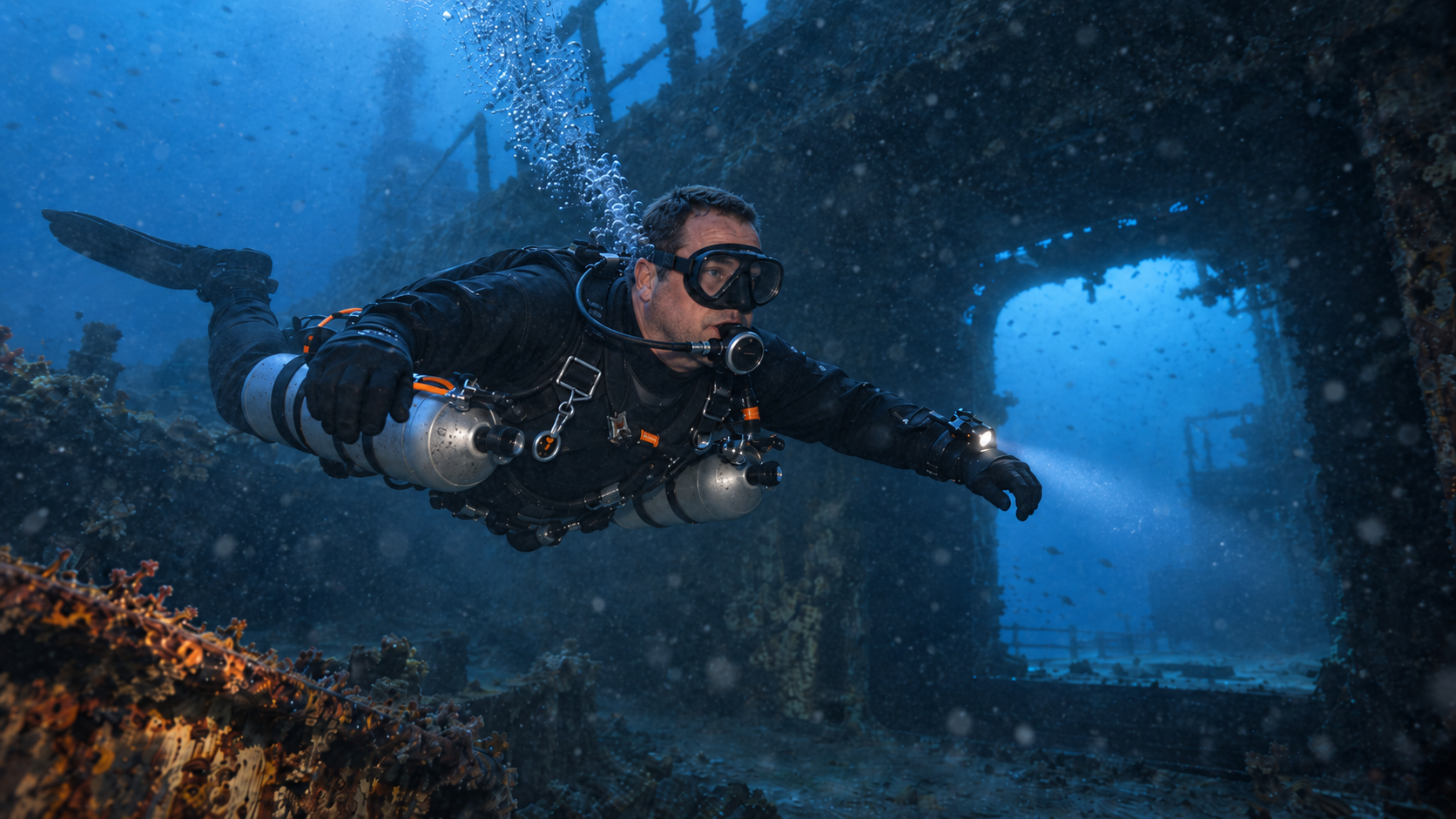
    Wreck diving is one of the big reasons I am interested in technical progression.

    I have already enjoyed being inside wrecks such as the Thistlegorm.

    What interests me is sensible penetration and swim-throughs where there is actually something worth going in to see.

    I am not particularly interested in forcing myself through tiny restrictions purely so I can later tell somebody that I fitted.

    Sidemount gives me more options around wreck structure.

    The cylinders sit alongside me rather than forming one wide rigid block across my back.

    They can also be moved when the environment and training make that appropriate.

    That does not turn every hole in a wreck into an invitation.

    Training, gas, line work, team planning and exit strategy still matter.

    But the configuration gives me options.

    Depth is not really the goal

    This links back to something Deep Diver taught me.

    I am not particularly interested in going deeper simply because I can.

    Forty metres is just forty metres.

    If there is a wreck feature at 38 metres, a swim-through, something unusual to see or a proper training objective, then the depth may be justified.

    If the only objective is touching the number and coming back up, I am not especially interested.

    Technical training appeals to me much more because of what the planning can unlock.

    More options.

    More redundancy.

    Longer planned dives.

    Wreck penetration.

    Structured decompression where appropriate.

    Better answers to failures.

    Technical diving can sound backwards from the outside

    People sometimes hear “technical diving” and immediately translate it to:

    More dangerous diving.

    I understand why.

    The dives can involve greater complexity, different gases, overhead environments or decompression obligations.

    But one thing that appeals to me is how much attention technical training gives to planning failures before they happen.

    What if a regulator fails?

    What if gas disappears?

    What if the planned exit becomes unavailable?

    What gas do I need to solve the problem?

    What is the team doing?

    What is the backup?

    I love that kind of thinking.

    Not because complexity automatically creates safety.

    It does not.

    But deliberate redundancy and planning can create options when something changes.

    I know I am going to get worse before I get better

    I am not expecting to put on a sidemount wing and immediately look like I have been diving the configuration for ten years.

    Quite the opposite.

    I expect a few fairly substantial steps backwards.

    My current trim and buoyancy feel increasingly natural.

    Changing the entire buoyancy and cylinder configuration means learning parts of that again.

    Where does the gas sit?

    Where do the cylinders sit?

    How does the wing behave?

    How does my centre of gravity change?

    How does propulsion feel with cylinders alongside me?

    I know there will be dives where I look significantly less polished than I currently do.

    That is fine.

    I would rather temporarily look like a beginner again than pretend a new configuration requires no relearning.

    Fit the system first

    When I eventually start the sidemount course, the first thing I want is not a long list of impressive drills.

    I want the wing fitted correctly.

    Then I want the cylinders sitting correctly.

    Perfectly horizontal.

    Close to the body.

    Valves where they should be.

    Nothing hanging down like a pair of shopping bags.

    Once the platform is right, then I want to start learning the skills.

    That order matters to me.

    I do not want to spend a course compensating for a badly fitted rig and accidentally turn those compensations into habits.

    The current front runner

    At the moment, the XDEEP STEALTH 2.0 TEC is the system sitting at the top of my list.

    I have also looked at systems from Hollis, Apeks and others.

    The STEALTH keeps pulling me back because it appears to line up with the direction I want my diving to go.

    But this is exactly where I need to follow my own gear rule.

    Test everything and choose what disappears into the background for you.

    I do not want to buy a sidemount system purely because the specification sheet looks good or because I already like another XDEEP product.

    I want experience in the configuration before treating the buying decision as final.

    Sidemount first, then Tec 40?

    I would be happy for my sidemount and Tec 40 progression to overlap.

    But at the moment I am leaning towards doing sidemount first.

    The reason is task loading.

    If I am still consciously thinking about where my cylinders sit, how the wing behaves or how to manage the configuration, that is attention I cannot spend elsewhere.

    Tec 40 will introduce its own procedures and planning.

    I would rather have the basic sidemount platform feeling familiar before I start layering more complexity on top.

    Get the platform boring first. Then add complexity.

    This will not be my “technical-only” setup

    One thing I am already fairly confident about is that I do not see sidemount as something I would save for special technical dives.

    Once I am properly trained and comfortable, I can genuinely see myself using it for around 90% of my diving.

    Recreational dives too.

    If the configuration gives me easier entries, independent gas, clean trim, good travel options and freedom underwater, I do not see why I would leave it at home simply because the planned dive is inside recreational limits.

    The other 10% would probably be the simplest dives where a single cylinder on my XDEEP ZEN is the obvious answer.

    That gives me two configurations rather than forcing one setup onto everything.

    At first, though, I want to use it constantly

    When I first qualify in sidemount, I want to use it whenever reasonably possible.

    Not because I think it is automatically the best setup for every dive.

    Because I need repetition.

    I want gas switching to stop feeling novel.

    I want clipping and unclipping cylinders to stop requiring conscious thought.

    I want the valves to be exactly where my hands expect them.

    I want the trim to become normal.

    I want to stop thinking:

    “I am diving sidemount.”

    And simply think:

    “I am diving.”

    Then it becomes another tool

    Once that confidence exists, my attitude changes.

    Sidemount does not need to win.

    Single-tank backmount does not need to win.

    I just need to choose the tool that makes sense.

    Simple recreational dive where a single cylinder on the ZEN is easiest?

    Use the ZEN.

    Dive where independent cylinders, easier transport, wreck flexibility or technical planning make sidemount the better configuration?

    Use sidemount.

    That is ultimately where I want to end up.

    Final thought

    Sidemount appeals to me more than twinset because it seems to fit both my diving and the way I think.

    It reduces the part I dislike most about twins — carrying an enormous rigid package around on land.

    It works better with the fact that I travel.

    It gives me independent gas systems.

    It gives me more flexibility around wrecks and swim-throughs.

    And it looks like a configuration I could use for far more than technical dives.

    But none of that means I expect it to be easy.

    I fully expect to get worse before I get better.

    I expect to relearn trim.

    Relearn buoyancy.

    Learn new gas habits.

    Learn new equipment habits.

    And spend a lot of time making tiny adjustments until the configuration stops demanding my attention.

    That is the goal.

    Learn it until sidemount stops feeling like sidemount — then choose the right tool for the dive.
  • My Current Dive Kit Setup: What I Carry and Why

    My Current Dive Kit Setup: What I Carry and Why

    Gear • Dive Kit • Diver Development

    My Current Dive Kit Setup: What I Carry and Why

    My equipment has slowly changed from “carry everything” to “everything has a reason and a home.”

    My current dive setup looks very different from the gear configuration I started with.

    Early on, I carried almost anything I thought might possibly be useful.

    Slate.

    Compass.

    Knife.

    Lights.

    Beacon.

    Multiple spools.

    Multiple DSMBs.

    Huge console.

    If I owned it, there was a reasonable chance it was hanging off me somewhere.

    These days I think about kit differently.

    If I need it, it should have a reason for being there and a predictable place to live.

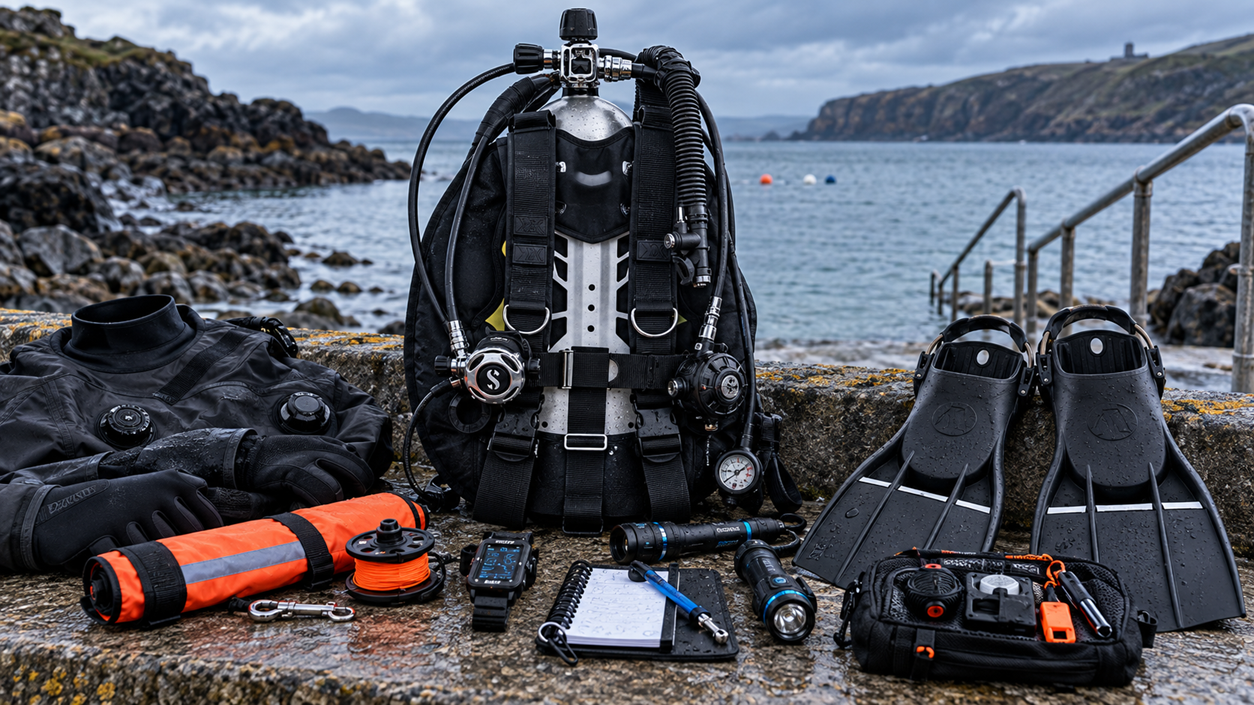
    The foundation: XDEEP ZEN backplate and wing

    My normal backmount setup is built around an XDEEP ZEN wing with the ZEN NX aluminium backplate.

    I chose aluminium because my diving is split between UK diving and trips that involve air travel.

    It gives me the rigid platform I want without making airline luggage even more entertaining than it already is.

    The biggest benefit is not that it looks technical.

    It is that underwater I barely notice it.

    Once the harness is adjusted properly and the weight comes off my back in the water, the system almost disappears.

    That is exactly what I want from equipment.

    Exposure protection depends entirely on the dive

    I do not have one exposure setup that I try to force onto every environment.

    For warmer diving I still enjoy being in a wetsuit.

    In the Red Sea, I actually like feeling the water against my skin.

    Depending on conditions, I have a 5 mm wetsuit, a 4 mm shortie and lighter thermal options.

    For colder UK diving I use a drysuit.

    I currently have a neoprene drysuit, although a custom trilaminate suit is high on my future purchase list because I want more mobility and less of the Maggie-Simpson-in-a-snowsuit experience.

    I also have my 7 mm semi-dry, which still has a place.

    The important thing for me is choosing the exposure protection that fits the actual conditions rather than automatically reaching for the biggest or warmest option.

    Regulators: several options, one job

    Over time I have ended up with a fairly substantial regulator collection.

    My first stages include Scubapro MK25, MK17 EVO and additional MK25 EVO units.

    Second stages include G260s, an A700, R380s, R190 and R105.

    I do not carry all of them on every dive, obviously.

    The advantage of having multiple regulator sets is being able to configure cylinders for different kinds of diving without constantly stripping everything apart.

    As I move further towards sidemount and technical diving, that flexibility becomes increasingly useful.

    Cylinders: this got out of hand quite quickly

    I appear to have accidentally collected cylinders.

    At the moment the collection includes multiple 12-litre steels, a 2 × 12-litre twinset, 10-litre stumpies, 7-litre cylinders, 5-litre cylinders, a 3-litre and a 2-litre.

    There are also pony mounts and sidemount or cross-body options.

    That sounds excessive until you start changing configurations.

    A cylinder that makes sense as a normal back-gas cylinder is not necessarily the cylinder you want as a pony, stage or suit-inflation bottle.

    The collection gives me options.

    It also gives Gemma plenty of evidence whenever she wants to argue that my definition of “essential dive equipment” has become dangerously flexible.

    Computers: information without becoming obsessed with screens

    My current dedicated dive computer is an Aqualung i330R.

    I also use an Apple Watch Ultra, with the Ultra 3 becoming part of the wider setup.

    Longer term, I am looking at moving towards a more technical-capable dedicated computer with air integration.

    The computer matters enormously, but I do not want to spend the whole dive staring at it.

    Depth.

    Time.

    Gas.

    NDL.

    Deco information when that eventually becomes relevant.

    I want those checks to become routine enough that I can process the information quickly and then get back to actually diving.

    Lights depend on whether darkness is part of the problem

    My main lights currently include an Orca D610 and Orca ZD710, along with several backup lights.

    I also carry small blue and red Orca beacons when appropriate.

    My redundancy changes with the dive.

    On a night dive, I take a primary and two strong backups.

    That means if the primary dies, I still move onto a proper light while retaining another backup.

    On a normal daytime dive where a torch is only useful for looking into cracks for lobsters, I may take only one.

    Redundancy should match the consequence of losing the item, not the size of the equipment cupboard at home.

    My right pocket: things I expect to use

    My right pocket is basically the utility pocket.

    It contains the things I reasonably expect to reach for during the dive.

    • Wetnotes containing the dive plan or tables
    • Slate where required
    • Routine DSMB
    • Routine spool or reel
    • Second backup torch where appropriate

    My first backup torch normally sits clipped to the right shoulder D-ring and is held neatly against the harness with a ranger band.

    If I am doing a dive with lots of recording — a survey or conservation activity, for example — I may use a wrist slate instead.

    My left pocket: safety and emergency kit

    The left pocket is more about things I hope I do not need.

    • Spare mask
    • Safety spool
    • Yellow emergency SMB or lift bag where appropriate
    • Spare double-ender
    • CPR mask
    • Shears or cutting tool
    • Small multi-tool where appropriate
    • Waterproof personal ID card

    I use a waterproof ID card containing a QR code.

    It is not something I particularly enjoy thinking about, but if I am ever in a situation where I cannot identify myself, I find some comfort in knowing that there is still information available to help connect me back to my family.

    DSMBs and spools: I may own slightly too many

    My DSMB and spool collection has become fairly healthy.

    I have multiple DSMBs, finger spools ranging from roughly 10 metres to 50 metres, and larger reels extending out towards 150 metres.

    I also have surface buoys and flags.

    But owning ten spools does not mean ten spools need to come on the dive.

    Normally there is a routine DSMB and deployment spool, plus an emergency or safety option where the dive justifies it.

    Everything else can remain in the bag until there is an actual reason to carry it.

    Cutting tools should be reachable

    I have never understood the point of carrying an emergency tool somewhere I cannot actually reach in an emergency.

    A cutting device should be secure but accessible.

    Shears and compact cutting tools make more sense to me than carrying something enormous simply because it looks impressive.

    As with the rest of my setup, the important question is:

    Can I reach it instinctively when I am stressed?

    The £20 dive mirror

    One of the cheapest pieces of equipment I have added has turned out to be surprisingly useful.

    A small dive mirror.

    I originally bought it before leading part of a St Abbs dive with Matthew behind me.

    It meant I could glance into the mirror and check that he was still where I expected without constantly turning around.

    It is also useful for doing my own bubble checks.

    Twenty quid.

    Tiny.

    Hardly glamorous.

    Very useful.

    My fins and boots are deliberately boring

    My main fins are black RK3s.

    I also use different boots depending on the site and exposure setup, including Cressi rock boots and other dive boots.

    That is one reason I am leaning towards socks rather than permanently attached boots when I eventually buy my trilaminate drysuit.

    I want the ability to choose the boot for the environment rather than have the suit make that decision for me.

    Hoods and gloves: UK diving’s glamour department

    I have accumulated different hood and glove thicknesses — roughly 3 mm, 5 mm and heavier cold-water options.

    Again, I would rather choose based on conditions than automatically wear the thickest thing I own.

    My hands can be beautifully warm in a drysuit while my face feels painfully cold.

    Nobody said UK diving was supposed to make complete sense.

    Nitrox analyser

    I carry my own NCR Nitrox analyser.

    If I am going to breathe a gas mixture, I want to know what is actually in the cylinder rather than rely entirely on somebody else’s label.

    That becomes even more important as I move further towards technical training and multiple-gas configurations.

    First-aid and emergency equipment

    My surface emergency kit has grown alongside my Rescue training.

    I have a substantial EFR kit that includes items such as splints and general first-aid equipment.

    An oxygen kit is another area I want to develop further.

    This equipment obviously does not come underwater with me.

    But it is still part of what I consider a complete dive setup.

    The dive does not begin at the descent and it does not end at the safety stop.

    I am still changing the setup

    This is not a finished configuration.

    I do not think it ever will be.

    The next big changes are likely to come from sidemount, technical training and a trilaminate drysuit.

    That will change where cylinders live.

    It may change buoyancy strategy.

    It will change gas planning.

    Some equipment will move.

    Some will disappear.

    Some new items will undoubtedly arrive in suspiciously large cardboard boxes.

    The important part is that the changes should solve problems rather than simply create a more impressive-looking equipment pile.

    My rule for deciding what comes on the dive

    I increasingly put equipment into three groups.

    Needed for life support or safety

    If losing it threatens the ability to safely complete the dive, I think seriously about redundancy.

    Needed to complete the planned dive

    This depends on the mission.

    Night diving needs lights.

    Surveys need recording equipment.

    A lobster dive may need a torch but not three of them.

    Nice to have

    This is where I am much more ruthless now.

    If I cannot explain what the item is doing for me on this particular dive, perhaps it can enjoy a relaxing afternoon in the dive bag.

    One is none and two is one — sometimes

    I like the basic redundancy principle of “one is none and two is one.”

    But I do not apply it blindly.

    Losing a primary light during a night dive is very different from losing the torch I was using to look underneath a rock at midday.

    Redundancy should be related to consequence.

    And carrying a backup is not enough.

    I need to know where it is.

    I need to be able to reach it.

    I need to be able to deploy it without dropping something else.

    That is why bolt snaps and bungee inside pockets matter.

    A shiny backup reel is significantly less useful when it is slowly disappearing into the abyss.

    Gear should reduce task loading

    This is probably the principle connecting the entire setup.

    I do not want equipment constantly demanding my attention.

    The harness should fit.

    The regulator should be where I expect it.

    The backup torch should be reachable.

    The DSMB should be in the same pocket.

    Nothing should be dangling around underneath me.

    If something fails, I should already know what comes next.

    The more of that becomes automatic, the more attention I have available for the environment, my buddy and the actual reason I got into the water.

    Final thought

    My current kit setup is not the correct scuba configuration.

    It is simply the configuration that currently works for me.

    Gemma’s setup is slightly different.

    Matthew’s will be different again.

    And mine will almost certainly change as I move further towards sidemount and technical diving.

    What matters more than any particular brand or piece of equipment is that I understand why it is there.

    It should fit.

    It should have a home.

    It should solve a problem.

    And ideally, once I am underwater, I should barely have to think about it.

    Carry what the dive needs. Know where it lives. Let the kit disappear.

  • Deep Diver: More Than Just a Bigger Number

    Deep Diver: More Than Just a Bigger Number

    Training Notes • Deep Diver • Human Factors

    Deep Diver: More Than Just a Bigger Number

    Deep Diver taught me that depth is only a number. The real lesson was gas, limits, standards and having a reason to be there.

    Deep Diver sounds like it should be about a number.

    How deep did you go? Did you get to 40 metres? Did it feel different? Did you feel narced? Did you get the card?

    Those are easy questions to ask, but they are not the best lessons from the course.

    For me, Deep Diver did not make depth feel like a trophy. It made depth feel like a set of costs: gas, time, temperature, no-decompression limit, attention and planning.

    It also made me realise something I did not expect to come away with: I do not need to go deep unless there is actually a reason to be there.

    A busy start to the holiday

    I did my Deep and Night Diver training with Pyramids over the first four days of the holiday.

    It was not a gentle, lazy start. I landed at around 23:00, and by midday the next day I was already doing my shakedown dive. That same evening I did my first night dive.

    I was not fully rested, but that first night dive was amazing — and that absolutely deserves its own post soon.

    The first few days were full on. Day one was the shakedown dive and night dive one. Day two was deep dives one and two. Day three was deep dives three and four, which completed Deep Diver. Day four was night dives two and three.

    After that I had a reset day, then moved into nine days of diving with Gemma and Elite. Looking back, those first four days felt like the training block of the trip before settling into the wider holiday diving.

    Calm leadership matters

    One thing I did appreciate was the instructor. He was calm, relaxed and good to be around.

    That mattered. When you are doing deeper training dives, watching gas, tracking depth, checking no-decompression limit and thinking about ascent discipline, the tone of the person leading the dive can spread through the whole group.

    If an instructor is rushed, tense or casual in the wrong way, that can make the whole dive feel messy. In this case, his calmness helped me stay calm as well.

    The dives felt managed rather than pressured, and that gave me more mental space to focus on what I was supposed to be learning.

    Safety culture matters too

    I do need to separate the instructor from the wider centre culture, because those are not always the same thing.

    The instructor I trained with was really good. But over those four days I heard comments from a couple of Divemasters that sounded, to me, like new divers or people doing try dives were being encouraged to be less than accurate on medical forms.

    I raised what I had heard with the centre when I had the opportunity. I cannot know what, if anything, was done with that concern afterwards.

    But it mattered to me because dive medicals are not paperwork theatre. They are part of the safety system. New divers, nervous divers and try-dive participants should be made to feel that honesty is the safe and correct route, not an inconvenience.

    I had originally booked there because I thought Wessam was still with them. Once I realised he was elsewhere, I moved over to Elite Divers to follow him for the rest of the trip’s diving.

    That experience made me think differently about choosing a dive centre. Before this, I probably thought instructor first. A good instructor still matters massively, but the wider system around them matters too.

    A good instructor can shape a dive. A good safety culture shapes everything around it.

    Narcosis: no obvious effect, but no complacency

    Personally, I did not feel any obvious narcosis at 40 metres.

    I was able to carry out the example tasks at the same rate as I had at the surface, and the instructor confirmed that he could not see any difference in how I was performing.

    But that does not mean I think I am immune to narcosis. That would be a dangerous lesson to take from it.

    At most, it means that on that dive, in those conditions, I seemed to tolerate it well. Maybe I have a greater resistance, maybe I was lucky, maybe the situation simply did not expose it. Either way, narcosis is not something I want to treat casually.

    If something can affect your judgement while also affecting your ability to judge your own judgement, then the answer is not ego. The answer is planning, limits, buddy awareness and honesty.

    Gas became very real

    What I did notice very clearly was gas.

    I am a greedy breather, and at 40 metres I could see the needle moving. That made the planning feel very real.

    It made me focus on not wasting movement, checking which gas I was breathing at what depth, and tracking my no-decompression limit as it moved surprisingly fast, especially when doing multiple deep dives around 40 metres.

    Everything had a cost. Gas had a cost. Time had a cost. Movement had a cost. Attention had a cost.

    I was glad to know I had taken an additional side-slung pony, and that we also had a 38% mix available at 5 metres for the safety stop.

    That did not make the dive casual. It made it feel planned.

    The cold surprised me

    The other thing that surprised me was the temperature.

    I was comfortable in my 3 mm shortie in the Red Sea, but once we got down through the 20–30 metre range, and especially around 40 metres, there was definitely a chill.

    That was a useful reminder that even warm-water diving changes with depth.

    It is easy to think of the Red Sea as warm, bright and comfortable — and much of it is — but depth still changes the feel of the dive. It changes light, temperature, gas use, time and how deliberate you need to be.

    Forty metres is not automatically interesting

    One thing I did not expect to come away with was the feeling that 40 metres can actually be quite boring if there is no real reason to be there.

    At depth I felt relaxed. I could hover, look up and see the fish above me, look out into the deep blue, and look down into the nothing as the wall fell far below.

    It was calm and beautiful in its own way.

    But it also made something very clear: depth by itself is not the point.

    Leaving a Deep Diver course thinking, “Yeah, I do not need to go deep unless there is actually a reason,” was not what I expected. But it was probably one of the most useful lessons from the course.

    Depth needs a reason

    I would happily go deep again if there was a genuine reason to be there.

    A wreck feature, a swim-through, a wall, marine life, a training objective, or something at depth that actually adds to the dive — those all make sense to me.

    If there was a swim-through at 38 metres that allowed me to see something special, that would feel like a reason. If the only point of the dive was to touch 40 metres and come back up, I am not sure that interests me much.

    Depth is not the reward by itself. Depth is just where something might be.

    The side-slung pony changed my thinking

    Using the side-slung pony was one of the biggest practical takeaways from the course.

    It gave me a small taste of what carrying gas beside me could feel like, and it helped push me toward sidemount rather than twinset as the route I am more interested in.

    I enjoyed the gas planning more than I expected. That was probably the point where I started properly looking into decompression diving.

    Not just because of depth, but because of what planning can give you: longer dives, wreck-penetration options, more redundancy, more “what if” thinking and more structured problem-solving.

    It sounds backwards to some people, but technical diving can become safer in certain ways because you stop pretending the simple plan is enough. You plan for failures. You plan gas. You plan exits. You plan reserves. You plan what you will do if something changes.

    That appeals to my brain a lot.

    Deep does not mean better

    Deep Diver showed me that depth is just a number.

    It does not automatically make you a better diver, and it does not make you a worse one either.

    Going deeper is not the achievement by itself. What matters is staying within your limits, understanding what changes at depth, and being honest about whether the dive actually has a reason.

    For me, the course did not make me want to chase depth. It made me think more seriously about how sidemount and technical training might allow me to extend my limits safely, with better planning, more redundancy, clearer gas choices and more structured answers to the “what ifs.”

    The start of a technical-thinking path

    I think this course was one of the points where I started looking more seriously at the technical side of diving.

    Not because I suddenly wanted to go as deep as possible, but because I liked the thinking. I liked the planning. I liked the structure. I liked the idea of having proper answers to problems before they happen.

    Deco diving, sidemount and technical training appeal to me because they are not just about extending depth. They can also be about extending options, extending time, improving redundancy, and making the “what if” part of the plan instead of pretending it does not exist.

    That is the bit I enjoy: the preparation, the logic, the problem-solving, and the feeling that the dive has been thought through properly.

    Final thought

    Deep Diver did not teach me to chase depth.

    It taught me to respect what depth changes.

    It changes gas use. It changes temperature. It changes time. It changes no-decompression limit. It changes how much space you have for casual thinking. It also changes how much the culture around the dive matters.

    The safety concerns I had during that training block made me look harder at what is important. A good instructor matters, but the centre culture matters too. If an instructor holds themselves to a high standard, but works somewhere that does not seem to hold the same standards around safety, medical honesty or reporting concerns, that raises difficult questions.

    That is not about blame. It is about standards.

    I left Deep Diver with more respect for gas planning, more interest in sidemount and technical diving, and less interest in depth for its own sake.

    That feels like a useful result.

    Depth is only a number. Standards are what keep that number safe.

  • Welcome

    Welcome • Dive journal • Training notes • Kit • Sites

    Welcome to the ZeusTek Dive Journal

    This is my public scuba diving journal: a place to share the journey, the training, the mistakes, the good dives, the kit experiments and the lessons that come from trying to become a calmer, safer and more useful diver.
    Category: Training Notes · Tags: welcome, return to diving, training, dive journal
    Starting point

    What This Site Is

    ZeusTek Dive Journal is where I am collecting my scuba diving journey in one place. It covers dive logs, training notes, equipment progression, dive-site thoughts, trip reflections and the odd bit of kit-nerd waffle.

    I came back to diving properly after a long gap, rebuilt confidence, worked through training, reached Master Scuba Diver and started looking seriously at Divemaster, sidemount and possible technical pathways.

    This site is not meant to be a polished “I know everything” expert blog. It is a learning journal. Sometimes that means celebrating progress. Sometimes it means writing down what went wrong so I can learn from it.

    Why I am sharing it

    The Point of the Journal

    I wanted somewhere to share the journey from the inside: not just the pretty reef moments, but the training decisions, confidence wobbles, equipment changes, mistakes, human factors and little lessons that make diving better.

    If someone else is coming back to diving, nervous about getting in the water, trying to make sense of kit choices, or wondering what the path from recreational diving into Pro or Tec might look like, hopefully parts of this will be useful.

    Also, if I do not write things down, my brain stores them in the same filing system as random regulator model numbers, zombie fiction plots and where I definitely put that one spool. So, yes. A journal was needed.

    The goal is simple: dive better, think clearer, build confidence, and become the kind of buddy people feel safe and relaxed diving with.
    What you will find here

    The Main Sections

    How I write

    Honest Notes, Not Perfect Dives

    I am interested in the useful bits: what worked, what did not, what felt harder than expected, what kit helped, what skill needs practice and what decisions mattered.

    • Training: what each course or workshop actually taught me
    • Sites: what a place is useful for, not just whether it looked pretty
    • Equipment: what works in real use, not just what looks good online
    • Human factors: communication, task loading, awareness and decision-making
    • Progression: how recreational diving may lead into Divemaster, sidemount and technical training
    Public site

    A Quick Note on Privacy

    This is a public site, so I keep live travel details, private family information and sensitive personal details off it. Trip notes are written as reflections after the event, not live location updates.

    I may share public dive locations, dive centres, general areas, lessons learned and useful travel/dive preparation notes. I will not use the site to publish live itineraries or turn family time into public content.

    Comments

    Feedback Is Welcome

    Sensible comments, useful experience, dive-site tips, gear thoughts and constructive disagreement are welcome. I am learning, and good input from other divers is valuable.

    Comments are moderated, because the internet occasionally behaves like an untrained goblin with a keyboard. Useful discussion is welcome. Spam, bots and drive-by nonsense can stay on the surface interval.

    So, welcome.
    This journal is here to track the journey: from coming back to diving, to building confidence, to Master Scuba Diver, and now towards whatever comes next in the Pro and Tec direction.