Tag: Scuba Diving

  • Fish ID: Why Aquarium Keeping Helps Underwater

    Fish ID: Why Aquarium Keeping Helps Underwater

    Marine Life • Fish ID • Aquarium Keeping

    Fish ID: Why Aquarium Keeping Helps Underwater

    My aquarium hobby gave me a head start — not because I know every species, but because I had already learned how to look.

    Fish ID was one of the easier AOW dives for me

    When Fish ID came up as part of my Advanced Open Water course, I expected it to be enjoyable.

    What surprised me was how familiar the thinking felt.

    Years of keeping marine aquariums had already pushed me into fish taxonomy, family groups, body shapes, colour patterns and behaviour.

    I certainly cannot identify every fish I see, but the process of working out what I am looking at was already something my brain enjoyed doing.

    Aquarium keeping did not give me every answer. It taught me what details to look for.

    I tend to look for families before species

    Trying to identify every animal down to species level immediately is a brilliant way to overwhelm yourself.

    I find it easier to start broad.

    What shape is it? How does it swim? Where is it feeding? Is it hovering above the reef, sitting on sand, tucked into rockwork or defending a patch?

    Once I have the likely family or type in mind, the smaller markings become much more useful.

    Behaviour is part of identification

    One thing aquarium keeping teaches very quickly is that behaviour matters.

    Fish learn routines and recognise the people around their tank. They also have very obvious individual personalities.

    That makes me pay attention underwater to what an animal is doing rather than only its colour.

    Is it grazing? Picking at coral? Hovering over a burrow? Guarding eggs? Cleaning another fish? Disappearing into the same hole every time a diver approaches?

    Those observations make the dive more interesting even when I never manage to put an exact species name on the animal.

    The ugly little details help too

    Keeping reefs has also taught me about algae, pests, the biological cycle and water chemistry.

    That means I am often just as interested in what is growing on the rock as what is swimming over it.

    A patch of algae, a tiny invertebrate, a burrow, a damaged coral surface or a cluster of something unfamiliar can become the thing I remember from the dive.

    Taxonomy became a hobby almost by accident

    I did not sit down one day and decide I needed to learn marine taxonomy.

    It happened because one question leads to another.

    What is that fish? What family is it in? What does it eat? Is it reef safe? What does it look like as a juvenile? Why is it behaving like that?

    Do that for long enough and you end up with a surprisingly useful framework when somebody hands you a Fish ID slate underwater.

    The goal is curiosity, not showing off

    I do not want Fish ID to turn into another badge-collecting exercise where the person who can name the most Latin species wins.

    For me the useful outcome is that I pay closer attention.

    If I identify the fish later from a photograph or book, brilliant. If I only come away knowing that I watched something behave in an interesting way, that is still a better dive than swimming past it without noticing.

    The aquarium hobby gave me vocabulary and a habit of observation.

    Diving gives me the chance to use both where the animals actually live.

    The more I know what I am looking at, the less of the reef becomes background scenery.

  • Keeping Reef Tanks Changed How I Look at Reefs

    Keeping Reef Tanks Changed How I Look at Reefs

    Marine Life • Reef Keeping • Diver Perspective

    Keeping Reef Tanks Changed How I Look at Reefs

    Owning a reef tank has made me look at the sea less like scenery and more like a living system.

    I often feel like I am keeping water

    People look at a marine aquarium and naturally see the fish and corals first. I do too.

    But after keeping reef tanks for long enough, I have ended up with a slightly different way of thinking about them.

    Quite often it feels like I am keeping water that just happens to have fish and corals in it.

    The animals are the reason for doing it, obviously, but the water is the thing that makes everything else possible. Temperature, salinity, nutrients, alkalinity, calcium, flow, light, filtration and the biological cycle all interact. You can have a beautiful aquascape and expensive equipment, but if the environment is wrong the animals still have to live in it.

    The reef is not just the things swimming over it. It is the whole system they depend on.

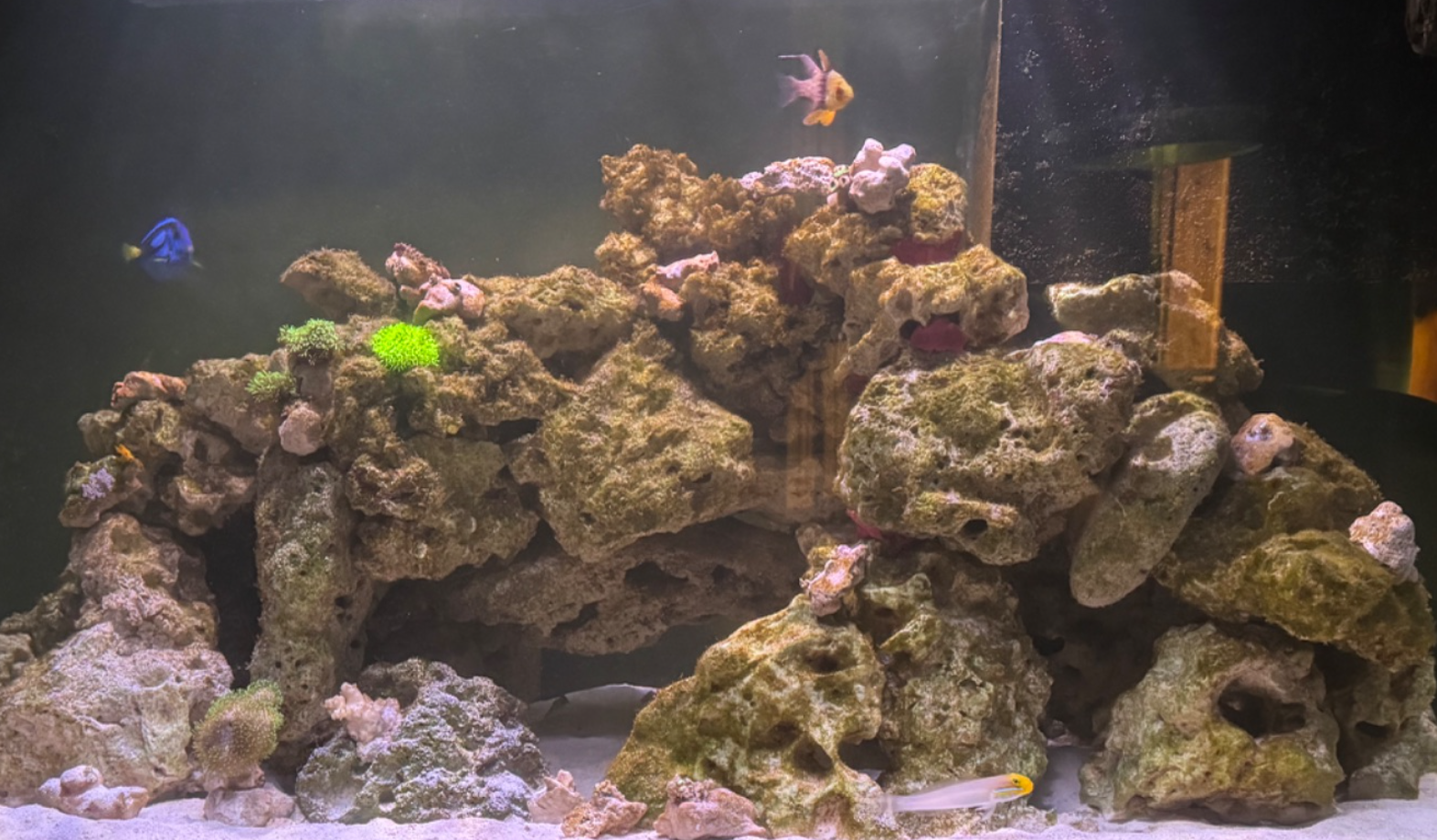
    Martin's home marine reef aquarium with live rock, corals and fish
    Keeping a reef tank has made me pay much more attention to the water, the biology and the small changes behind what I see.

    Small changes stop looking small

    One of the biggest lessons my tanks have taught me is how little it can take for coral growth to slow down.

    A parameter drifting out of the range my system is happy with does not necessarily produce some dramatic instant disaster. Sometimes the first sign is simply that something stops thriving quite as well.

    That experience inevitably follows me underwater. When I look at a natural reef I find myself thinking about the water around it as much as the coral itself.

    It is also why sewage, rubbish and avoidable pollution bother me so much. If I can see in a closed aquarium how sensitive coral growth can be to changing conditions, it is difficult not to ask why we would casually add more stress to the real environment.

    Fish are much smarter than they get credit for

    Keeping marine fish has also destroyed the idea that they are little colourful automatons.

    They learn routines. They learn who is approaching the tank. They associate people with food, maintenance and interaction. Different individuals of the same species can behave completely differently.

    I have had fish that are confident, fish that are cautious, fish that seem permanently offended by the existence of everybody else, and fish that appear to know exactly what I am doing before I do it.

    Once you spend enough time watching that at home, fish underwater stop becoming anonymous scenery. I find myself watching how an individual is behaving, what it is guarding, where it retreats and what it is reacting to.

    A fish ID card tells me what something is. Watching a fish tells me who it is behaving like.

    The ugly stuff taught me just as much

    Reef keeping is not all fluorescent coral and perfect photographs.

    I have had to learn about algae, pests, nutrient problems, the nitrogen cycle, water chemistry and the less glamorous biological processes that keep a small marine system functioning.

    That has probably made me more interested in the messy parts of a natural reef too. Algae is not automatically just an ugly patch to swim past. Tiny organisms in rockwork matter. Grazers matter. Detritus has a story. What looks like empty rock often is not empty at all.

    The aquarium hobby teaches patience because there is rarely a useful instant fix. You observe, test, change something carefully and watch what happens.

    AOW Fish ID suddenly felt very familiar

    When I did Fish ID as part of my Advanced Open Water course, I found it surprisingly comfortable.

    That was not because I had somehow memorised every fish in the sea. I absolutely have not.

    It was because aquarium keeping had already dragged me down the rabbit hole of fish taxonomy. Thinking in families, body shapes, behaviour and identifying features felt familiar rather than new.

    The result is that the Fish ID dive felt less like learning an entirely new skill and more like taking something I already enjoyed and applying it in the environment where those animals actually belong.

    The reef aquarium has made the real reef bigger

    I do not think keeping an aquarium makes me an expert on wild reefs. A glass box in a house is not the ocean and aquarium husbandry is not the same thing as reef ecology.

    What it has done is make me more curious.

    I notice more. I ask more questions. I am more interested in the relationship between the water, the coral, the algae, the invertebrates and the fish rather than only looking for the biggest animal in front of me.

    That has made diving richer for me.

    My reef tanks have not made the ocean feel smaller or more familiar.

    They have made me realise how much more there is to notice.

    The more I learn to look after a few hundred litres of seawater, the more respect I have for the real thing.

  • Receiving my PADI Master Scuba Dive

    Receiving my PADI Master Scuba Dive

    Training Notes • Diver Background • Milestones

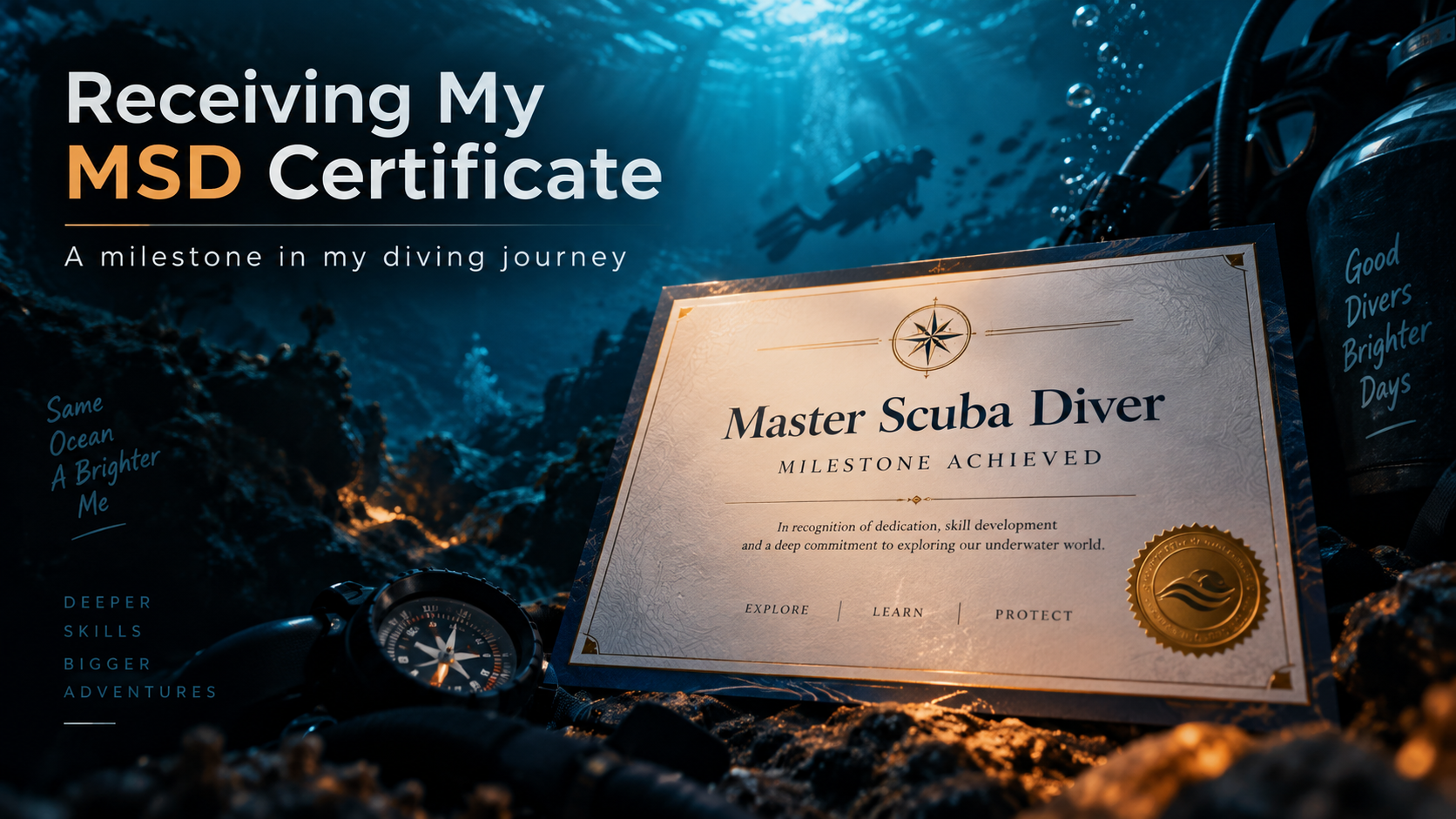
    Receiving My PADI Master Scuba Diver Certificate

    A small card, a big milestone, and a useful moment to look back at how my diving has changed.

    My PADI Master Scuba Diver certificate arrived today.

    On paper, it is another diving card. Another qualification. Another step in the growing pile of plastic, e-cards, logbook notes, kit lists and training records that seem to follow divers around like very expensive confetti.

    But this one feels different.

    Master Scuba Diver is not a professional rating. It does not make me an instructor. It does not mean I have completed diving, solved the ocean, or become immune to doing something daft while wearing neoprene.

    What it does mark is a chapter. A year of showing up, learning, making mistakes, getting colder than planned, fixing kit problems, building confidence, expanding my diving range, and slowly becoming a more rounded diver.

    What the certificate represents

    For me, the certificate is less about status and more about evidence.

    Evidence that I kept going. Evidence that the training has stacked up. Evidence that I moved beyond simply wanting to dive and started building the skills, habits and judgement that make diving safer, broader and more enjoyable.

    The route to Master Scuba Diver brought together several important pieces: Advanced Open Water, Rescue Diver, logged dives, and specialties including Deep, Night, Drysuit, Enriched Air and Equipment Specialist. Some broadened my thinking; others expanded the conditions, depths and environments I was prepared to dive in.

    The certificate and e-card is the simple version of the story. The real story is in the dives, the briefings, the awkward moments, the corrections, the kit changes, the debriefs and the lessons learned along the way.

    Rescue changed the way I think

    Of all the steps on the way to MSD, Rescue Diver was probably the biggest mental shift.

    Before Rescue, it is easy to think mostly about your own dive: your buoyancy, your gas, your comfort, your kit, your plan. Rescue pulls the lens wider. You start thinking more about the team, the site, the conditions, the surface, the exit, stress signals, tired divers, missing divers, and what happens when a simple dive stops being simple.

    That does not make every dive dramatic. Most dives should not be dramatic. That is rather the point.

    Rescue made me more aware of prevention. Small checks. Better briefings. Watching people more carefully. Noticing when someone seems overloaded, cold, quiet, rushed or unsure.

    It also made me realise that being a good buddy is not just about swimming near someone with a regulator in your mouth. It is about being useful before, during and after the dive.

    Deep, night, drysuit and the practical range of diving

    Some qualifications change how you think. Some change where, when and how comfortably you can dive. Some do both.

    Deep Diver was one of the specialties that genuinely expanded my diving range. It was not just about going deeper for the sake of a number. It was about planning, awareness, gas, narcosis, descent control, ascent discipline, and understanding that deeper dives leave less room for casual thinking.

    Night Diver also changed the feel of diving for me. Diving in darkness narrows the world down even further: torch beam, buddy light, signals, depth, time, and the immediate space around you. It makes communication, positioning and awareness feel more deliberate. It also adds a different kind of calm, provided the plan is clear and the team is switched on.

    Drysuit training was another very practical step. UK diving is not always warm, gentle or forgiving, and being more comfortable in a drysuit opens up more of the year and more of the sites I want to dive. It also adds its own task loading, especially around buoyancy, weighting, seals, undersuits and general pre-dive faff.

    Nitrox and equipment training mattered too, but in a slightly different way. I already had my Dive Talk Nitrox+ 50% certification, so the PADI Enriched Air course was not my first exposure to enriched air thinking. It did, however, bring Nitrox properly into my PADI pathway and reinforced the planning mindset around oxygen exposure, depth limits, gas choice and analysing what is actually in the cylinder.

    Equipment Specialist fitted me well because I like understanding how kit works, what can fail, what needs checking, and how small setup choices can make a dive smoother or more annoying. Diving is full of tiny practical details, and tiny practical details are exactly where future faff likes to hide.

    Together, those specialties did not just add badges. They made the diving world wider: deeper dives, darker dives, colder UK conditions, better planning, and a more deliberate approach to the kit and gas that make those dives possible.

    It is not the finish line

    Receiving the MSD certificate does not feel like the end of something. It feels more like a marker post.

    It says: I have built a foundation.

    That foundation matters because the next steps are not smaller. I want to keep developing as a diver, a buddy, and eventually possibly through Divemaster training. I am interested in sidemount, technical foundations, better planning, better trim, better team awareness, and a more deliberate approach to human factors.

    The certificate is not a reason to relax and assume I am now “good enough.” It is a reason to take the next stage seriously.

    The emotional bit

    I am proud of it.

    Not in a chest-beating, “behold my greatness” sort of way. More in the quiet sense of knowing what went into it.

    There were early nerves. There were awkward skills. There were dives where I learned something because something felt clumsy, cold, rushed or harder than expected. There were moments where confidence had to be built rather than assumed.

    There were also dives that quietly changed my sense of what I was capable of. Deeper dives, night dives, drysuit dives, rescue training, more deliberate kit choices, and the slow process of becoming calmer and more useful in the water.

    That is probably why this certificate matters to me. It is not just a reward for completing requirements. It is a reminder that progress often looks like repetition, reflection and turning up again.

    What comes next

    The next part of the journey is about depth rather than badges.

    More experience. Better judgement. More honest logging. More thoughtful kit choices. More human-factors learning. More time in UK conditions. More practice with the basics until they are properly boring, because boring basics are often what make exciting dives safer.

    I also want this journal to track that development properly. Not just the polished bits, but the working bits: the training notes, kit changes, site research, planning, lessons learned, and the small decisions that make a diver better over time.

    Final thought

    Receiving my Master Scuba Diver certificate feels like a good moment to pause, smile, and then get back to work.

    It is a milestone, not a destination.

    And honestly, that is probably the best kind.