Training Notes • Diver Background • Milestones
Receiving My PADI Master Scuba Diver Certificate
A small card, a big milestone, and a useful moment to look back at how my diving has changed.
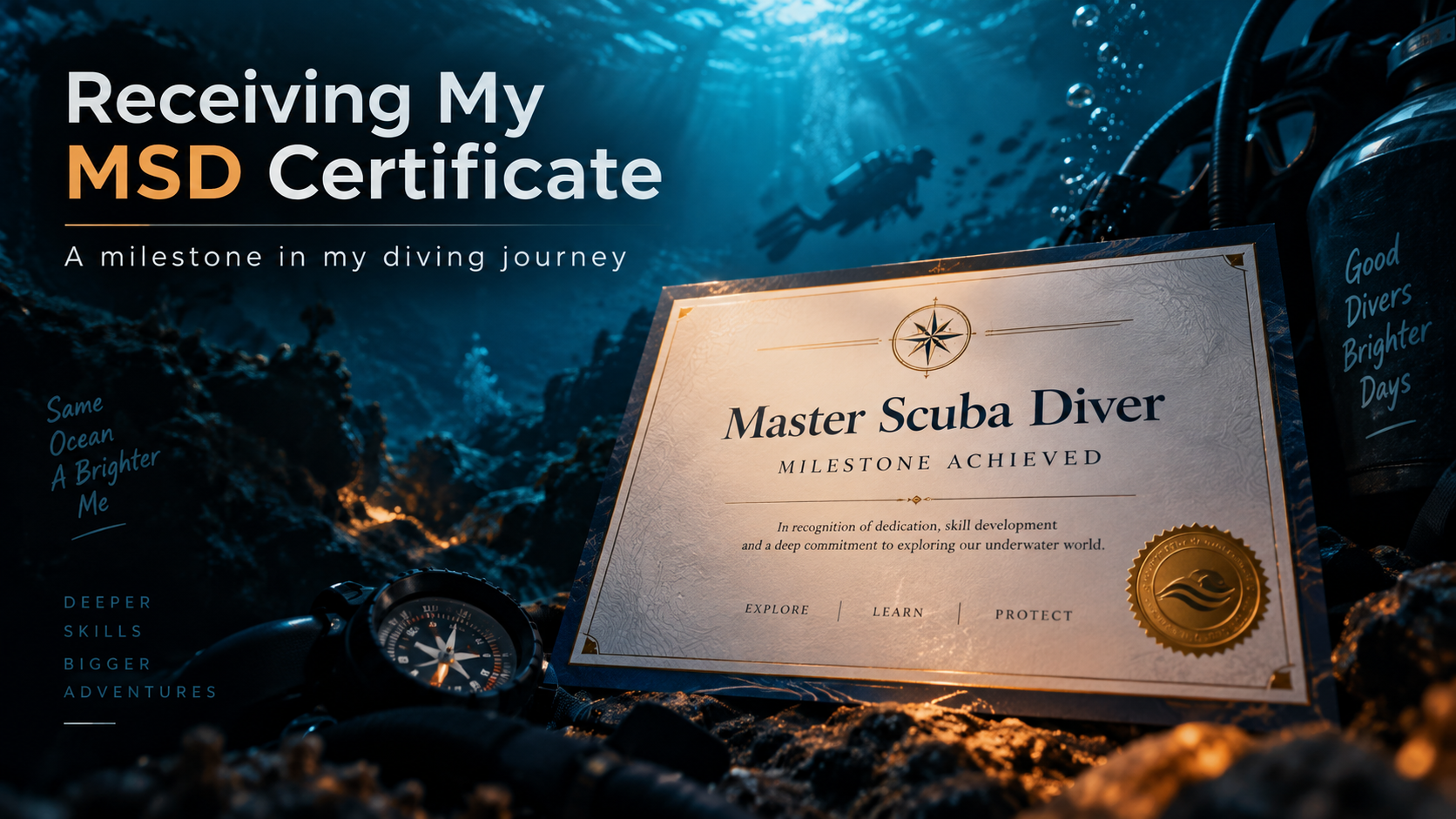
My PADI Master Scuba Diver certificate arrived today.
On paper, it is another diving card. Another qualification. Another step in the growing pile of plastic, e-cards, logbook notes, kit lists and training records that seem to follow divers around like very expensive confetti.
But this one feels different.
Master Scuba Diver is not a professional rating. It does not make me an instructor. It does not mean I have completed diving, solved the ocean, or become immune to doing something daft while wearing neoprene.
What it does mark is a chapter. A year of showing up, learning, making mistakes, getting colder than planned, fixing kit problems, building confidence, expanding my diving range, and slowly becoming a more rounded diver.
What the certificate represents
For me, the certificate is less about status and more about evidence.
Evidence that I kept going. Evidence that the training has stacked up. Evidence that I moved beyond simply wanting to dive and started building the skills, habits and judgement that make diving safer, broader and more enjoyable.
The route to Master Scuba Diver brought together several important pieces: Advanced Open Water, Rescue Diver, logged dives, and specialties including Deep, Night, Drysuit, Enriched Air and Equipment Specialist. Some broadened my thinking; others expanded the conditions, depths and environments I was prepared to dive in.
The certificate and e-card is the simple version of the story. The real story is in the dives, the briefings, the awkward moments, the corrections, the kit changes, the debriefs and the lessons learned along the way.
Rescue changed the way I think
Of all the steps on the way to MSD, Rescue Diver was probably the biggest mental shift.
Before Rescue, it is easy to think mostly about your own dive: your buoyancy, your gas, your comfort, your kit, your plan. Rescue pulls the lens wider. You start thinking more about the team, the site, the conditions, the surface, the exit, stress signals, tired divers, missing divers, and what happens when a simple dive stops being simple.
That does not make every dive dramatic. Most dives should not be dramatic. That is rather the point.
Rescue made me more aware of prevention. Small checks. Better briefings. Watching people more carefully. Noticing when someone seems overloaded, cold, quiet, rushed or unsure.
It also made me realise that being a good buddy is not just about swimming near someone with a regulator in your mouth. It is about being useful before, during and after the dive.
Deep, night, drysuit and the practical range of diving
Some qualifications change how you think. Some change where, when and how comfortably you can dive. Some do both.
Deep Diver was one of the specialties that genuinely expanded my diving range. It was not just about going deeper for the sake of a number. It was about planning, awareness, gas, narcosis, descent control, ascent discipline, and understanding that deeper dives leave less room for casual thinking.
Night Diver also changed the feel of diving for me. Diving in darkness narrows the world down even further: torch beam, buddy light, signals, depth, time, and the immediate space around you. It makes communication, positioning and awareness feel more deliberate. It also adds a different kind of calm, provided the plan is clear and the team is switched on.
Drysuit training was another very practical step. UK diving is not always warm, gentle or forgiving, and being more comfortable in a drysuit opens up more of the year and more of the sites I want to dive. It also adds its own task loading, especially around buoyancy, weighting, seals, undersuits and general pre-dive faff.
Nitrox and equipment training mattered too, but in a slightly different way. I already had my Dive Talk Nitrox+ 50% certification, so the PADI Enriched Air course was not my first exposure to enriched air thinking. It did, however, bring Nitrox properly into my PADI pathway and reinforced the planning mindset around oxygen exposure, depth limits, gas choice and analysing what is actually in the cylinder.
Equipment Specialist fitted me well because I like understanding how kit works, what can fail, what needs checking, and how small setup choices can make a dive smoother or more annoying. Diving is full of tiny practical details, and tiny practical details are exactly where future faff likes to hide.
Together, those specialties did not just add badges. They made the diving world wider: deeper dives, darker dives, colder UK conditions, better planning, and a more deliberate approach to the kit and gas that make those dives possible.
It is not the finish line
Receiving the MSD certificate does not feel like the end of something. It feels more like a marker post.
It says: I have built a foundation.
That foundation matters because the next steps are not smaller. I want to keep developing as a diver, a buddy, and eventually possibly through Divemaster training. I am interested in sidemount, technical foundations, better planning, better trim, better team awareness, and a more deliberate approach to human factors.
The certificate is not a reason to relax and assume I am now “good enough.” It is a reason to take the next stage seriously.
The emotional bit
I am proud of it.
Not in a chest-beating, “behold my greatness” sort of way. More in the quiet sense of knowing what went into it.
There were early nerves. There were awkward skills. There were dives where I learned something because something felt clumsy, cold, rushed or harder than expected. There were moments where confidence had to be built rather than assumed.
There were also dives that quietly changed my sense of what I was capable of. Deeper dives, night dives, drysuit dives, rescue training, more deliberate kit choices, and the slow process of becoming calmer and more useful in the water.
That is probably why this certificate matters to me. It is not just a reward for completing requirements. It is a reminder that progress often looks like repetition, reflection and turning up again.
What comes next
The next part of the journey is about depth rather than badges.
More experience. Better judgement. More honest logging. More thoughtful kit choices. More human-factors learning. More time in UK conditions. More practice with the basics until they are properly boring, because boring basics are often what make exciting dives safer.
I also want this journal to track that development properly. Not just the polished bits, but the working bits: the training notes, kit changes, site research, planning, lessons learned, and the small decisions that make a diver better over time.
Final thought
Receiving my Master Scuba Diver certificate feels like a good moment to pause, smile, and then get back to work.
It is a milestone, not a destination.
And honestly, that is probably the best kind.