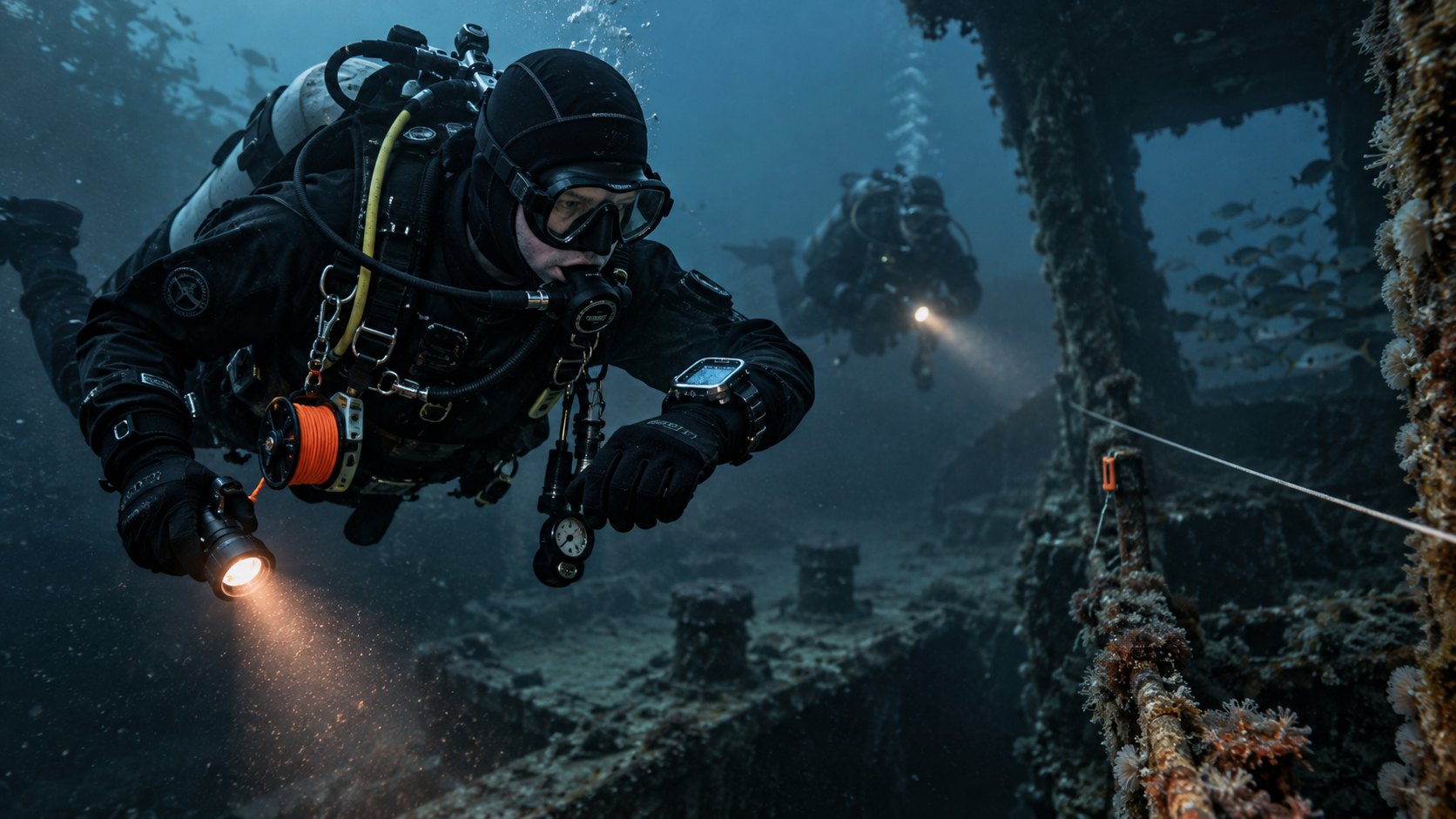
Task loading is one of those diving phrases that sounds more complicated than the idea actually is.
Put simply, it is what happens when too many things are demanding your attention at the same time.
The important bit is that none of those things has to be particularly difficult on its own.
Check gas.
Watch your buddy.
Hold depth.
Navigate.
Control buoyancy.
Deal with cold.
Sort a torch.
Remember where the exit is.
Keep an eye on your computer.
Any one of those is manageable.
Stack enough of them together and suddenly a diver who was perfectly capable five minutes ago starts making poor decisions.
Task loading is rarely one big problem. It is lots of small problems all asking for attention at the same time.
It often starts before the dive
One thing I have become much more aware of is that task loading does not begin when I descend.
It can begin hours earlier.
An early alarm.
A two-to-two-and-a-half-hour drive.
Loading cylinders and kit.
Walking hundreds of metres carrying equipment.
Getting changed.
Realising something is in the wrong bag.
Someone else waiting for you.
Weather getting worse.
None of that is underwater yet, but all of it is already using energy and attention.
That is one reason I bought a gear trolley.
Carrying a full UK setup for 600 metres before the dive does not make me tougher.
It just uses energy I would rather have available when I actually need it.
Equipment can either add load or remove it
My move to a backplate-and-wing changed how I think about equipment.
In my earlier setup, if I managed to get horizontal, I could still have a slate, compass, knife, torch, beacon, magnetic clips, several spools, DSMBs and a large console hanging below me.
Every dangling item was another thing that could move, snag, disappear behind me or need finding.
I gradually moved towards giving everything a home.
Routine-use equipment in one pocket.
Emergency kit in the other.
Backup torch clipped where I expect it.
Nothing hanging because I could not decide where else to put it.
The biggest compliment I can give my XDEEP ZEN is that once I am underwater, I tend to forget it exists.
Gear that disappears into the background gives your brain somewhere else to spend its attention.
Overweighting gave me a very literal lesson
My first open-water drysuit dive gave me one of the clearest examples of task loading I have experienced.
Including my backplate, I had been given around 19 kg.
I now know that, depending on the suit, I am generally happier somewhere around 11–14 kg.
That extra weight did not just mean carrying more lead.
It meant carrying more gas in the suit to compensate.
More gas meant a bigger moving bubble.
A bigger bubble meant more attention needed for trim and buoyancy.
Holding a two-minute hover at around 11 metres became much harder than it needed to be.
The lesson was not simply:
“Too much weight is bad.”
It was:
One setup mistake can quietly create several extra jobs for you underwater.
Then the exit added another layer
After that dive came the St Abbs exit.
Rocky shore.
One-to-two metre swell.
Heavy steel cylinder.
Ballast.
Drysuit.
Wing.
Tired legs.
Someone tried to help and grabbed the corrugated inflator hose on my XDEEP wing.
The hose came off.
I went back underwater and surfaced with a wing full of North Sea.
At that point I was no longer dealing with one problem.
I was dealing with fatigue, unstable footing, swell, heavy equipment and now a compromised wing.
That is what stacking looks like.
It does not require panic.
It just requires the available mental and physical capacity to keep shrinking.
Deep diving makes the budget visible
Deep Diver showed me task loading in a different way.
At 40 metres, I personally did not notice any obvious narcosis.
The instructor could not see a difference in my example tasks either.
But I could absolutely see the gas needle moving.
I am a greedy breather.
At that depth, gas use became very visible.
So I was consciously avoiding wasted movement, checking which gas I was breathing, monitoring depth and watching the NDL disappear surprisingly quickly across repeated deep dives.
None of those jobs was difficult by itself.
But they all had to happen.
That is one reason deeper diving feels different even when you feel calm.
You have fewer spare resources.
Forty metres also taught me something slightly embarrassing
Depth itself can be quite boring.
I remember hovering calmly, looking up at fish above me, out into the deep blue and down into the nothing as the wall continued beneath us.
It was beautiful.
But I also remember thinking:
Why am I actually down here?
The dive was costing me more gas, more NDL and more attention purely because of depth.
That changed how I think about deep diving.
If depth adds task loading, I want there to be an actual reason for accepting the cost.
A wreck feature.
A swim-through.
Marine life.
A training objective.
Something.
Forty metres simply because the computer says forty is not particularly interesting to me.
Night diving did the opposite
This is where task loading gets interesting.
You would expect night diving to increase it.
Darkness.
Lights.
Different communication.
Reduced visibility.
Different navigation cues.
Yet for me, night diving often feels calmer.
My world becomes the torch beam, my buddy, my instruments and the next few metres.
The visual clutter disappears.
Instead of trying to absorb an entire reef, I am dealing with a smaller bubble of information.
That suits my brain.
Night diving did not feel like having less information. It felt like having fewer distractions.
But only if the kit is right
Night diving also shows why redundancy has to be thought through beforehand.
On a night dive, I take a primary light and two strong backups.
If my primary fails, I do not want the failure itself to create a huge new decision-making problem.
I know where the backup is.
I know how to reach it.
I know I still have another reserve.
That reduces the mental cost of the failure.
On a daytime lobster dive, I may only carry one light because losing it does not affect my ability to safely complete the dive.
Redundancy is not just about carrying more.
It is about making failures easier to manage.
A calm buddy reduces load too
Rescue Diver changed the way I look at other divers.
I am more willing now to approach somebody who looks uncomfortable and simply ask:
Hey there, how are you doing?
I may misread somebody.
They may be absolutely fine.
But early communication is cheap.
Waiting until somebody is visibly overwhelmed is expensive.
A buddy team should reduce task loading for each other, not add to it.
That means watching each other, keeping predictable positioning and solving small problems early.
Team positioning helps
Gemma and I tend to dive fairly close together.
One of us leads and the other is slightly offset, around a metre away.
When Matthew is with us, he takes the opposite side and we form a shallow V.
It is not some grand tactical formation.
It is simply easy to understand.
I know roughly where they should be.
They know roughly where I should be.
If somebody is suddenly not there, that change becomes obvious.
Predictability reduces the amount of active checking needed.
Good habits should become boring
I increasingly think one of the goals of training is to make important things boring.
Checking gas.
Knowing where the backup torch is.
Finding the DSMB.
Reaching the dump valve.
Looking for your buddy.
Holding trim.
These things should not require a committee meeting inside my head.
The more automatic the basics become, the more spare capacity I have when something genuinely unusual happens.
That is also why I like practising equipment changes in a pool.
I would rather discover how something behaves when nothing else matters.
My warning signs for rising task loading
I am still learning to recognise this in myself, but there are a few things I pay attention to.
- I start making larger buoyancy corrections instead of small ones.
- I stop noticing scenery because I am concentrating on equipment.
- I repeatedly check the same instrument because I did not properly process the information the first time.
- I become less aware of where my buddy is.
- I feel rushed even when nobody is actually rushing me.
- Simple tasks suddenly feel irritating.
- I realise I am reacting rather than thinking ahead.
None of those automatically means the dive must end.
They mean I should notice what is happening.
This is where Stop. Think. Assess fits
Task loading is exactly why I like the Stop. Think. Assess framework.
When the mental workload starts climbing, the instinct can be to move faster.
Fix everything.
Catch up.
Continue.
Sometimes the better response is the opposite.
Stop.
Stabilise.
Work out which problem actually matters.
Deal with that one.
Pause.
Reassess.
When everything feels important, the first job is often deciding what is actually important.
Final thought
Task loading is dangerous partly because it does not always feel dramatic.
You may simply feel busy.
Slightly rushed.
Slightly uncomfortable.
Slightly behind the dive.
And then another small thing happens.
The goal for me is not to eliminate task loading.
Diving will always require us to manage several things at once.
The goal is to stop wasting capacity on problems I could have removed earlier.
Better weighting.
Cleaner equipment.
Predictable buddy positioning.
Proper redundancy.
Enough rest.
Slower decisions.
And the willingness to stop when the stack starts getting too high.
The safest spare capacity is the capacity you never wasted in the first place.