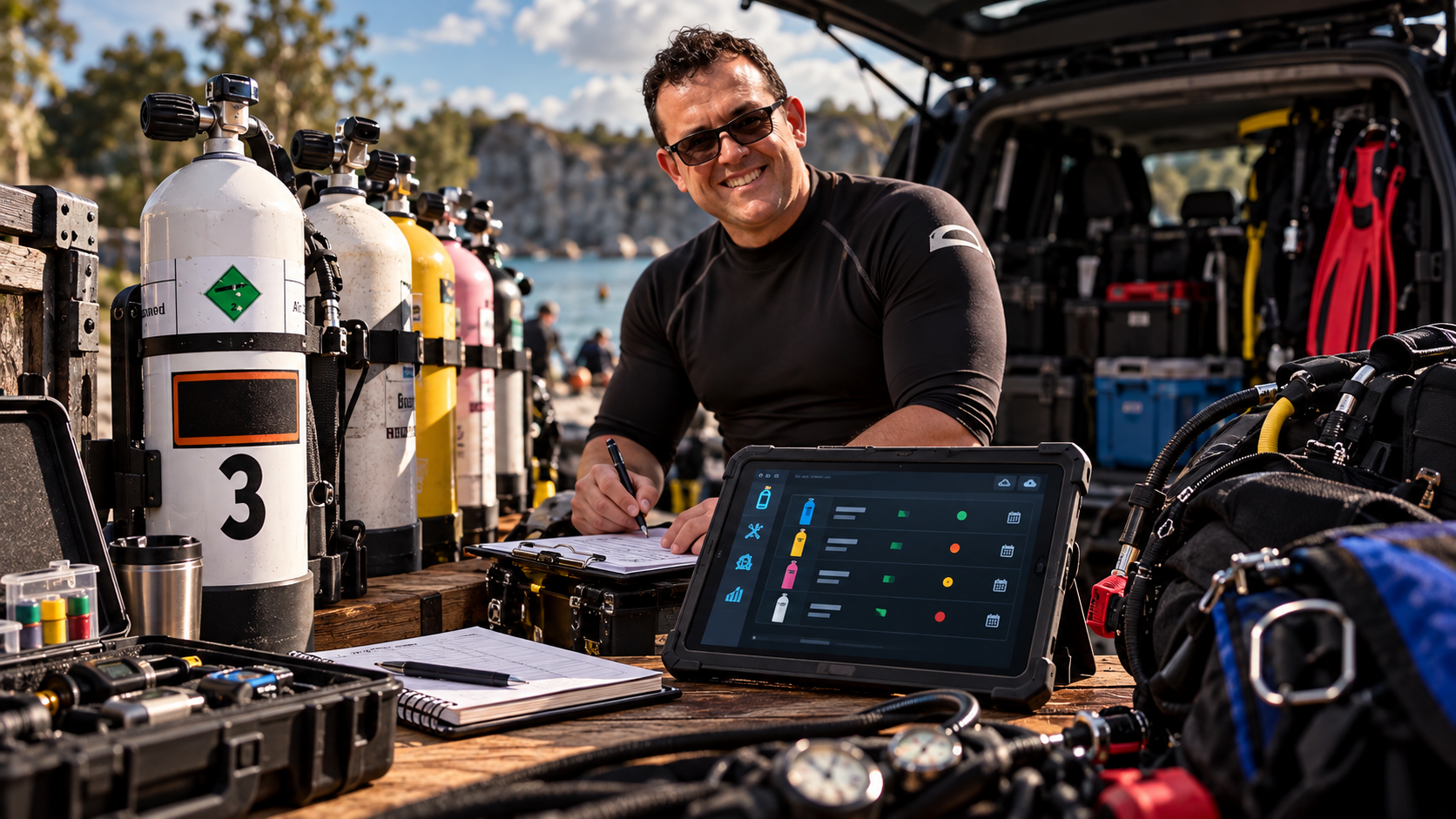
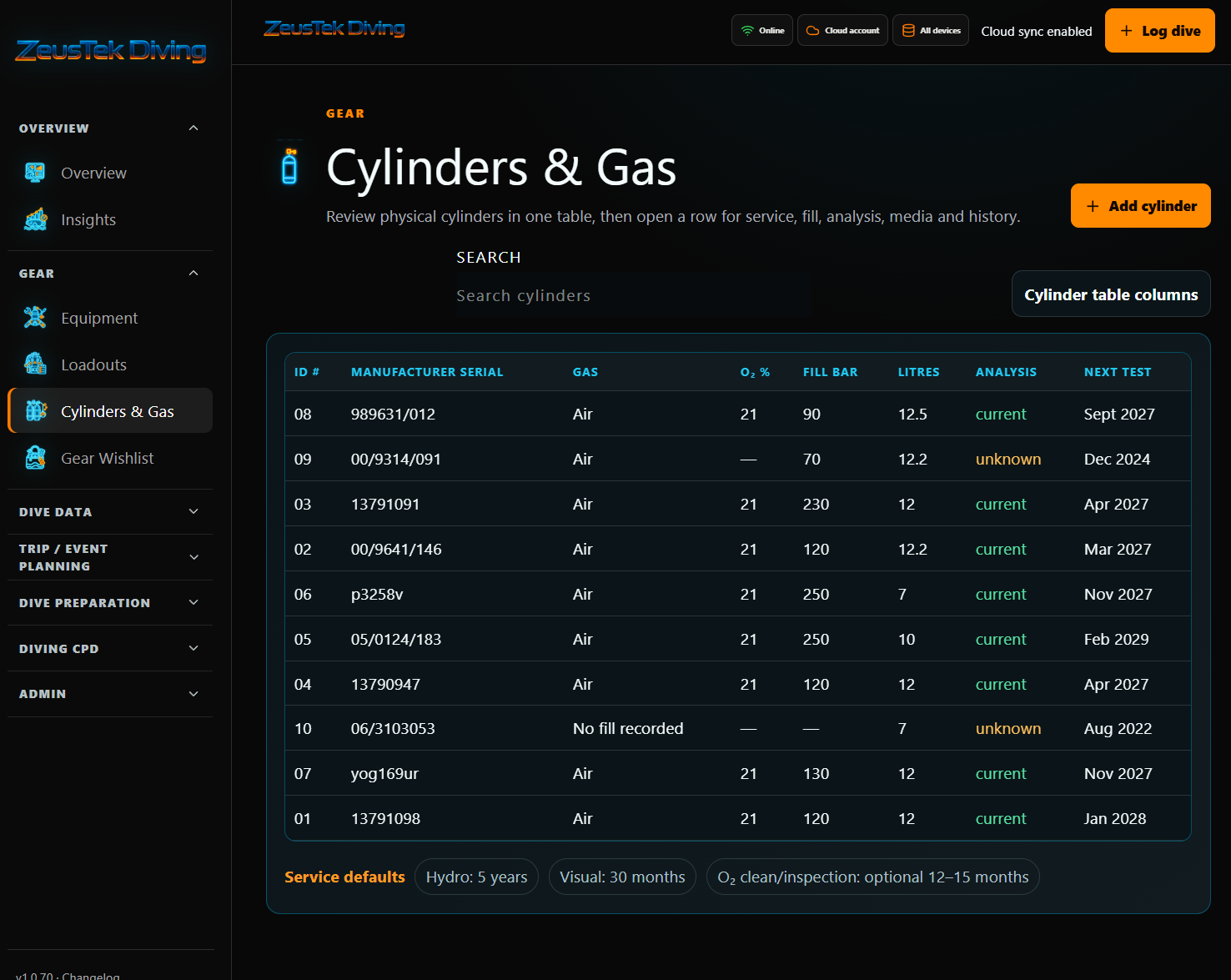
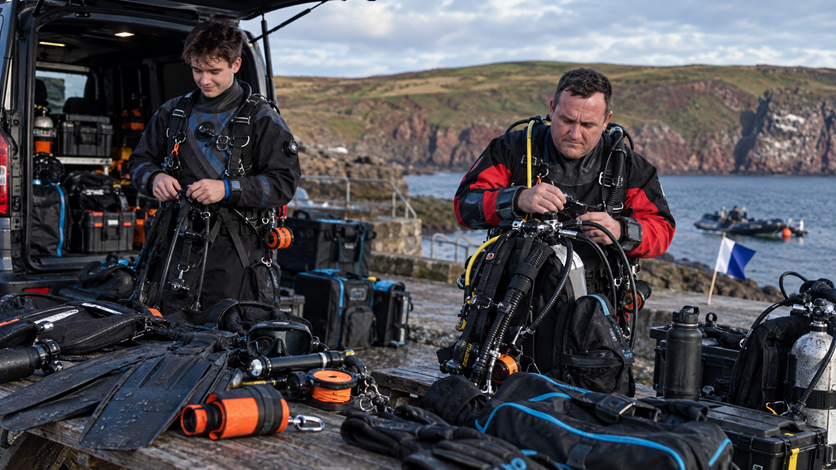
I have started thinking of it as the pre-dive faff factor.
None of it is dramatic.
An early alarm.
A long drive.
A heavy cylinder.
Something left in the wrong bag.
Boots refusing to cooperate.
Somebody asking where the spare reel is.
Walking what feels like half a county carrying a fully assembled UK dive setup.
By itself, none of that is a problem.
But stack enough little annoyances together and you can arrive at the water already tired, warm, irritated and mentally busy.
Task loading does not begin at depth. Sometimes it begins in the car park.
A UK dive day can start very early
A lot of my UK diving involves a two-to-two-and-a-half-hour drive before I even reach the site.
That often means an early start.
Then there is unloading.
Cylinder.
Wing.
Exposure suit.
Weights.
Fins.
Regulators.
Lights.
Bags.
The bits that somehow multiply every time you look away.
Even if the dive itself is straightforward, the logistics can already be taking a bite out of the energy budget.
The 600-metre lesson
One of the most obvious examples for me was walking around 600 metres carrying dive equipment.
There is a part of diving culture that can sometimes treat unnecessary suffering as if it is evidence of commitment.
Personally, I would rather save the effort for the actual dive.
That is why I bought a gear trolley.
It is not glamorous.
It is not technical.
It is a set of wheels.
But if those wheels save me from burning a chunk of my energy before I reach the water, they have done something useful.
Carrying more than you need to prove that you can is not the same as preparing well.
Heavy kit changes the whole morning
UK diving kit is not subtle.
A steel cylinder can still weigh around 14 kg when empty.
Add a backplate, wing, regulators, ballast, drysuit, boots and everything else and suddenly you are moving around with the equivalent of an extra child attached to your back and hips.
That matters before the dive.
It matters on the walk in.
It matters while standing around waiting.
It matters at the entry.
And it definitely matters when you are trying to get back out over rocks in a swell.
Energy management is part of dive planning whether we call it that or not.
Donning slowly is faster
Drysuit diving taught me that rushing the process is usually a false economy.
Donning and doffing a drysuit is something I prefer to do slowly and steadily.
Heavy undersuits can make movement awkward.
Rental suits can make fin donning feel like an Olympic flexibility event.
Gloves, seals, zips, boots and hoses all become harder to manage if I am already hot and trying to hurry.
Slowing down usually gets me ready quicker because I am not correcting mistakes created by rushing.
Slow is smooth. Smooth is usually quicker than fixing something you rushed.
Being too warm is task loading too
I naturally run warm.
That means I can be stood around in cold-water equipment feeling like I am slowly cooking while waiting to enter the water.
Then I get underwater and my body and hands are wonderfully warm while my face feels as though somebody has pressed it against a freezer.
UK diving has a sense of humour.
The point is that thermal comfort is not only an underwater issue.
Overheating while kitting up can leave you tired and irritated before the dive starts.
For me, that is another reason not to automatically reach for the thickest possible undersuit.
More insulation is not useful if it makes the whole preparation process harder than it needs to be.
Organisation beats memory
I do not want to rely on remembering where I put something while everyone is standing around waiting.
The more I dive, the more I want equipment to have a predictable place.
That applies underwater and on land.
If I know which bag contains the spare mask, where the DSMB is, which pocket the backup spool lives in, and where the batteries are, I am not spending mental effort searching.
The same principle that makes my BP/W feel cleaner underwater makes the dive day calmer on the surface.
The less I have to search for, remember or improvise, the more capacity I keep for the dive.
Bring what the dive actually needs
One of the biggest changes in my equipment thinking has been moving away from carrying everything because I own it.
If I am doing a daytime lobster dive, I do not need the same light redundancy I would take at night.
If I am not doing a survey, I probably do not need a giant slate.
If a piece of kit serves no purpose on that dive, carrying it can create more faff than benefit.
This does not mean cutting safety equipment.
It means making the equipment list deliberate.
Required.
Useful.
Backup.
Or staying in the bag.
Pool testing saves open-water faff
Hiring the five-metre pool to test our XDEEP ZENs was one of the better equipment decisions Gemma and I made.
It cost about £50.
For that, we got a controlled environment where we could adjust harnesses, check trim, practise skills and learn the rigs without adding current, waves, cold or a difficult exit.
That kind of shakedown removes uncertainty.
If I can discover that something rubs, moves or sits badly in a pool, that is one less problem waiting for me on the actual dive.
If possible, I also like the idea of sticking a camera on the pool wall and recording the session.
What feels perfectly horizontal may look rather more interpretive-dance when viewed afterwards.
The entry should be part of the plan
My St Abbs drysuit dives reinforced that the entry and exit are not just the bits before and after the “real” dive.
They are part of the dive.
A straightforward boat entry is very different from walking fully equipped over uneven ground.
A calm ladder exit is very different from a rocky shore with a one-to-two metre swell.
I much prefer boat diving.
To be fair, I prefer boat diving in tropical water too, so this is hardly a surprising revelation.
But whatever the site, I now want to understand how I am getting in and how I am getting back out before I start the dive.
And plan the exit while you still feel fresh
The exit can easily be the physically hardest part of a UK shore dive.
You are carrying the same equipment you entered with.
But now you may be tired.
The cylinder may be lighter, but you are not necessarily feeling lighter.
If the upper rocks are safe and stable, removing dumpable weight before completing the climb can make a big difference.
That is not cheating.
It is using the equipment as designed.
The goal is to get everybody out safely, not preserve the artistic purity of your complete kit configuration until you reach the car.
Helpful people can accidentally create more faff
At St Abbs, someone tried to help me out of the water by grabbing the corrugated inflator hose on my wing.
The hose disconnected.
I went back underwater.
The wing filled with water.
Not ideal.
But the lesson was not that nobody should help me.
The lesson was that assistance works better when everybody understands the equipment.
Afterwards, while repairing it, I explained that the cylinder valve or shoulder straps were safer places to get hold of me.
I thanked him for trying.
No drama required.
A buddy can remove faff too
Diving regularly with Gemma has advantages that have nothing to do with romance.
We know each other’s equipment.
We know roughly where things live.
We know how we normally position ourselves.
We know what “something feels off” looks like in each other.
And occasionally she needs me to retrieve the crotch strap on her BP/W.
That familiarity removes little bits of uncertainty.
When Matthew dives with us, we can give him a predictable place in the team too.
Predictability is underrated.
The pre-dive checklist I am moving towards
I am increasingly trying to make the preparation stage answer a few simple questions.
- Am I rested enough for the dive I am planning?
- Do I actually need everything I am carrying?
- Is my equipment where I expect it to be?
- Have I tested anything new before relying on it?
- Am I correctly weighted for this configuration?
- Do I understand the entry?
- Do I understand the exit?
- Is there an easier way to move the equipment to the water?
- Does my buddy understand anything unusual about my setup?
- Am I already tired, overheated or irritated?
That last question may be the most important.
Because sometimes the answer is not another equipment adjustment.
Sometimes the answer is:
Sit down.
Drink something.
Cool off.
Stop rushing.
Faff is a human-factors problem
It is tempting to treat all of this as convenience.
Nice-to-have organisation.
Better bags.
A trolley.
Cleaner equipment.
But I increasingly see it as human factors.
Every unnecessary problem I solve on land consumes attention, patience or physical energy.
If I arrive at the water already at 80% capacity, I have less left when something genuinely unexpected happens underwater.
Good preparation is not about making the dive perfect. It is about keeping enough capacity for when it isn’t.
Final thought
I do not think the goal is to remove every bit of pre-dive faff.
This is scuba diving.
There will always be a hose that has somehow tied itself around something impossible.
Somebody will forget where they put their mask.
A glove will disappear.
Britain will provide weather.
The goal is to stop creating unnecessary problems for ourselves.
Move the kit sensibly.
Organise it.
Test new configurations somewhere easy.
Know the entry and exit.
Bring what the dive needs.
And arrive at the water with enough energy left to actually enjoy being there.
Spend less energy on the faff so you have more left for the dive.