Tag: confidence

  • Receiving my PADI Master Scuba Dive

    Receiving my PADI Master Scuba Dive

    Training Notes • Diver Background • Milestones

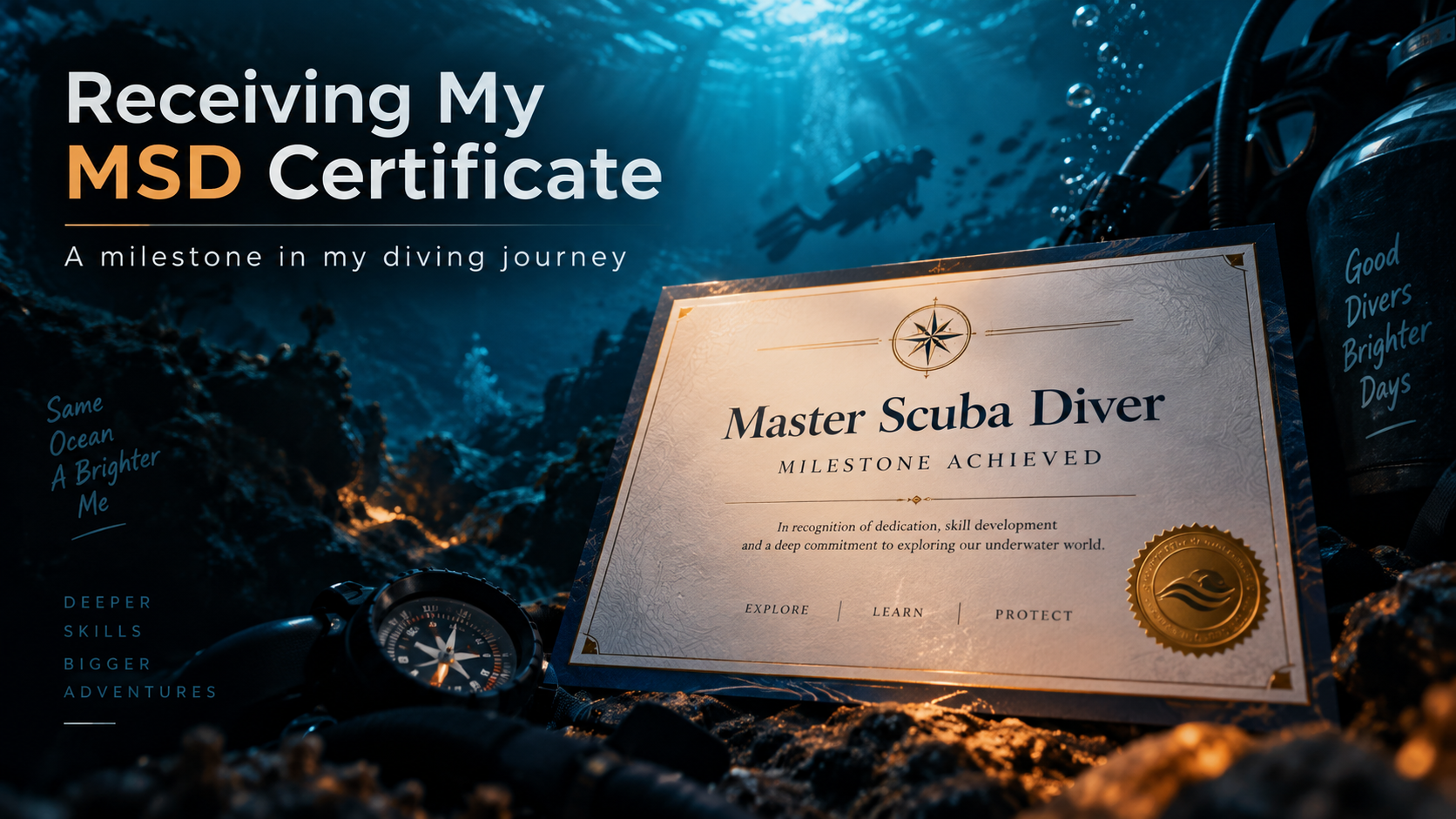
    Receiving My PADI Master Scuba Diver Certificate

    A small card, a big milestone, and a useful moment to look back at how my diving has changed.

    My PADI Master Scuba Diver certificate arrived today.

    On paper, it is another diving card. Another qualification. Another step in the growing pile of plastic, e-cards, logbook notes, kit lists and training records that seem to follow divers around like very expensive confetti.

    But this one feels different.

    Master Scuba Diver is not a professional rating. It does not make me an instructor. It does not mean I have completed diving, solved the ocean, or become immune to doing something daft while wearing neoprene.

    What it does mark is a chapter. A year of showing up, learning, making mistakes, getting colder than planned, fixing kit problems, building confidence, expanding my diving range, and slowly becoming a more rounded diver.

    What the certificate represents

    For me, the certificate is less about status and more about evidence.

    Evidence that I kept going. Evidence that the training has stacked up. Evidence that I moved beyond simply wanting to dive and started building the skills, habits and judgement that make diving safer, broader and more enjoyable.

    The route to Master Scuba Diver brought together several important pieces: Advanced Open Water, Rescue Diver, logged dives, and specialties including Deep, Night, Drysuit, Enriched Air and Equipment Specialist. Some broadened my thinking; others expanded the conditions, depths and environments I was prepared to dive in.

    The certificate and e-card is the simple version of the story. The real story is in the dives, the briefings, the awkward moments, the corrections, the kit changes, the debriefs and the lessons learned along the way.

    Rescue changed the way I think

    Of all the steps on the way to MSD, Rescue Diver was probably the biggest mental shift.

    Before Rescue, it is easy to think mostly about your own dive: your buoyancy, your gas, your comfort, your kit, your plan. Rescue pulls the lens wider. You start thinking more about the team, the site, the conditions, the surface, the exit, stress signals, tired divers, missing divers, and what happens when a simple dive stops being simple.

    That does not make every dive dramatic. Most dives should not be dramatic. That is rather the point.

    Rescue made me more aware of prevention. Small checks. Better briefings. Watching people more carefully. Noticing when someone seems overloaded, cold, quiet, rushed or unsure.

    It also made me realise that being a good buddy is not just about swimming near someone with a regulator in your mouth. It is about being useful before, during and after the dive.

    Deep, night, drysuit and the practical range of diving

    Some qualifications change how you think. Some change where, when and how comfortably you can dive. Some do both.

    Deep Diver was one of the specialties that genuinely expanded my diving range. It was not just about going deeper for the sake of a number. It was about planning, awareness, gas, narcosis, descent control, ascent discipline, and understanding that deeper dives leave less room for casual thinking.

    Night Diver also changed the feel of diving for me. Diving in darkness narrows the world down even further: torch beam, buddy light, signals, depth, time, and the immediate space around you. It makes communication, positioning and awareness feel more deliberate. It also adds a different kind of calm, provided the plan is clear and the team is switched on.

    Drysuit training was another very practical step. UK diving is not always warm, gentle or forgiving, and being more comfortable in a drysuit opens up more of the year and more of the sites I want to dive. It also adds its own task loading, especially around buoyancy, weighting, seals, undersuits and general pre-dive faff.

    Nitrox and equipment training mattered too, but in a slightly different way. I already had my Dive Talk Nitrox+ 50% certification, so the PADI Enriched Air course was not my first exposure to enriched air thinking. It did, however, bring Nitrox properly into my PADI pathway and reinforced the planning mindset around oxygen exposure, depth limits, gas choice and analysing what is actually in the cylinder.

    Equipment Specialist fitted me well because I like understanding how kit works, what can fail, what needs checking, and how small setup choices can make a dive smoother or more annoying. Diving is full of tiny practical details, and tiny practical details are exactly where future faff likes to hide.

    Together, those specialties did not just add badges. They made the diving world wider: deeper dives, darker dives, colder UK conditions, better planning, and a more deliberate approach to the kit and gas that make those dives possible.

    It is not the finish line

    Receiving the MSD certificate does not feel like the end of something. It feels more like a marker post.

    It says: I have built a foundation.

    That foundation matters because the next steps are not smaller. I want to keep developing as a diver, a buddy, and eventually possibly through Divemaster training. I am interested in sidemount, technical foundations, better planning, better trim, better team awareness, and a more deliberate approach to human factors.

    The certificate is not a reason to relax and assume I am now “good enough.” It is a reason to take the next stage seriously.

    The emotional bit

    I am proud of it.

    Not in a chest-beating, “behold my greatness” sort of way. More in the quiet sense of knowing what went into it.

    There were early nerves. There were awkward skills. There were dives where I learned something because something felt clumsy, cold, rushed or harder than expected. There were moments where confidence had to be built rather than assumed.

    There were also dives that quietly changed my sense of what I was capable of. Deeper dives, night dives, drysuit dives, rescue training, more deliberate kit choices, and the slow process of becoming calmer and more useful in the water.

    That is probably why this certificate matters to me. It is not just a reward for completing requirements. It is a reminder that progress often looks like repetition, reflection and turning up again.

    What comes next

    The next part of the journey is about depth rather than badges.

    More experience. Better judgement. More honest logging. More thoughtful kit choices. More human-factors learning. More time in UK conditions. More practice with the basics until they are properly boring, because boring basics are often what make exciting dives safer.

    I also want this journal to track that development properly. Not just the polished bits, but the working bits: the training notes, kit changes, site research, planning, lessons learned, and the small decisions that make a diver better over time.

    Final thought

    Receiving my Master Scuba Diver certificate feels like a good moment to pause, smile, and then get back to work.

    It is a milestone, not a destination.

    And honestly, that is probably the best kind.

  • Why I Came Back to Diving After Nearly 30 Years

    Return to diving • Confidence • Training journey

    Why I Came Back to Diving After Nearly 30 Years

    I first tried scuba diving in 1995. It went badly enough that, for years afterwards, even putting my head under water could bring the fear back. This is the story of why I came back to diving, what changed, and how a nightmare became a lifelong hobby.

    Corfu, 1995

    I first tried scuba diving in 1995.

    I was in Corfu, doing Open Water and Advanced Open Water together on the same course. I cannot honestly remember the agency, so I am not going to guess, but I remember the experience clearly enough.

    And it did not go well.

    In fact, “did not go well” is doing quite a lot of heavy lifting there. Knowing what I know now, the course was badly run and badly designed. On day three, on what I think was only my fifth dive, I was taken to around 28 metres.

    That is a lot, very early.

    The Dive That Changed Everything

    At 100 bar I told the instructor about my gas. We stayed at depth until I was down to around 50 bar. I got to the instructor’s octopus, switched to it, and signalled why. He then turned quickly and swam off, pulling the octopus out of my mouth.

    I had to switch back to my own gas, which then ran out before I could reach him or make a safe ascent.

    I got to the surface, swallowed water, passed out, and woke up on the boat being told off.

    So yes, not exactly the charming “welcome to scuba diving” brochure moment.

    The Divemaster, Ben, was kind to me afterwards. He was probably the only reason I tried a couple more dives on that trip. But the damage was done. For a year or two afterwards, even putting my head under water in the bath could trigger panic.

    Scuba had gone from something exciting to something my body treated like a threat.

    A bad instructor helped turn diving into a nightmare. A good instructor helped turn it back into a possibility.

    The Long Gap

    For years, diving was not something I thought I would come back to.

    I did eventually get back into snorkelling, especially in the Red Sea around 2013. That helped. I loved watching reefs and fish from the surface. There was still something about the underwater world that pulled me in.

    But scuba? Proper scuba? Breathing underwater again?

    That still sat in a different box in my head.

    The “absolutely not, thank you very much” box.

    Trying Again in 2024

    In May 2024, as a family, we decided to try diving.

    That first try dive was not perfect. As soon as I jumped in and tried to breathe underwater, some of the old memories came straight back. Not as a nice gentle memory either. More like my brain kicked the door open and shouted, “Remember Corfu?”

    Gemma also started to panic.

    That could easily have been the end of it.

    But our instructor, Wessam Fayez, in Sharm, handled it brilliantly. He settled both of us, got us breathing, got us thinking, and helped all four of us have a great try dive on a local reef.

    That changed everything.

    Gemma, the Catalyst

    Gemma was the catalyst.

    After that try dive, she was in love with diving and wanted to do more. So Gemma, Matthew and I decided to do our Open Water together.

    That mattered. It was not just me trying to prove something to myself. It became something we could share.

    But I would be lying if I said the fear vanished.

    It did not.

    There are still moments, especially when my face first hits the water, where I get that 10 to 30 seconds of fear. That little mammalian alarm response. My brain briefly asks, “Are we sure about this, big lad?”

    Most of the time now, the answer is yes.

    But it is still there sometimes.

    Rebuilding Trust

    The hardest part of coming back was not just the water.

    It was trust.

    Trusting an instructor again after Corfu was hard. Trusting someone with me was one thing. Trusting someone with Gemma and Matthew was another level entirely.

    That is where good instruction made the difference.

    Wessam helped me get back in. Gemma helped pull me forward. The Rescue Diver course helped me calm down and think better. Reading around human factors helped me understand more about what goes wrong, why people make poor decisions, and how teams can manage risk better.

    I like that side of diving.

    I like the thinking.

    I like the planning, the problem-solving, the “what if?” conversations, and the little details that make a dive safer and calmer. Diving scratches the same analytical part of my brain that likes systems, evidence, preparation and debriefing.

    It is not just floating about looking at pretty fish.

    Although, to be fair, floating about looking at pretty fish is also excellent.

    The Moments That Keep Me Going

    I am still not sure I have had one clean moment where I thought, “Yes, I can definitely do this now.”

    It has been more gradual than that.

    There are still times when I ask myself whether I can do it. But since doing Rescue Diver, that voice is quieter. I have more tools now. More understanding. More confidence that I can think through problems rather than just react to them.

    And then there are the good moments.

    Swimming with rays. Seeing sharks. Being on a reef and feeling that ridiculous sense of wonder. Watching marine life and then going home to my own reef tanks, where the same fascination continues in miniature.

    That helps. The reef tanks are relaxing, but they also keep me connected to the underwater world between dives.

    They are basically expensive, salty therapy boxes.

    From Open Water to Master Scuba Diver

    Master Scuba Diver was not originally some grand plan.

    I probably would not have chased it quite the same way if PADI had not been offering it for free at the time. But the specialties I chose were not random badge collecting. They were linked to the kind of diving I am interested in: drysuit, nitrox, deep, night, equipment, wreck, overhead environments, and eventually technical-style progression.

    For me, Master Scuba Diver feels less like an endpoint and more like a marker.

    It is a signal to stop thinking only in terms of basic recreational diving and to start asking bigger questions.

    Do I want to move towards Divemaster?

    Do I want to explore sidemount properly?

    Do I want to move into Tec?

    What kind of diver do I actually want to become?

    Why Divemaster Is on My Mind

    I am looking at Divemaster, but not because I am desperate to teach.

    I have taught before in other parts of my life. Teaching is not some shiny new fantasy for me. I am not currently looking to jump back into formal teaching or become an instructor.

    But Wessam put the idea in my head back in May 2026. He thought it was something I might be ready for.

    That stuck.

    For me, Divemaster is interesting because it could make me a better buddy, a calmer team member, and someone more useful around other divers. I like the idea of developing the awareness, control and responsibility that comes with professional-level training, even if I never turn it into a job.

    Why Tec and Sidemount Appeal

    Technical diving interests me for three main reasons.

    First, I want to see more.

    Second, I want to be safer.

    Third, I am analytical by nature, so the planning side appeals to me. Gas, redundancy, configuration, limits, procedures, decision-making — that all makes sense to my brain.

    Sidemount also appeals for very practical reasons. I have dived with a side-slung pony and it felt good. Getting cylinders off my back could make some shore and coastal entries much nicer, especially in the UK where some of the walks from the car park to the entry point feel like a punishment invented by someone who hates knees.

    Future me may still complain. But future me may complain with better cylinder logistics.

    What I Learned

    If there is one thing I want people to take from this, it is this:

    A good instructor can be the difference between a nightmare and a lifelong hobby.

    My first experience nearly ended diving for me before it had properly begun.

    Coming back took time. It took family. It took the right instructor. It took trust. It took a willingness to feel uncomfortable and try anyway.

    Now diving has become a major part of my life.

    I am still learning. I still have fear sometimes. I still have moments where I question myself. But I also have dives, memories, skills and ambitions that I would never have had if I had let 1995 be the end of the story.

    So this journal starts there.
    With a bad first chapter. And a much better second one.
  • Welcome

    Welcome • Dive journal • Training notes • Kit • Sites

    Welcome to the ZeusTek Dive Journal

    This is my public scuba diving journal: a place to share the journey, the training, the mistakes, the good dives, the kit experiments and the lessons that come from trying to become a calmer, safer and more useful diver.
    Category: Training Notes · Tags: welcome, return to diving, training, dive journal
    Starting point

    What This Site Is

    ZeusTek Dive Journal is where I am collecting my scuba diving journey in one place. It covers dive logs, training notes, equipment progression, dive-site thoughts, trip reflections and the odd bit of kit-nerd waffle.

    I came back to diving properly after a long gap, rebuilt confidence, worked through training, reached Master Scuba Diver and started looking seriously at Divemaster, sidemount and possible technical pathways.

    This site is not meant to be a polished “I know everything” expert blog. It is a learning journal. Sometimes that means celebrating progress. Sometimes it means writing down what went wrong so I can learn from it.

    Why I am sharing it

    The Point of the Journal

    I wanted somewhere to share the journey from the inside: not just the pretty reef moments, but the training decisions, confidence wobbles, equipment changes, mistakes, human factors and little lessons that make diving better.

    If someone else is coming back to diving, nervous about getting in the water, trying to make sense of kit choices, or wondering what the path from recreational diving into Pro or Tec might look like, hopefully parts of this will be useful.

    Also, if I do not write things down, my brain stores them in the same filing system as random regulator model numbers, zombie fiction plots and where I definitely put that one spool. So, yes. A journal was needed.

    The goal is simple: dive better, think clearer, build confidence, and become the kind of buddy people feel safe and relaxed diving with.
    What you will find here

    The Main Sections

    How I write

    Honest Notes, Not Perfect Dives

    I am interested in the useful bits: what worked, what did not, what felt harder than expected, what kit helped, what skill needs practice and what decisions mattered.

    • Training: what each course or workshop actually taught me
    • Sites: what a place is useful for, not just whether it looked pretty
    • Equipment: what works in real use, not just what looks good online
    • Human factors: communication, task loading, awareness and decision-making
    • Progression: how recreational diving may lead into Divemaster, sidemount and technical training
    Public site

    A Quick Note on Privacy

    This is a public site, so I keep live travel details, private family information and sensitive personal details off it. Trip notes are written as reflections after the event, not live location updates.

    I may share public dive locations, dive centres, general areas, lessons learned and useful travel/dive preparation notes. I will not use the site to publish live itineraries or turn family time into public content.

    Comments

    Feedback Is Welcome

    Sensible comments, useful experience, dive-site tips, gear thoughts and constructive disagreement are welcome. I am learning, and good input from other divers is valuable.

    Comments are moderated, because the internet occasionally behaves like an untrained goblin with a keyboard. Useful discussion is welcome. Spam, bots and drive-by nonsense can stay on the surface interval.

    So, welcome.
    This journal is here to track the journey: from coming back to diving, to building confidence, to Master Scuba Diver, and now towards whatever comes next in the Pro and Tec direction.