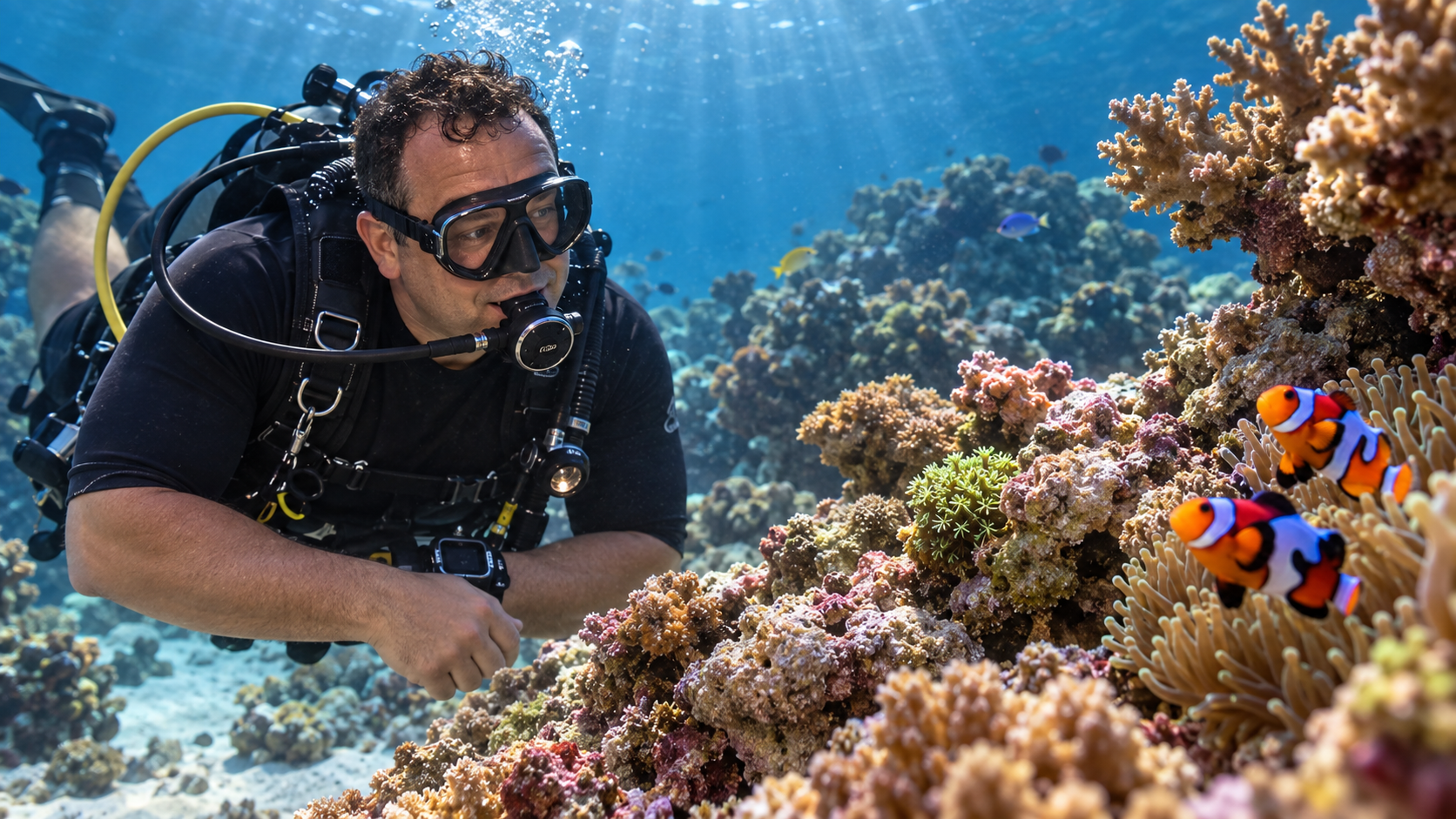
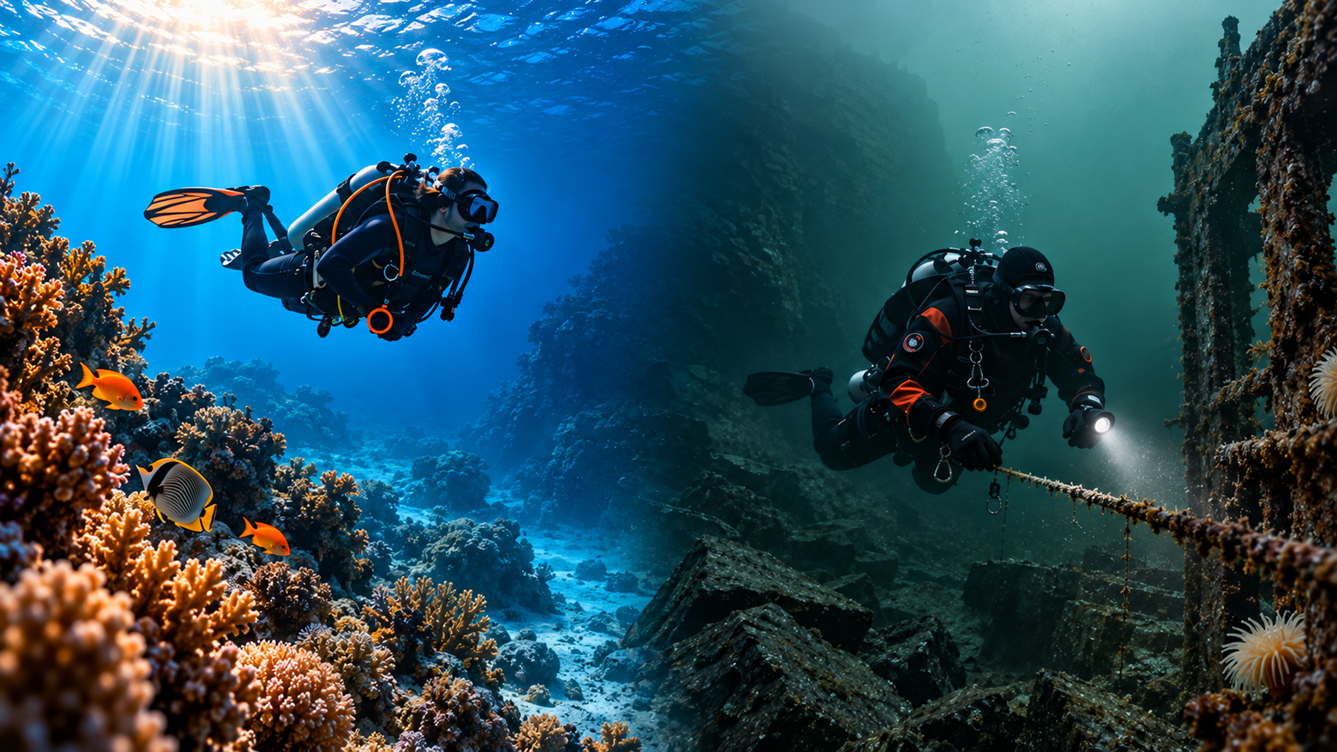
I started diving in the Red Sea.
That probably shaped me more than I realised at the time. Warm water, clear visibility,
colour everywhere, fish everywhere, and that ridiculous feeling of dropping below the surface
and suddenly being somewhere completely different.
It is the sort of diving that makes you understand very quickly why people get hooked.
Then I came back to the UK and did my Advanced Open Water inland at Capernwray.
Different world. Different pace. Different lessons.
The Red Sea gave me the magic
Holiday diving can feel almost unfairly beautiful.
The Red Sea gives you warmth, light, colour, visibility and marine life in a way that is very
easy to fall in love with. It is the version of diving that looks like the posters. Blue water,
coral, fish, sunshine, and that strange quiet that appears once your head goes below the surface.
For me, that first experience mattered because it gave scuba an emotional hook. It was not just
a sport or a training pathway. It was a doorway into a world I wanted to keep visiting.
It also made diving feel possible. I could experience the underwater world, move through it, see
things I had only seen in aquariums or documentaries, and feel that strong pull to do more.
Holiday diving gave me the wonder.
Capernwray gave me structure
Capernwray was a very different kind of diving.
It was inland UK diving, not warm-water holiday diving. Less coral reef magic, more controlled
training site. Less tropical colour, more structure, briefings, skills, checks, procedures and
repetition.
That was exactly what I needed for Advanced Open Water.
AOW at Capernwray gave me a more deliberate training environment. It made the diving less about
simply enjoying the underwater world and more about developing as a diver. Buoyancy, awareness,
task focus, navigation, depth, buddy work and the rhythm of a proper training day all started to
matter more.
It was not better than the Red Sea. It was different.
The Red Sea had shown me why I wanted to dive. Capernwray started showing me how to become better
at it.
The North East coast made it real
Rescue took the contrast even further.
Doing Rescue on the North East coast, in North Sea conditions, gave the training a different weight.
It was not just about performing skills in a neat, tidy way. It was about thinking about the site,
the surface, the exit, the cold, the conditions, tired divers, stress signals, and what happens when
a normal dive starts to unravel.
UK sea diving has a realism to it. Weather matters. Temperature matters. Visibility matters. Getting
in and out matters. Kit choices matter. Timing matters. Communication matters.
Rescue in that setting made me think more seriously about the whole dive, not just the underwater
bit.
That is where UK diving started to feel less like a substitute for holiday diving and more like a
powerful training ground in its own right.
What holiday diving gives me
I do not see holiday diving as “easy mode” in a dismissive way. That would be unfair.
Holiday diving gives a lot. Warmth reduces one kind of task loading. Better visibility can make
navigation, buddy awareness and marine-life observation feel more natural. Repeated dives over a trip
can build rhythm and confidence. Boat routines, guided dives and relaxed conditions can help you enjoy
diving without every moment being shaped by cold-water logistics.
It also gives something that should not be underrated: joy.
Seeing reefs, fish, wrecks, light, colour and open blue water is not a soft or silly part of diving.
It is part of why many of us started. It is part of why we keep coming back.
Holiday diving reminds me what I love about scuba.
What UK diving gives me
UK diving gives me something different.
It gives me discipline. It gives me preparation. It makes kit organisation matter. It makes thermal
protection matter. It makes weighting matter. It makes “I’ll sort it when I get there” feel like a
poor life choice wearing fins.
Cold water, lower visibility, drysuit use, shore or quarry logistics, changing weather and heavier kit
all add load. That does not make UK diving worse. It means UK diving teaches different lessons.
It teaches patience. It teaches planning. It teaches honesty about comfort and capacity. It teaches
you to notice when small things are starting to stack up.
In other words, UK diving is very good at showing you what kind of diver you really are when the easy
parts are removed.
The trap is thinking one is “real” and the other is not
I do not like the idea that one type of diving is the “proper” version and the other is somehow lesser.
Warm-water holiday diving can still demand good buoyancy, awareness, gas discipline, buddy skills and
respect for the environment. Clear water does not remove the need for judgement.
UK diving can be challenging and skill-building, but it is not automatically superior just because it
is colder, darker or more awkward. Suffering is not a qualification.
They are different environments with different lessons.
The mistake would be to treat holiday diving as mindless fun or UK diving as miserable character
building. Both can be valuable. Both can teach. Both can expose weak habits. Both can give brilliant
dives.
Why the contrast matters for me
The contrast matters because it has shaped my pathway.
The Red Sea gave me the emotional start. Capernwray gave me structured inland training. The North East
coast gave Rescue a real-world edge. Together, they have created a much more rounded picture of what
diving can be.
That is useful as I look ahead.
I want more UK sea time. I want more drysuit practice. I want more comfort in colder, lower-visibility
conditions. I want to continue building the sort of habits that will make future trips, including the
Red Sea, more enjoyable and safer.
I do not want warm-water dives to become an escape from skill-building. I want them to become a place
where good habits show up more easily because they have already been trained elsewhere.
Cold water skills, warm water rewards
If I had to summarise it simply, I would say this:
Holiday diving reminds me why I fell in love with scuba. UK diving teaches me how to become the diver I want to be.
That does not mean every UK dive has to be a grim lesson in character and every holiday dive has to be
pure relaxation. There is overlap. There is joy in UK diving and discipline in holiday diving.
But the balance is useful.
One gives me wonder. The other gives me grit. One gives colour and comfort. The other gives preparation
and resilience. One makes me want to dive. The other makes me want to dive better.
Final thought
I started in the Red Sea, and I am glad I did.
It gave me the magic first.
But coming back to the UK, doing Advanced Open Water at Capernwray, and later doing Rescue on the North
East coast, gave me something else: structure, realism, and a clearer sense of the diver I want to become.
I do not want holiday diving instead of UK diving, or UK diving instead of holiday diving.
I want both.
Wonder gets you started. Discipline keeps you growing.