
Category: Training Notes

  • Deep Diver: More Than Just a Bigger Number

    Deep Diver: More Than Just a Bigger Number

    Training Notes • Deep Diver • Human Factors

    Deep Diver: More Than Just a Bigger Number

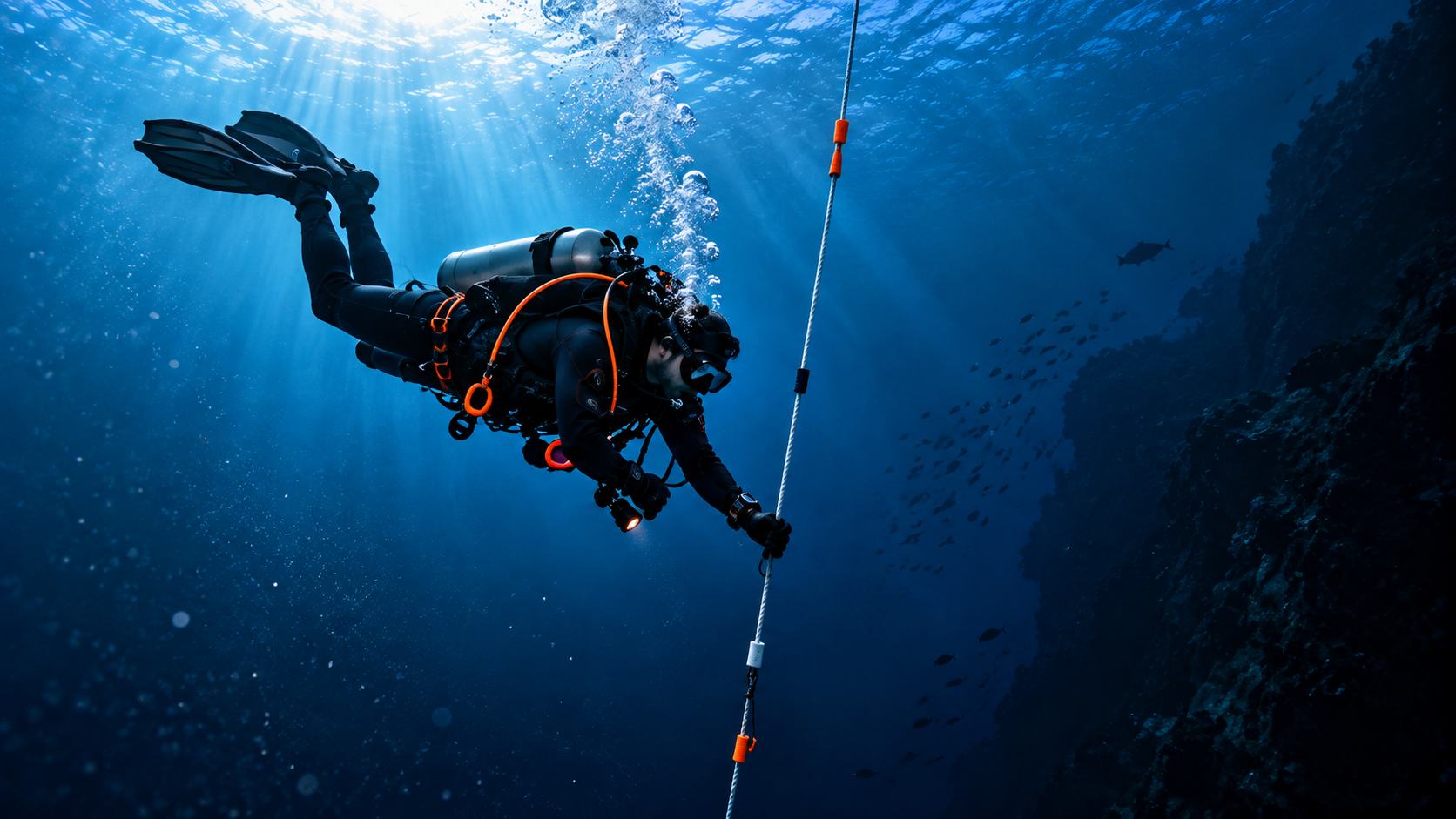
    Deep Diver taught me that depth is only a number. The real lesson was gas, limits, standards and having a reason to be there.

    Deep Diver sounds like it should be about a number.

    How deep did you go? Did you get to 40 metres? Did it feel different? Did you feel narced? Did you get the card?

    Those are easy questions to ask, but they are not the best lessons from the course.

    For me, Deep Diver did not make depth feel like a trophy. It made depth feel like a set of costs: gas, time, temperature, no-decompression limit, attention and planning.

    It also made me realise something I did not expect to come away with: I do not need to go deep unless there is actually a reason to be there.

    A busy start to the holiday

    I did my Deep and Night Diver training with Pyramids over the first four days of the holiday.

    It was not a gentle, lazy start. I landed at around 23:00, and by midday the next day I was already doing my shakedown dive. That same evening I did my first night dive.

    I was not fully rested, but that first night dive was amazing — and that absolutely deserves its own post soon.

    The first few days were full on. Day one was the shakedown dive and night dive one. Day two was deep dives one and two. Day three was deep dives three and four, which completed Deep Diver. Day four was night dives two and three.

    After that I had a reset day, then moved into nine days of diving with Gemma and Elite. Looking back, those first four days felt like the training block of the trip before settling into the wider holiday diving.

    Calm leadership matters

    One thing I did appreciate was the instructor. He was calm, relaxed and good to be around.

    That mattered. When you are doing deeper training dives, watching gas, tracking depth, checking no-decompression limit and thinking about ascent discipline, the tone of the person leading the dive can spread through the whole group.

    If an instructor is rushed, tense or casual in the wrong way, that can make the whole dive feel messy. In this case, his calmness helped me stay calm as well.

    The dives felt managed rather than pressured, and that gave me more mental space to focus on what I was supposed to be learning.

    Safety culture matters too

    I do need to separate the instructor from the wider centre culture, because those are not always the same thing.

    The instructor I trained with was really good. But over those four days I heard comments from a couple of Divemasters that sounded, to me, like new divers or people doing try dives were being encouraged to be less than accurate on medical forms.

    I raised what I had heard with the centre when I had the opportunity. I cannot know what, if anything, was done with that concern afterwards.

    But it mattered to me because dive medicals are not paperwork theatre. They are part of the safety system. New divers, nervous divers and try-dive participants should be made to feel that honesty is the safe and correct route, not an inconvenience.

    I had originally booked there because I thought Wessam was still with them. Once I realised he was elsewhere, I moved over to Elite Divers to follow him for the rest of the trip’s diving.

    That experience made me think differently about choosing a dive centre. Before this, I probably thought instructor first. A good instructor still matters massively, but the wider system around them matters too.

    A good instructor can shape a dive. A good safety culture shapes everything around it.

    Narcosis: no obvious effect, but no complacency

    Personally, I did not feel any obvious narcosis at 40 metres.

    I was able to carry out the example tasks at the same rate as I had at the surface, and the instructor confirmed that he could not see any difference in how I was performing.

    But that does not mean I think I am immune to narcosis. That would be a dangerous lesson to take from it.

    At most, it means that on that dive, in those conditions, I seemed to tolerate it well. Maybe I have a greater resistance, maybe I was lucky, maybe the situation simply did not expose it. Either way, narcosis is not something I want to treat casually.

    If something can affect your judgement while also affecting your ability to judge your own judgement, then the answer is not ego. The answer is planning, limits, buddy awareness and honesty.

    Gas became very real

    What I did notice very clearly was gas.

    I am a greedy breather, and at 40 metres I could see the needle moving. That made the planning feel very real.

    It made me focus on not wasting movement, checking which gas I was breathing at what depth, and tracking my no-decompression limit as it moved surprisingly fast, especially when doing multiple deep dives around 40 metres.

    Everything had a cost. Gas had a cost. Time had a cost. Movement had a cost. Attention had a cost.

    I was glad to know I had taken an additional side-slung pony, and that we also had a 38% mix available at 5 metres for the safety stop.

    That did not make the dive casual. It made it feel planned.

    The cold surprised me

    The other thing that surprised me was the temperature.

    I was comfortable in my 3 mm shortie in the Red Sea, but once we got down through the 20–30 metre range, and especially around 40 metres, there was definitely a chill.

    That was a useful reminder that even warm-water diving changes with depth.

    It is easy to think of the Red Sea as warm, bright and comfortable — and much of it is — but depth still changes the feel of the dive. It changes light, temperature, gas use, time and how deliberate you need to be.

    Forty metres is not automatically interesting

    One thing I did not expect to come away with was the feeling that 40 metres can actually be quite boring if there is no real reason to be there.

    At depth I felt relaxed. I could hover, look up and see the fish above me, look out into the deep blue, and look down into the nothing as the wall fell far below.

    It was calm and beautiful in its own way.

    But it also made something very clear: depth by itself is not the point.

    Leaving a Deep Diver course thinking, “Yeah, I do not need to go deep unless there is actually a reason,” was not what I expected. But it was probably one of the most useful lessons from the course.

    Depth needs a reason

    I would happily go deep again if there was a genuine reason to be there.

    A wreck feature, a swim-through, a wall, marine life, a training objective, or something at depth that actually adds to the dive — those all make sense to me.

    If there was a swim-through at 38 metres that allowed me to see something special, that would feel like a reason. If the only point of the dive was to touch 40 metres and come back up, I am not sure that interests me much.

    Depth is not the reward by itself. Depth is just where something might be.

    The side-slung pony changed my thinking

    Using the side-slung pony was one of the biggest practical takeaways from the course.

    It gave me a small taste of what carrying gas beside me could feel like, and it helped push me toward sidemount rather than twinset as the route I am more interested in.

    I enjoyed the gas planning more than I expected. That was probably the point where I started properly looking into decompression diving.

    Not just because of depth, but because of what planning can give you: longer dives, wreck-penetration options, more redundancy, more “what if” thinking and more structured problem-solving.

    It sounds backwards to some people, but technical diving can become safer in certain ways because you stop pretending the simple plan is enough. You plan for failures. You plan gas. You plan exits. You plan reserves. You plan what you will do if something changes.

    That appeals to my brain a lot.

    Deep does not mean better

    Deep Diver showed me that depth is just a number.

    It does not automatically make you a better diver, and it does not make you a worse one either.

    Going deeper is not the achievement by itself. What matters is staying within your limits, understanding what changes at depth, and being honest about whether the dive actually has a reason.

    For me, the course did not make me want to chase depth. It made me think more seriously about how sidemount and technical training might allow me to extend my limits safely, with better planning, more redundancy, clearer gas choices and more structured answers to the “what ifs.”

    The start of a technical-thinking path

    I think this course was one of the points where I started looking more seriously at the technical side of diving.

    Not because I suddenly wanted to go as deep as possible, but because I liked the thinking. I liked the planning. I liked the structure. I liked the idea of having proper answers to problems before they happen.

    Deco diving, sidemount and technical training appeal to me because they are not just about extending depth. They can also be about extending options, extending time, improving redundancy, and making the “what if” part of the plan instead of pretending it does not exist.

    That is the bit I enjoy: the preparation, the logic, the problem-solving, and the feeling that the dive has been thought through properly.

    Final thought

    Deep Diver did not teach me to chase depth.

    It taught me to respect what depth changes.

    It changes gas use. It changes temperature. It changes time. It changes no-decompression limit. It changes how much space you have for casual thinking. It also changes how much the culture around the dive matters.

    The safety concerns I had during that training block made me look harder at what is important. A good instructor matters, but the centre culture matters too. If an instructor holds themselves to a high standard, but works somewhere that does not seem to hold the same standards around safety, medical honesty or reporting concerns, that raises difficult questions.

    That is not about blame. It is about standards.

    I left Deep Diver with more respect for gas planning, more interest in sidemount and technical diving, and less interest in depth for its own sake.

    That feels like a useful result.

    Depth is only a number. Standards are what keep that number safe.
  • Holiday Diving vs UK Diving: What Each Has Taught Me

    Holiday Diving vs UK Diving: What Each Has Taught Me

    Diver Background • UK Diving • Red Sea

    Holiday Diving vs UK Diving: What Each Has Taught Me

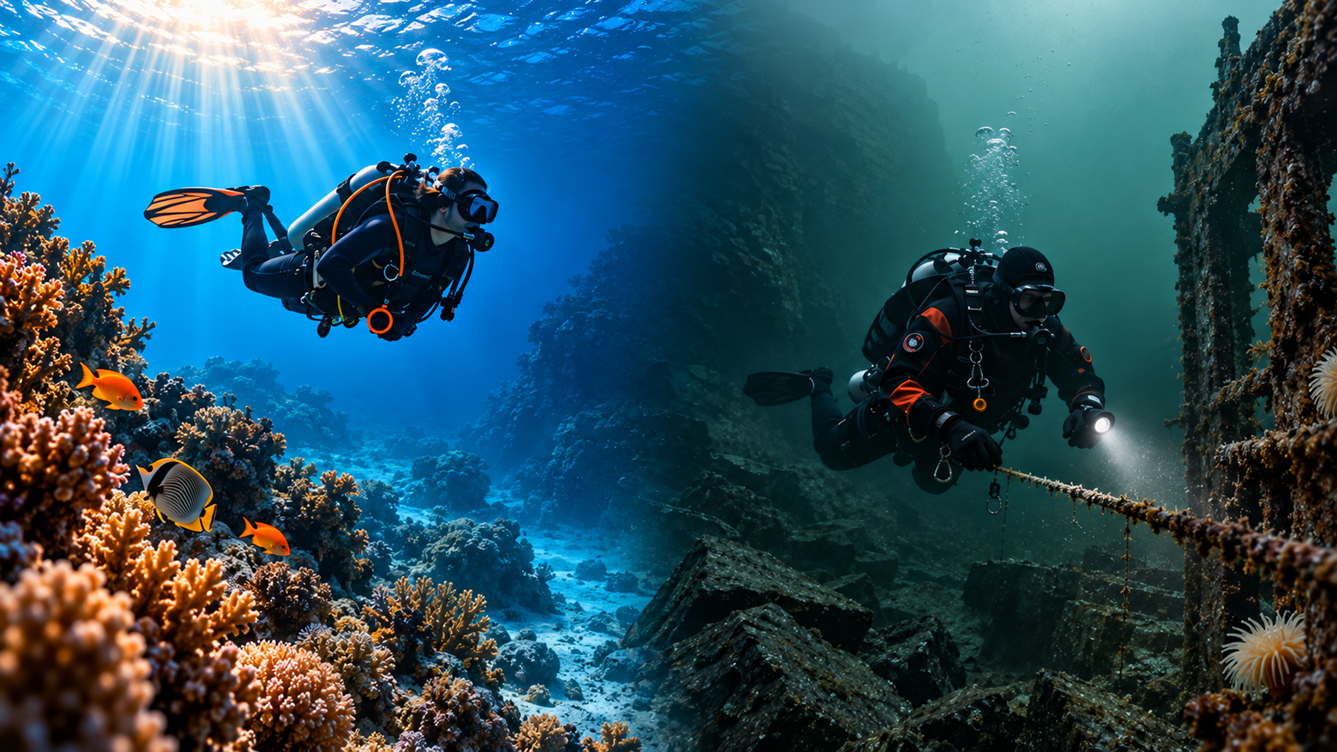
    I started diving in the Red Sea, but UK diving has taught me a very different kind of lesson.

    I started diving in the Red Sea.

    That probably shaped me more than I realised at the time. Warm water, clear visibility,
    colour everywhere, fish everywhere, and that ridiculous feeling of dropping below the surface
    and suddenly being somewhere completely different.

    It is the sort of diving that makes you understand very quickly why people get hooked.

    Then I came back to the UK and did my Advanced Open Water inland at Capernwray.

    Different world. Different pace. Different lessons.

    The Red Sea gave me the magic

    Holiday diving can feel almost unfairly beautiful.

    The Red Sea gives you warmth, light, colour, visibility and marine life in a way that is very
    easy to fall in love with. It is the version of diving that looks like the posters. Blue water,
    coral, fish, sunshine, and that strange quiet that appears once your head goes below the surface.

    For me, that first experience mattered because it gave scuba an emotional hook. It was not just
    a sport or a training pathway. It was a doorway into a world I wanted to keep visiting.

    It also made diving feel possible. I could experience the underwater world, move through it, see
    things I had only seen in aquariums or documentaries, and feel that strong pull to do more.

    Holiday diving gave me the wonder.

    Capernwray gave me structure

    Capernwray was a very different kind of diving.

    It was inland UK diving, not warm-water holiday diving. Less coral reef magic, more controlled
    training site. Less tropical colour, more structure, briefings, skills, checks, procedures and
    repetition.

    That was exactly what I needed for Advanced Open Water.

    AOW at Capernwray gave me a more deliberate training environment. It made the diving less about
    simply enjoying the underwater world and more about developing as a diver. Buoyancy, awareness,
    task focus, navigation, depth, buddy work and the rhythm of a proper training day all started to
    matter more.

    It was not better than the Red Sea. It was different.

    The Red Sea had shown me why I wanted to dive. Capernwray started showing me how to become better
    at it.

    The North East coast made it real

    Rescue took the contrast even further.

    Doing Rescue on the North East coast, in North Sea conditions, gave the training a different weight.
    It was not just about performing skills in a neat, tidy way. It was about thinking about the site,
    the surface, the exit, the cold, the conditions, tired divers, stress signals, and what happens when
    a normal dive starts to unravel.

    UK sea diving has a realism to it. Weather matters. Temperature matters. Visibility matters. Getting
    in and out matters. Kit choices matter. Timing matters. Communication matters.

    Rescue in that setting made me think more seriously about the whole dive, not just the underwater
    bit.

    That is where UK diving started to feel less like a substitute for holiday diving and more like a
    powerful training ground in its own right.

    What holiday diving gives me

    I do not see holiday diving as “easy mode” in a dismissive way. That would be unfair.

    Holiday diving gives a lot. Warmth reduces one kind of task loading. Better visibility can make
    navigation, buddy awareness and marine-life observation feel more natural. Repeated dives over a trip
    can build rhythm and confidence. Boat routines, guided dives and relaxed conditions can help you enjoy
    diving without every moment being shaped by cold-water logistics.

    It also gives something that should not be underrated: joy.

    Seeing reefs, fish, wrecks, light, colour and open blue water is not a soft or silly part of diving.
    It is part of why many of us started. It is part of why we keep coming back.

    Holiday diving reminds me what I love about scuba.

    What UK diving gives me

    UK diving gives me something different.

    It gives me discipline. It gives me preparation. It makes kit organisation matter. It makes thermal
    protection matter. It makes weighting matter. It makes “I’ll sort it when I get there” feel like a
    poor life choice wearing fins.

    Cold water, lower visibility, drysuit use, shore or quarry logistics, changing weather and heavier kit
    all add load. That does not make UK diving worse. It means UK diving teaches different lessons.

    It teaches patience. It teaches planning. It teaches honesty about comfort and capacity. It teaches
    you to notice when small things are starting to stack up.

    In other words, UK diving is very good at showing you what kind of diver you really are when the easy
    parts are removed.

    The trap is thinking one is “real” and the other is not

    I do not like the idea that one type of diving is the “proper” version and the other is somehow lesser.

    Warm-water holiday diving can still demand good buoyancy, awareness, gas discipline, buddy skills and
    respect for the environment. Clear water does not remove the need for judgement.

    UK diving can be challenging and skill-building, but it is not automatically superior just because it
    is colder, darker or more awkward. Suffering is not a qualification.

    They are different environments with different lessons.

    The mistake would be to treat holiday diving as mindless fun or UK diving as miserable character
    building. Both can be valuable. Both can teach. Both can expose weak habits. Both can give brilliant
    dives.

    Why the contrast matters for me

    The contrast matters because it has shaped my pathway.

    The Red Sea gave me the emotional start. Capernwray gave me structured inland training. The North East
    coast gave Rescue a real-world edge. Together, they have created a much more rounded picture of what
    diving can be.

    That is useful as I look ahead.

    I want more UK sea time. I want more drysuit practice. I want more comfort in colder, lower-visibility
    conditions. I want to continue building the sort of habits that will make future trips, including the
    Red Sea, more enjoyable and safer.

    I do not want warm-water dives to become an escape from skill-building. I want them to become a place
    where good habits show up more easily because they have already been trained elsewhere.

    Cold water skills, warm water rewards

    If I had to summarise it simply, I would say this:

    Holiday diving reminds me why I fell in love with scuba. UK diving teaches me how to become the diver I want to be.

    That does not mean every UK dive has to be a grim lesson in character and every holiday dive has to be
    pure relaxation. There is overlap. There is joy in UK diving and discipline in holiday diving.

    But the balance is useful.

    One gives me wonder. The other gives me grit. One gives colour and comfort. The other gives preparation
    and resilience. One makes me want to dive. The other makes me want to dive better.

    Final thought

    I started in the Red Sea, and I am glad I did.

    It gave me the magic first.

    But coming back to the UK, doing Advanced Open Water at Capernwray, and later doing Rescue on the North
    East coast, gave me something else: structure, realism, and a clearer sense of the diver I want to become.

    I do not want holiday diving instead of UK diving, or UK diving instead of holiday diving.

    I want both.

    Wonder gets you started. Discipline keeps you growing.

  • Why I Came Back to Diving After Nearly 30 Years

    Return to diving • Confidence • Training journey

    Why I Came Back to Diving After Nearly 30 Years

    I first tried scuba diving in 1995. It went badly enough that, for years afterwards, even putting my head under water could bring the fear back. This is the story of why I came back to diving, what changed, and how a nightmare became a lifelong hobby.

    Corfu, 1995

    I first tried scuba diving in 1995.

    I was in Corfu, doing Open Water and Advanced Open Water together on the same course. I cannot honestly remember the agency, so I am not going to guess, but I remember the experience clearly enough.

    And it did not go well.

    In fact, “did not go well” is doing quite a lot of heavy lifting there. Knowing what I know now, the course was badly run and badly designed. On day three, on what I think was only my fifth dive, I was taken to around 28 metres.

    That is a lot, very early.

    The Dive That Changed Everything

    At 100 bar I told the instructor about my gas. We stayed at depth until I was down to around 50 bar. I got to the instructor’s octopus, switched to it, and signalled why. He then turned quickly and swam off, pulling the octopus out of my mouth.

    I had to switch back to my own gas, which then ran out before I could reach him or make a safe ascent.

    I got to the surface, swallowed water, passed out, and woke up on the boat being told off.

    So yes, not exactly the charming “welcome to scuba diving” brochure moment.

    The Divemaster, Ben, was kind to me afterwards. He was probably the only reason I tried a couple more dives on that trip. But the damage was done. For a year or two afterwards, even putting my head under water in the bath could trigger panic.

    Scuba had gone from something exciting to something my body treated like a threat.

    A bad instructor helped turn diving into a nightmare. A good instructor helped turn it back into a possibility.

    The Long Gap

    For years, diving was not something I thought I would come back to.

    I did eventually get back into snorkelling, especially in the Red Sea around 2013. That helped. I loved watching reefs and fish from the surface. There was still something about the underwater world that pulled me in.

    But scuba? Proper scuba? Breathing underwater again?

    That still sat in a different box in my head.

    The “absolutely not, thank you very much” box.

    Trying Again in 2024

    In May 2024, as a family, we decided to try diving.

    That first try dive was not perfect. As soon as I jumped in and tried to breathe underwater, some of the old memories came straight back. Not as a nice gentle memory either. More like my brain kicked the door open and shouted, “Remember Corfu?”

    Gemma also started to panic.

    That could easily have been the end of it.

    But our instructor, Wessam Fayez, in Sharm, handled it brilliantly. He settled both of us, got us breathing, got us thinking, and helped all four of us have a great try dive on a local reef.

    That changed everything.

    Gemma, the Catalyst

    Gemma was the catalyst.

    After that try dive, she was in love with diving and wanted to do more. So Gemma, Matthew and I decided to do our Open Water together.

    That mattered. It was not just me trying to prove something to myself. It became something we could share.

    But I would be lying if I said the fear vanished.

    It did not.

    There are still moments, especially when my face first hits the water, where I get that 10 to 30 seconds of fear. That little mammalian alarm response. My brain briefly asks, “Are we sure about this, big lad?”

    Most of the time now, the answer is yes.

    But it is still there sometimes.

    Rebuilding Trust

    The hardest part of coming back was not just the water.

    It was trust.

    Trusting an instructor again after Corfu was hard. Trusting someone with me was one thing. Trusting someone with Gemma and Matthew was another level entirely.

    That is where good instruction made the difference.

    Wessam helped me get back in. Gemma helped pull me forward. The Rescue Diver course helped me calm down and think better. Reading around human factors helped me understand more about what goes wrong, why people make poor decisions, and how teams can manage risk better.

    I like that side of diving.

    I like the thinking.

    I like the planning, the problem-solving, the “what if?” conversations, and the little details that make a dive safer and calmer. Diving scratches the same analytical part of my brain that likes systems, evidence, preparation and debriefing.

    It is not just floating about looking at pretty fish.

    Although, to be fair, floating about looking at pretty fish is also excellent.

    The Moments That Keep Me Going

    I am still not sure I have had one clean moment where I thought, “Yes, I can definitely do this now.”

    It has been more gradual than that.

    There are still times when I ask myself whether I can do it. But since doing Rescue Diver, that voice is quieter. I have more tools now. More understanding. More confidence that I can think through problems rather than just react to them.

    And then there are the good moments.

    Swimming with rays. Seeing sharks. Being on a reef and feeling that ridiculous sense of wonder. Watching marine life and then going home to my own reef tanks, where the same fascination continues in miniature.

    That helps. The reef tanks are relaxing, but they also keep me connected to the underwater world between dives.

    They are basically expensive, salty therapy boxes.

    From Open Water to Master Scuba Diver

    Master Scuba Diver was not originally some grand plan.

    I probably would not have chased it quite the same way if PADI had not been offering it for free at the time. But the specialties I chose were not random badge collecting. They were linked to the kind of diving I am interested in: drysuit, nitrox, deep, night, equipment, wreck, overhead environments, and eventually technical-style progression.

    For me, Master Scuba Diver feels less like an endpoint and more like a marker.

    It is a signal to stop thinking only in terms of basic recreational diving and to start asking bigger questions.

    Do I want to move towards Divemaster?

    Do I want to explore sidemount properly?

    Do I want to move into Tec?

    What kind of diver do I actually want to become?

    Why Divemaster Is on My Mind

    I am looking at Divemaster, but not because I am desperate to teach.

    I have taught before in other parts of my life. Teaching is not some shiny new fantasy for me. I am not currently looking to jump back into formal teaching or become an instructor.

    But Wessam put the idea in my head back in May 2026. He thought it was something I might be ready for.

    That stuck.

    For me, Divemaster is interesting because it could make me a better buddy, a calmer team member, and someone more useful around other divers. I like the idea of developing the awareness, control and responsibility that comes with professional-level training, even if I never turn it into a job.

    Why Tec and Sidemount Appeal

    Technical diving interests me for three main reasons.

    First, I want to see more.

    Second, I want to be safer.

    Third, I am analytical by nature, so the planning side appeals to me. Gas, redundancy, configuration, limits, procedures, decision-making — that all makes sense to my brain.

    Sidemount also appeals for very practical reasons. I have dived with a side-slung pony and it felt good. Getting cylinders off my back could make some shore and coastal entries much nicer, especially in the UK where some of the walks from the car park to the entry point feel like a punishment invented by someone who hates knees.

    Future me may still complain. But future me may complain with better cylinder logistics.

    What I Learned

    If there is one thing I want people to take from this, it is this:

    A good instructor can be the difference between a nightmare and a lifelong hobby.

    My first experience nearly ended diving for me before it had properly begun.

    Coming back took time. It took family. It took the right instructor. It took trust. It took a willingness to feel uncomfortable and try anyway.

    Now diving has become a major part of my life.

    I am still learning. I still have fear sometimes. I still have moments where I question myself. But I also have dives, memories, skills and ambitions that I would never have had if I had let 1995 be the end of the story.

    So this journal starts there.
    With a bad first chapter. And a much better second one.