
Category: Red Sea Diving

  • Planning for Sharm 2027

    Planning for Sharm 2027

    Trip Planning • Red Sea • 2027

    Planning for Sharm 2027

    We already know we love diving there. The interesting bit now is working out how much training to mix into a three-week family trip.

    We are going back

    After diving with Elite in Egypt, the obvious question was not whether we wanted to return.

    It was how soon we could sensibly do it.

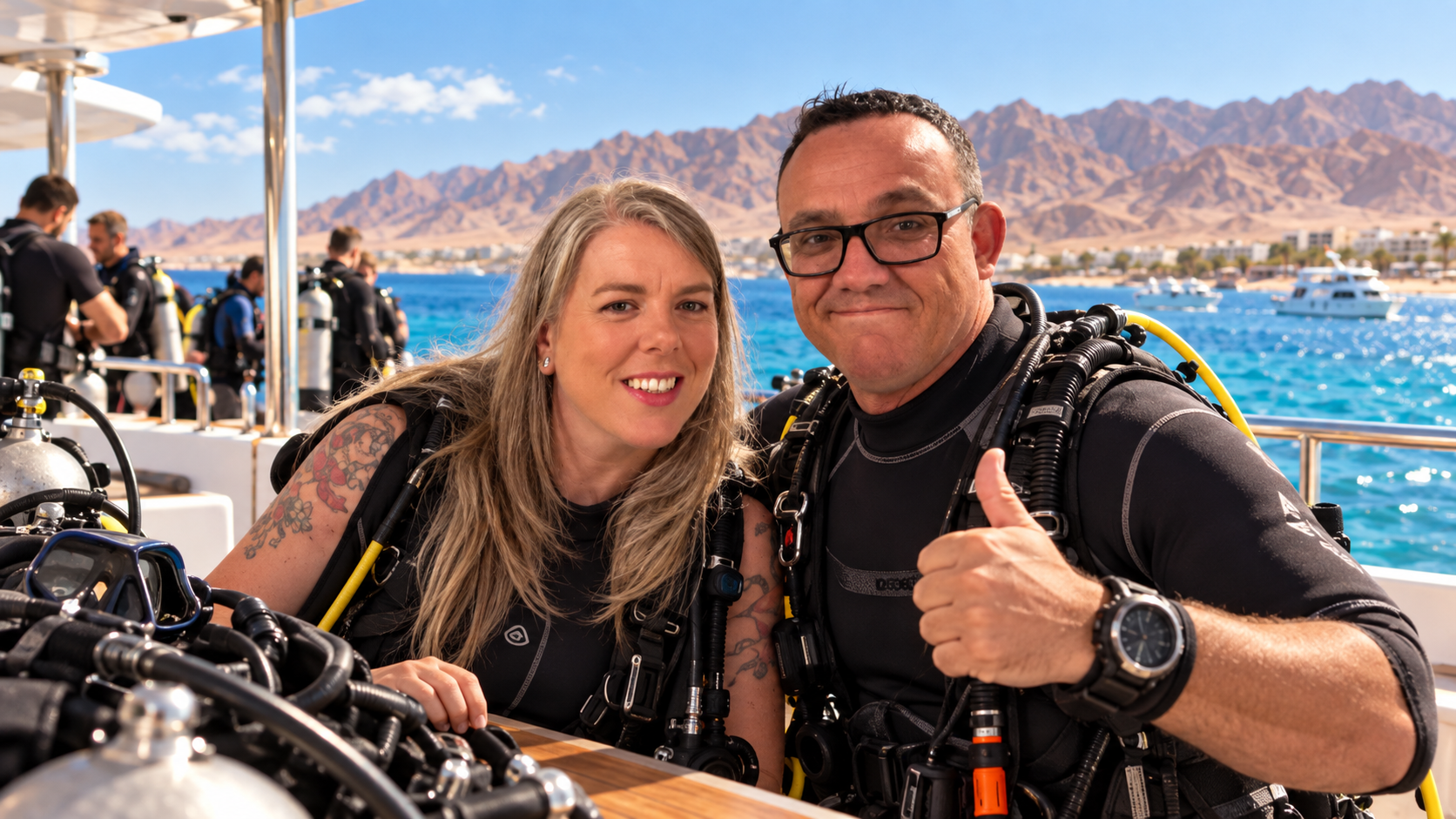
    The current plan is to be back in Sharm from 28 June to 21 July 2027, staying in an Airbnb arrangement recommended through Jenny and Wessam and diving again with the people we already know.

    That familiarity matters. A holiday is a lot easier when the diving centre is not another unknown quantity to solve on day one.

    This trip is not about collecting courses. It is about building a lot of good diving around a few carefully chosen goals.

    The family plan matters more than my course list

    This is a trip for me, Gemma and Matthew.

    I want us to have plenty of days where the only objective is to go diving together and enjoy being in the Red Sea.

    We are looking at roughly 10–14 days of diving depending on how the courses fit, rather than trying to cram training into every available morning.

    Gemma is interested in doing Deep while we are there, and Matthew will be diving with us as well.

    My own direction is getting more technical

    My interests are changing.

    I still love ordinary recreational diving, but I am increasingly curious about sidemount and technical training.

    Tec 40 is the obvious first step I keep coming back to, with Tec 45 as a possibility if the progression, time and experience all make sense.

    I am not treating Tec 45 as something I am entitled to bolt onto the holiday because it exists on a course list. If Tec 40 needs to stand on its own, that is fine.

    Sidemount could make the trip even more interesting

    I have also asked about sidemount training and whether a suitable wing could be rented rather than me immediately travelling with another mountain of equipment.

    Sidemount is appealing to me for a lot of reasons: independent gas, flexibility, easier equipment handling and where I think my longer-term diving may be heading.

    Doing the course somewhere warm and clear has obvious appeal, but I also want whatever I learn to transfer back to UK diving rather than becoming a holiday-only configuration.

    Three weeks gives us something valuable: breathing room

    The best part of having three weeks is that not every day has to be productive.

    We can have training days, family dive days, easier days and rest days without feeling that one weather change or tired morning has destroyed the whole plan.

    That is exactly how I want to approach it.

    I would rather finish the trip wishing I had squeezed in one extra dive than spend the last week knackered because I treated a holiday like a military exercise.

    What would make the trip a success

    For me, a successful Sharm 2027 would be pretty simple:

    • lots of enjoyable dives with Gemma and Matthew;
    • Gemma getting the Deep training she wants;
    • me making a sensible next step toward sidemount and/or Tec 40;
    • enough repetition that new skills start to feel normal;
    • coming home more experienced rather than merely more certified.

    I am excited by the courses, obviously.

    But the real attraction is three weeks of being around diving, doing it repeatedly, and sharing it with the people I most want beside me.

    The qualification is a bonus. The diving is the point.
  • Night Diver: Why Darkness Made Me Calmer

    Night Diver: Why Darkness Made Me Calmer

    Training Notes • Night Diver • Human Factors

    Night Diver: Why Darkness Made Me Calmer

    I expected night diving to feel more stressful. Instead, the darkness narrowed the world and made me calmer.

    Night Diver was one of those courses I expected to feel more intense than it actually did.

    On paper, night diving sounds like it should add a lot: darkness, torches, different communication, reduced visibility, different marine life, and the simple fact that the surface world has disappeared into blackness.

    I expected that to make the dive feel busier.

    Instead, something different happened. The darkness made the dive feel smaller, quieter and more focused.

    For me, that was the surprise.

    A full-on start to the trip

    My first night dive came very early in the holiday.

    I had landed at around 23:00, then by midday the next day I was already doing my shakedown dive. That same evening I was doing night dive one.

    So this was not a perfectly rested, gentle, slow introduction. I had travelled, arrived late, got back into the water, checked kit and weighting, then went straight into the first night dive.

    And even though I was not fully rested, that first night dive was amazing.

    The world gets smaller

    The biggest thing I noticed was how the world changes at night.

    During the day, there is so much to take in. The reef, the fish, the light, the wider scene, other divers, the blue water, the boat, the guide, the group, the camera moments, the everything.

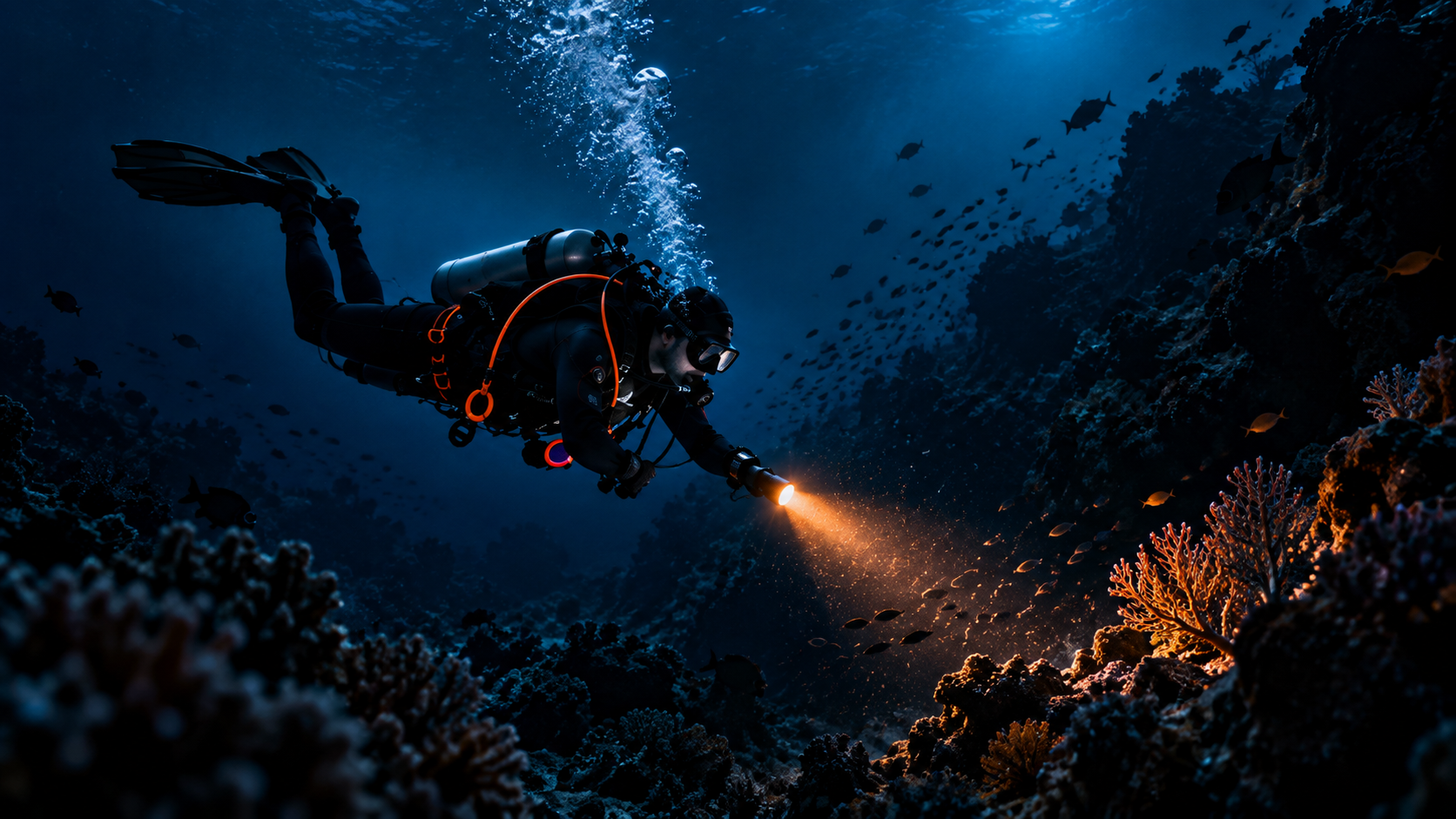
    At night, your world becomes the beam of your torch, your buddy, your gauges, your breathing and the next few metres in front of you.

    That could sound limiting, but I did not experience it that way. I found it calming.

    It reduced the amount of visual noise. It made the dive feel simpler, not more complicated.

    Darkness changed my focus

    Night diving made me focus differently.

    Instead of scanning a whole reef or trying to take in everything at once, I was paying attention to the things that mattered in that moment: light position, buddy location, buoyancy, depth, gas, direction and how the dive felt.

    It made the dive feel more deliberate.

    I like that about it. There is something about narrowing the field of attention that works well for my brain. It takes away some of the clutter and leaves the important things closer to the surface.

    Night diving did not feel like diving with less information. It felt like diving with fewer distractions.

    Lights become communication

    One of the useful lessons from Night Diver is that a torch is not just a way to see.

    It becomes part of how you communicate.

    You use it to get attention, signal okay, point to things, show where you are, avoid dazzling people, and keep the buddy team connected without turning every moment into a hand-signal performance.

    That means light discipline matters.

    Where you point the torch matters. How calmly you move it matters. Whether you sweep it around like a caffeinated lighthouse definitely matters.

    Good torch use makes the dive feel calmer. Bad torch use can make a calm dive feel busy very quickly.

    Buddy awareness feels different at night

    Buddy awareness also changes at night.

    In daylight, it is easier to use peripheral vision and the wider scene to keep track of people. At night, you are more dependent on light, position and deliberate checks.

    That made me more aware of spacing and movement.

    It also made the buddy team feel more important. You are not just two divers near each other. You are two pools of light moving through the dark, and it is very obvious when one of those lights is no longer where you expected it to be.

    That is useful. It makes connection visible.

    The reef feels different after dark

    One of the best parts of night diving is that the same site does not feel like the same site.

    The reef changes character. Colours look different under torchlight. Fish behave differently. Small details stand out more. Things that disappear into the daytime background suddenly become interesting.

    It is not just diving in the dark. It is diving in a different version of the same place.

    That is probably why the first night dive stuck with me. I was tired, I had only just arrived, and still the dive cut through all of that.

    It felt special.

    Why it suited my brain

    I have written before about diving with ASD and how scuba can work well for my brain because it has structure, rules, kit, checks and a clear task focus.

    Night diving added another layer to that.

    The darkness narrowed the environment. The torch gave me a clear focus point. The procedures mattered. The buddy checks mattered. The communication mattered. The dive had a rhythm.

    Instead of making things feel chaotic, it made things feel contained.

    That is not what I expected, but it makes sense now. Sometimes less visual information is not a problem. Sometimes it is a relief.

    Night diving still needs respect

    None of this means night diving is something to treat casually.

    Darkness changes the dive. You need reliable lights, backups, clear communication, proper buddy awareness, good buoyancy, a sensible plan and enough calm to avoid rushing.

    It also makes simple problems feel bigger if you have not prepared properly.

    A failed torch, a separated buddy, poor buoyancy, uncertainty about direction or a messy ascent can all become more stressful at night.

    But when it is planned properly, night diving can feel incredibly peaceful.

    Confidence through calm

    Night Diver gave me a different kind of confidence.

    Not loud confidence. Not “look what I can do” confidence.

    More like quiet confidence: I can slow down, check the important things, use the light properly, stay connected with my buddy, and let the dive unfold without trying to force it.

    That kind of confidence matters to me.

    It is the same type of confidence I want to keep building through UK diving, Rescue, drysuit practice, sidemount and eventually technical training. Calm, structured, aware and useful.

    Final thought

    Night Diver surprised me.

    I expected darkness to add stress. Instead, it narrowed the world in a way that made me feel calmer and more focused.

    The torch beam became the centre of the dive. Buddy awareness became more deliberate. Communication became simpler and more intentional. The reef felt different, quieter and more intimate.

    It reminded me that not every challenge in diving feels the way you expect. Sometimes the thing that sounds like it will add task loading actually removes distraction.

    For me, night diving did exactly that.

    In the dark, the dive got smaller — and somehow I got calmer.