Training Notes • Divemaster • Diver Development
Preparing for Divemaster: What I Need to Sharpen
I’m not doing Divemaster for the title. I’m doing it to become smoother, calmer, more capable — and a better buddy.
Starting Divemaster feels different from the other courses I have done.
It is longer.
It asks for more consistency.
It is less about learning one new skill and more about refining everything around the way I dive.
That is exactly why I want to do it.
I am not chasing a professional title for the sake of having one.
About 90% of the reason I want to do Divemaster is simple:
I want to become the best dive buddy I can be.
The other 10% is the small voice saying:
“Well… if the professional route was affordable enough, maybe I could eventually do a bit at weekends and let diving help pay for diving.”
I am not building a whole new career plan around that idea.
But I am not pretending it has never crossed my mind either.
Demo-quality skills are probably what excites me most
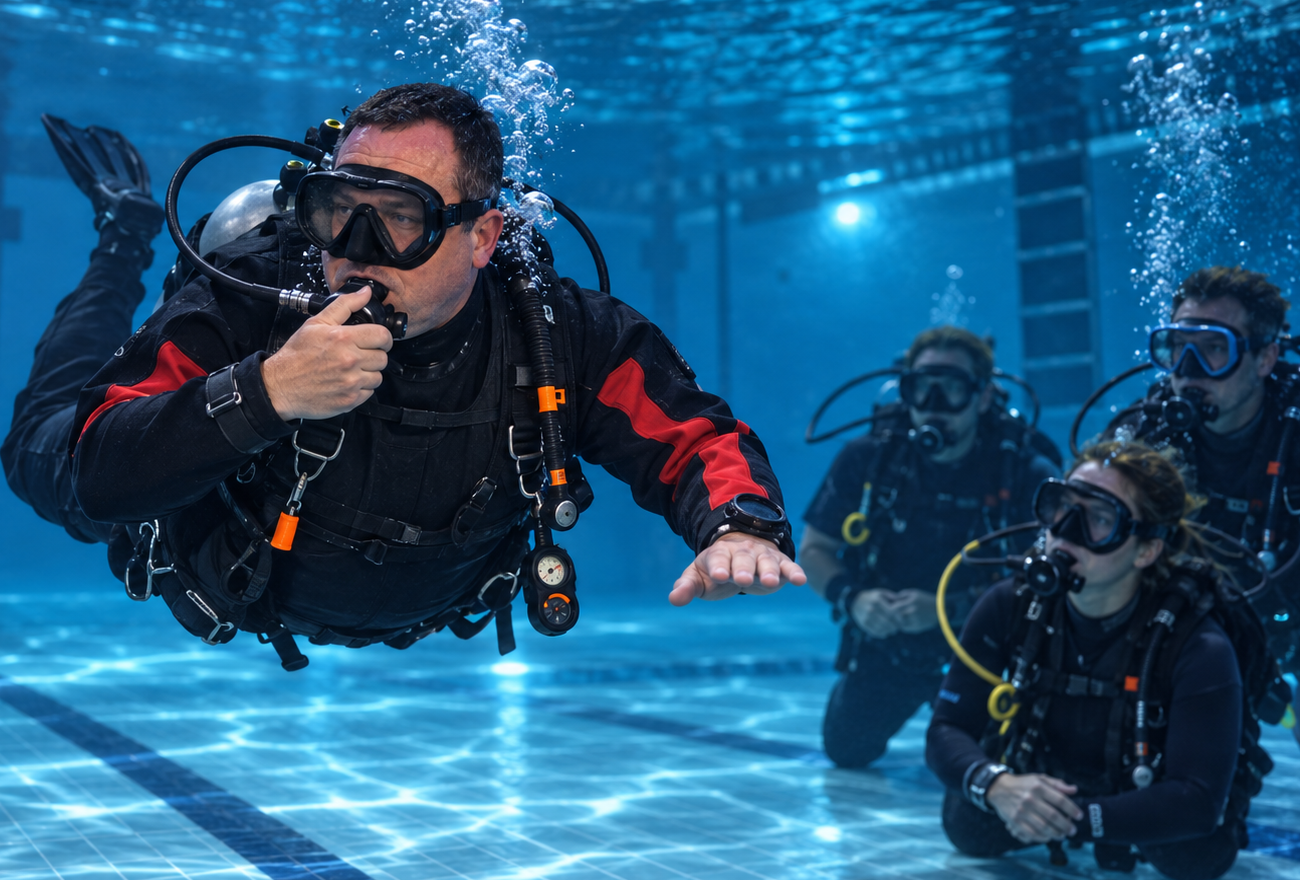
The part of Divemaster I am most looking forward to is developing demo-quality skills.
I like the idea of taking something I can already do and slowing it right down until every part of the skill is deliberate and clear.
For me, the logic is:
Perfectly slow first. Smooth next. Fast comes later.
If I can demonstrate a skill slowly and cleanly, then I should understand the movement well enough to do it smoothly.
And smooth is fast.
That is the kind of refinement I want.
Not rushing.
Not showing off.
Just understanding the skill so well that I can make it obvious to somebody else.
I want better underwater task management
Another reason Divemaster appeals to me is task management.
I want to be better at doing several things at once without letting any of them become messy.
Watching students.
Monitoring depth.
Checking the group.
Thinking about positioning.
Staying aware of the instructor.
Keeping my own buoyancy and trim boringly stable.
Noticing when somebody looks uncomfortable before they become a problem.
That is exactly the kind of workload I want to get better at handling.
It links directly to the human-factors side of diving that interests me so much.
The goal is not to become busy.
The goal is to become capable while busy.
Surface swimming is probably my weakest confidence area
Oddly, one of the areas I feel least confident about is surface swimming.
I can swim.
That is not the problem.
What is strange is that I am less comfortable swimming in deep water at the surface than I am scuba diving in the deep blue below it.
Underwater, I have equipment.
Buoyancy.
Breathing gas.
Gauges.
A plan.
Something specific to do.
On the surface, I feel more exposed and less structured.
So improving my confidence in deep-water surface swimming is one of the things I actually want Divemaster training to force me to work on.
The 800-metre snorkel is the one I am least excited about
Of the water-skill assessments, the 800-metre snorkel is probably the one I am least enthusiastic about.
Not because 800 metres sounds impossible.
It is the sensation of breathing through a snorkel that I dislike.
I find the restriction irritating.
I am much happier breathing from a regulator underwater than breathing through a tube at the surface, which sounds slightly ridiculous when written down.
But that is the reality.
The 100-metre tired-diver tow and rescue work feel much more comfortable to me.
Those are purposeful tasks.
There is a clear objective.
Rescue training has already given me a lot of confidence in that area.
So the snorkel is less about raw fitness and more about building comfort with something I currently dislike.
Solo rescue is something I want to sharpen
Rescue Diver changed the way I think about helping somebody.
One of the strongest moments for me was rescuing Gemma after a morning of rescue swimming.
I was tired.
It was emotional because it was my wife.
But I got her to safety.
That showed me I could do more than I thought.
Divemaster gives me another opportunity to refine those rescue skills until the response is calmer, more efficient and less dependent on brute force.
I am physically strong.
That is useful.
But strength should be a reserve, not the first technique.
The goal is not to overpower the problem. It is to solve it cleanly.
Leading dives is another big one
I have already had small opportunities to lead parts of dives.
At St Abbs, leading with Matthew behind me was something I was genuinely proud of.
I had a small dive mirror, so I could keep an eye on him while still looking forwards.
Navigation was straightforward enough because I had been paying attention on the way out.
Rock formation on the left going out.
Rock formation on the right coming back.
West takes us towards land.
“Natural navigation, my son.”
Divemaster should give me more opportunities to develop that properly.
Leading is not just knowing where to go.
It is setting a pace.
Watching the team.
Making decisions early.
And looking calm enough that other people feel calm too.
Being a calm big bloke might actually be useful
Physically, I am fairly imposing.
That can be useful for carrying kit, rescue work and surface support.
But I am hoping the more useful thing is the contrast.
If somebody sees a big bloke who is completely calm, relaxed and soft in the water, perhaps that helps them relax too.
I do not want to look like I am fighting the environment.
I want to look unhurried.
Stable.
Approachable.
Like the person who has time to help because they are not busy fighting their own equipment.
The three strengths I think I bring in
If I had to identify the three biggest strengths I already bring into Divemaster, they would probably be:
Technical understanding
I like understanding why things work.
I am much happier when I understand the system rather than simply memorising a procedure.
That applies to gas planning, buoyancy, equipment configuration, human factors and pretty much anything else I can disappear down a research rabbit hole about.
Physical strength
I am strong.
That is useful when moving cylinders, assisting someone or dealing with the more physical side of UK diving.
But I want Divemaster to help make sure I use technique before strength whenever possible.
Teaching experience
I also come into Divemaster with a formal teaching qualification and years of experience in higher education and university teaching.
That does not make me a dive instructor.
I do not want to pretend it does.
But I am already comfortable breaking skills down, explaining ideas in different ways and recognising that repeating the same explanation louder is not the same as teaching.
I will help pretty much anybody
I am happy helping nervous divers.
Experienced divers.
Bigger divers.
Smaller divers.
Neurodivergent divers.
People struggling with one skill.
People who simply need another few minutes.
Pretty much anybody.
The only area where that becomes more complicated is behaviour that targets other people.
Racism.
Homophobia.
Bullying.
If someone needs help and it is my responsibility to help them, I will still do that professionally.
But being calm and welcoming does not mean having no boundaries.
If behaviour is making the environment worse for other people, I would expect to challenge it appropriately.
This course is different for another reason
Divemaster is also the first longer diving course I am doing without Gemma there in the same way to support my ASD needs.
That makes it significant for me beyond the actual diving.
Gemma knows me extremely well.
She often notices when I am overloaded before I necessarily say anything.
This time, I will be managing that myself.
The training.
The social side.
The physical demands.
The long days.
The new expectations.
And the inevitable point where my brain decides it has received quite enough input for one day.
Simply seeing what I can complete independently will mean a lot to me.
Most people probably will not notice I am autistic
I am pretty good at masking my ASD.
Most people probably would not immediately identify me as neurodivergent.
Academically and technically, absorbing information is rarely the problem.
I tend to soak up information and process it very quickly.
The more relevant issue is the accumulated social and sensory load over a long course.
Masking works well for me.
The downside is that it costs energy.
Something can look effortless from the outside while still being mentally tiring.
Underwater gives me a break from masking
Diving gives me an odd advantage here.
Once we are underwater, a lot of the normal social performance disappears.
Communication becomes structured.
Signals.
Positioning.
Eye contact.
Equipment.
The dive plan.
I do not have to maintain the same level of masking for eight continuous hours.
The underwater sections can actually give my brain a different kind of space.
That is probably one of the reasons diving works so well for me in the first place.
I can make almost anywhere quiet
Another useful tool is noise cancellation.
If I need ten minutes where the world disappears, headphones can turn a surprisingly ordinary space into somewhere quiet.
That means I can reset without needing some elaborate arrangement.
Shut the world out.
Process.
Come back.
Part of doing Divemaster without Gemma will be recognising when I need that reset myself rather than relying on somebody else to spot it for me.
I would rather manage my ASD myself
I do not currently feel the need to make my ASD the first item on the course briefing.
I know what normally works for me.
I am used to managing social situations.
I process the technical material quickly.
So I would rather manage it myself unless something genuinely becomes difficult.
If something did become unmanageable, though, I would raise it.
That is not failure.
It is simply giving the instructor useful information before a manageable problem becomes an unnecessary one.
Independence does not mean refusing to speak up when something stops working.
I do not need to be the best person in the room
I care a lot about being the best I can be at something.
That does not mean I need to be the best person there.
Diving makes that fairly obvious.
One person may be brilliant at navigation.
Another at rescue work.
Another at teaching.
Another at trim.
Another at reading a nervous diver.
There is no one person who is best at everything.
What matters to me is knowing I have pushed my own skills as far as I reasonably can.
Identified the weak bits.
Worked on them.
And learned from the people who are better than me at something.
What would success actually look like?
Success will not just be a score.
Or a card.
Or somebody saying I completed the course.
I want to look back and see that my skills became smoother.
That my surface confidence improved.
That I can manage more tasks without becoming rushed.
That my rescue response became calmer.
That I can lead a dive without spending the whole time wondering whether I look like I am leading a dive.
And that I became more useful to the people around me.
And if the instructors want me to continue…
If, by the end of it, somebody says:
“We hope he changes his mind about not continuing down the professional route because he would make a great instructor.”
That would obviously mean a lot.
But I would also quite happily settle for:
You passed.
Anything beyond that is a bonus.
Final thought
I am not starting Divemaster because I think I have finished learning recreational diving.
I am starting it because I know I have not.
There are skills I want smoother.
Weaknesses I want exposed.
Surface confidence I want to build.
Rescue skills I want sharper.
Leadership I want to practise.
And a whole new level of task management I want to experience.
If it also teaches me that I am capable of completing a long training programme without Gemma beside me managing the bits of my ASD that normally sit quietly in the background, that may be one of the most important outcomes of all.
I do not need to be the best Divemaster.
I just want to find out how good a Divemaster I can become.
Perfectly slow. Smooth. Calm. Useful. Then see where it takes me.